Place Setting Diagram: How to Set a Table for Casual, Holiday and Formal Dinners

Here is the basic place setting in words: the dinner plate goes in the center, about an inch from the table edge. Forks go on the left. The knife goes on the right with the blade facing the plate, and the spoon goes to the right of the knife. The water glass sits above the tip of the knife, and the napkin goes to the left of the forks or folded on the plate.
For a fancier meal, you simply add utensils in the order they will be used, working from the outside in toward the plate. Once you know that one rule, every table setting makes sense, from a weeknight dinner to a formal holiday meal with five courses. Below are all three versions, the space each guest needs, and a full worked example for a Christmas dinner for eight.
Key facts
- Forks on the left; knives and spoons on the right.
- Knife blades always face the plate.
- Use utensils from the outside in, in the order the courses arrive.
- Bread plate upper left, glasses upper right.
- Allow about 24 inches of table edge per guest, up to 30 for formal.
Free calculator from Home Project Resources
Table Setting Planner: A Labeled Layout and Space for Your Guests
Pick how formal your meal is and how many are coming. You get the layout in order and how much table you'll need.
Need more? Open the free Paint Calculator.
 Paint Calculator
 Square Footage Calculator
 Wallpaper Calculator
Use the table setting planner above by picking how formal your meal is (casual family dinner, an everyday holiday dinner with a few courses, or a formal dinner with many courses) and how many guests are coming (2 to 6, 7 to 12, or 13 or more). It lays out the setting in order, piece by piece, and tells you how much table you need, such as a 6-foot table for about six people or an 8 to 10 foot table, or two tables pushed together, for a bigger group.
Quick reference: where each piece goes
| Piece | Casual | Holiday (a few courses) | Formal |
|---|---|---|---|
| Plate | Center, 1 in from edge | Center; salad plate on top for first course | On a charger |
| Forks | One, left of plate | Salad fork outside, dinner fork inside | Up to three, outside in by course |
| Knives | One, right, blade in | Dinner knife, right, blade in | Up to three, outside in by course |
| Spoons | Right of knife | Soup spoon outside the knife | Soup spoon on the far right |
| Bread plate | Optional | Upper left, butter knife across | Upper left, butter knife across |
| Dessert | Brought with dessert | Fork or spoon above the plate | Fork and spoon above the plate |
| Glasses | Water above the knife | Water, plus one to its right | Small row or triangle above knives |
| Napkin | Left of fork or on plate | Left of forks or on plate | On the charger or left of forks |
The two rules behind every setting
Every layout, however fancy, follows two ideas. First, utensils are used from the outside in. The fork farthest from the plate is for the first course, and the one closest to the plate is for the main course. Guests never have to guess; they just start at the outside and work inward. If salad comes after the main course, as it does in some homes, swap the forks so the order still matches the meal.
Second, food goes on the left and drinks go on the right. Forks, the bread plate and the napkin live on the left side. Knives, spoons and glasses live on the right. Everything else is detail. If a guest has never seen a formal table, these two rules are all they need to get through dinner comfortably.
Memory tricks that stick
For the forks: "fork" has four letters, and so does "left." "Knife" and "spoon" have five letters, and so does "right." Kids love that one, and it makes them great helpers when it is time to set the table.
For bread and drinks, hold both hands in front of you and touch each thumb to its index finger to make a circle, with the other fingers pointing up. Your left hand makes a lowercase "b" and your right hand makes a "d." Your bread plate goes on the left and your drink goes on the right. It is a handy trick to quietly check at a crowded table when your plate and your neighbor's are close together.
The casual setting, piece by piece
This is the everyday table: weeknight dinners, family meals and relaxed holiday lunches. Set the dinner plate in the center of each place, about an inch from the table edge. Lay the fork on the left. Put the knife on the right, blade facing the plate, and the spoon to the right of the knife if the meal needs one. The water glass goes above the tip of the knife. Fold the napkin and set it left of the fork, or put it on the plate.
Line up the bottoms of the utensils with the bottom of the plate, about an inch from the edge, so the row looks neat. That small detail is what makes a simple table look cared for. For a kids' table, keep it even simpler: plate, fork, spoon, a cup and a fun paper placemat.
A holiday dinner with a few courses
For a Christmas or holiday dinner with salad, soup, a main course and dessert, build on the casual setting. On the left, place the salad fork on the outside and the dinner fork next to the plate. On the right, the dinner knife sits next to the plate with the blade in, and the soup spoon goes outside the knife. Add a small bread plate above the forks with a butter knife laid across it.
The dessert fork or spoon lies sideways above the dinner plate. The water glass stays above the knife, and a second glass for juice, sparkling cider or milk goes just to its right. The napkin goes left of the forks, on the plate, or tucked in the water glass if you like a fun fold. If you are using a salad plate, set it right on top of the dinner plate for the first course and clear it before the main dish arrives.
The formal setting, without the fuss
A formal setting looks complicated, but it is the same rules with more pieces. Only set out what your menu needs, and never more than three of each utensil at a time. If a course needs a fourth fork, it comes out with that course.
Start with a charger, a large decorative plate that sits under the dinner plate and stays until the main course is cleared. Forks go on the left in the order used, from the outside in; for example, fish fork, then dinner fork, then salad fork if salad is served last. Knives go on the right, blades in, in the same outside-in order, with the soup spoon on the far right. The bread plate sits above the forks with a butter knife across the top.
Above the plate, lay the dessert fork with its handle pointing left and the dessert spoon above it with its handle pointing right, so each is easy to pick up with the correct hand. Glasses go above the knives in a small row or triangle, with the water glass closest. A place card sits above the dessert utensils, and the napkin goes on the charger or to the left of the forks. Formal settings need more room, about 30 inches per guest.
How much table each guest needs
Plan on about 24 inches of table edge per person for a casual meal and up to 30 inches for a formal one with chargers. In practice, a round table 48 inches across seats 4 to 6 people. A 6-foot rectangle seats about 6, an 8-foot rectangle about 8, and a 10-foot rectangle about 10. With 13 or more guests, two tables pushed together, or a main table plus a kids' table, is usually easier than one very long one.
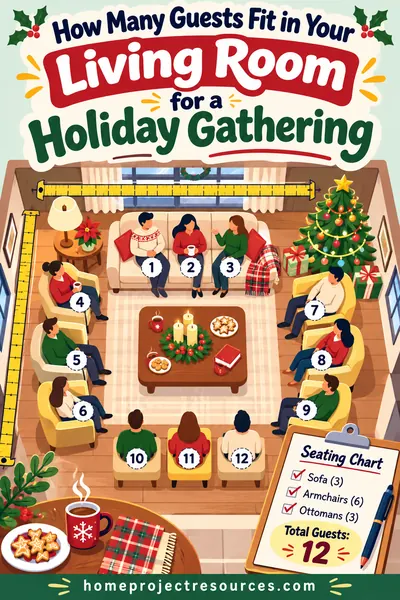
Leave room behind the chairs, too: about 3 feet from the table edge to the wall lets people sit down and get up without squeezing. If you are not sure the table fits the room, measure the room and check it with the square footage calculator, and our guide to how many guests fit in a room helps you plan seating and standing space for the rest of the gathering.
A worked example: Christmas dinner for eight
The menu is soup, salad, ham, sides and pie. The table is an 8-foot rectangle, so each of the 8 seats gets about 24 inches, with the host and one guest at the ends. Here is each place, left to right: napkin, salad fork, dinner fork, the dinner plate with the salad plate on top for the first courses, dinner knife, soup spoon.
Above the place: a bread plate with a butter knife on the upper left, a dessert fork lying sideways above the plate for the pie, and on the upper right a water glass with a sparkling cider glass to its right. That is 8 dinner plates, 8 salad plates, 8 bread plates, 16 forks plus 8 dessert forks, 8 dinner knives, 8 butter knives, 8 soup spoons and 16 glasses. Count your pieces a week before; if you are short, a dessert fork can simply come out with the pie.
Napkins, glasses and the small details
A cloth napkin folded in a simple rectangle is always right. For a holiday look, tie it with ribbon and a sprig of rosemary, or fold it into a tree shape on the plate. Paper napkins are fine for casual meals and for a big crowd. If linen napkins come out of the drawer with old spots, treat them a few days ahead; our guide on getting grease stains out works on table linens too.
Glasses always sit on the upper right, above the knife. The water glass is the one that is always there, and it goes closest to the plate. A juice or sparkling cider glass sits to its right. Fill water glasses just before guests sit down so they don't warm up or collect dust.
Getting ready the night before
Set the table the night before; it is one less job on the big day. Polish any silver a week early so it has time to air out, using our guide to how to clean silver. Run the good dishes and glasses through a clean dishwasher a few days ahead; if yours leaves a film, cleaning the dishwasher usually fixes it. Keep the centerpiece low so guests can see each other, and if you use real candles, keep them well away from napkins and greenery and never leave them burning in an empty room. If a candle drips, here is how to remove candle wax from carpet.
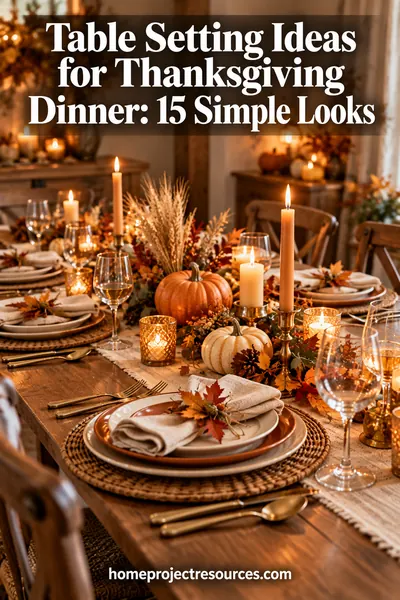
Once the settings are down, the decor is the fun part. Our Christmas table decorating ideas cover runners and centerpieces, our Thanksgiving table setting ideas suit November, and the New Year table decorations reuse the same table on December 31. The rest of our free home project tools are there for the next project around the house.
Quick answers about place settings
Where does the fork go in a place setting?
On the left of the plate. If there is more than one fork, the one you will use first goes on the outside, farthest from the plate, and the dinner fork sits closest to the plate. The dessert fork is the exception; it lies sideways above the plate.
Which way does the knife blade face?
Toward the plate. That is true for the dinner knife and any other knives in a formal setting. The butter knife sits across the top of the bread plate on the upper left, and its blade also faces down or toward the diner, never out toward the next guest.
Where does the napkin go?
To the left of the forks, or folded on the plate. In a formal setting it can sit on the charger. For a fun holiday fold, you can tuck it into the water glass. The only real rule is to keep it off the right side, where the knife and glasses are.
Where does the bread plate go?
Above the forks, on the upper left, with a small butter knife laid across it. Drinks go on the upper right, above the knife. The "b" and "d" hand trick is an easy way to remember: bread on the left, drink on the right.
How do you set a table for Christmas dinner?
Start with the plate in the center, salad and dinner forks on the left, the knife and soup spoon on the right, a bread plate above the forks, a dessert fork above the plate, and the water glass above the knife with a second glass to its right. Only set what your menu needs.
How much space do you need per place setting?
About 24 inches of table edge per person for a casual meal, and up to 30 inches for a formal setting with chargers. A 6-foot table seats about six, an 8-foot table about eight, and a 48-inch round seats four to six.
How many forks go on a formal table?
Never more than three at a time, and only the ones your menu needs. A common set is fish fork, dinner fork and salad fork, arranged outside in by course. If a course needs another fork, it is brought out with that course rather than crowding the table from the start.