Fireplace Mantel Christmas Decorating Ideas That Hold Up

The mantel ideas that last through the season are the ones that respect three numbers: how deep the shelf is, how much weight each anchor point holds, and how far everything sits from the firebox. Measure the depth, weigh what you plan to put up, keep it all out of the 3-foot heat zone, and almost any look works. Ignore those three and the garland slides, the stockings tip the holders, and the greenery dries out above the fire.
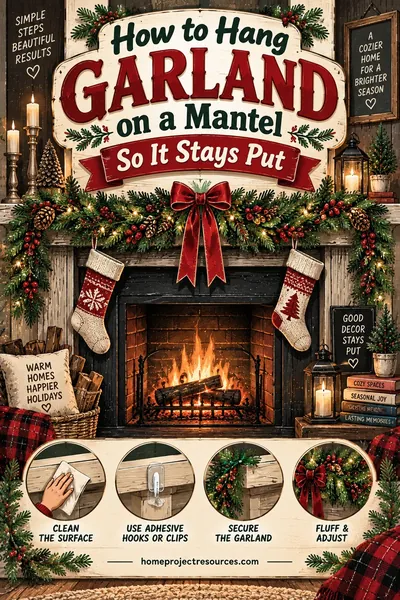
So these fireplace mantel christmas decorating ideas are organized by mantel type, because a deep wood shelf, a narrow stone ledge, and a wall with no mantel at all each take a different approach. Every idea comes with the physical limits that make it work, and the hardware side (clips, weights, hooks) lives in our companion guide on how to hang garland on a mantel.
Planning brickwork around the fireplace as part of the makeover? Our brick calculator gives you brick and mortar counts for any surround or hearth area.
Updated September 2026
Fireplace mantel Christmas decorating ideas start with three measurements
Every idea on this page depends on these three measurements. Take them once, write them on a sticky note, and every decision after that gets easier.
Depth of the shelf, front to back. This decides what can stand on the mantel. A candlestick with a 4-inch base needs a 5-inch shelf to sit safely. A picture frame or mirror leaning against the wall needs the depth of its base plus the lean, and a 20-inch tall frame leaning at a comfortable angle uses about 4 inches of shelf. Anything that overhangs the front edge by more than a third of its base is going to get knocked off.
Weight per anchor. Each thing that hangs from the mantel (garland, stockings, a swag of ribbon) pulls on an anchor point, and every anchor has a rating printed on its package. Weigh the garland with lights and ornaments on it, and weigh a stocking after you've filled it. Then buy anchors rated for at least double. Ratings vary widely between products, so read the package rather than assuming.
Distance from the firebox opening to the underside of the shelf. The National Fire Protection Association's winter holiday safety guidance is to keep decorations at least 3 feet from any heat source. On most mantels, that means nothing hangs below the shelf in front of the surround while a fire is burning, and on a low mantel the decorations stay on top of the shelf with almost no droop. If you burn fires, use LED lights only, and take fresh greenery down once it starts dropping needles.
| Mantel type | Typical shelf depth | What stands on it | Best garland anchor | Where the stockings go |
|---|---|---|---|---|
| Deep wood shelf | 6 to 10 inches | Almost anything: lanterns, leaning frames, stacked boxes, a small tree | Mantel clips at the ends, hooks between | Weighted holders on the shelf, or hooks on the front face |
| Narrow stone or brick ledge | 2 to 4 inches | Flat and low items only: votives, a flat runner, small ornaments | Garland weights (clips can't grip stone) | Weighted holders if the ledge is wide enough; otherwise a nearby shelf |
| Painted brick with no mantel | None | Nothing; everything hangs | Brick clips or mortar hooks on the face | Brick clips in a row |
| Flat wall above a firebox, no mantel | None | Nothing; everything hangs | Removable adhesive hooks on smooth paint | A shelf, a rod, or a ladder beside the fireplace |
| Mantel with a TV above it | Any | Low items that don't block the screen | Same as the mantel type | Front face only; keep everything below the screen |
Deep wood mantel ideas (6 inches or more)
A deep wood mantel is the easiest to decorate and the easiest to overload. You've got room to layer, so the question becomes what order to layer in.
The layering order that works
- Anchors first. Clips at each end, hooks every 2 to 3 feet. Nothing else goes on until the anchors are set.
- Garland second. Lay it along the back third of the shelf, wire the ends to the anchors, and shape the swags. Keep the swags shallow if you'll be lighting fires.
- Lights third. Weave an LED strand through the garland while you can still reach the back. Route the cord or battery pack to one end and hide it behind whatever tall thing goes there.
- Tall pieces fourth. Lanterns, a leaning mirror, a stack of wrapped boxes, candlesticks of different heights. Set them at the ends and off center, not symmetrically, unless you want a formal look.
- Fillers last. Pine cones, ornaments tucked into the garland, small figures, ribbon loops. These sit on top of the greenery and use museum putty if they're small enough to get knocked over.
Ideas that suit the depth
A leaning mirror behind the garland. A mirror 24 to 36 inches wide leaned against the wall at the back of a deep mantel doubles the lights and makes a short mantel look taller. It needs 4 to 5 inches of depth for the base plus a safe lean angle, and the bottom edge should sit on a strip of rubber shelf liner so it can't walk forward. A mirror this size is heavy: lean it, don't hang it, and keep it away from the end where the garland's battery pack lives.
A lantern cluster at one end. Three lanterns of different heights (say 8, 12, and 16 inches) grouped at one end give the mantel a focal point and hide the light cord. Battery candles inside, never real flame in a lantern sitting in greenery. Their bases need to sit fully on the shelf; measure the largest lantern's footprint against the depth.
Stacked wrapped boxes. Empty boxes wrapped in paper and stacked three high at the opposite end from the lanterns give height without weight. They're light enough to knock over, so a pea of museum putty under the bottom box keeps the stack honest.
A small tabletop tree. A 24-inch artificial tree on a deep mantel is a strong look, and a real weight on the shelf. Center it or set it at one end, and check that the pot's base sits entirely on the shelf. If the mantel is low, remember the tree's tip is now closer to any heat rising off the front of the surround.
Stockings on a deep mantel
Weighted stocking holders sit on the shelf and hang the stockings off the front. The math is simple: add the stocking width to the gap you want between them, and divide the mantel length by that number to see how many fit.
A 60-inch mantel with 8-inch-wide stockings and 4-inch gaps fits five (5 × 8 = 40, plus 4 gaps × 4 = 16, total 56, which fits in 60 with 2 inches of margin at each end). Weigh a filled stocking and check it against the holder's weight; a holder that's lighter than the stocking tips forward.
If a fire is burning below, stockings hanging off the front of a low mantel are inside the heat zone. Either fill them only on the night and hang them somewhere else the rest of the time, or keep the fire out on the nights they're up.
Narrow stone or brick mantel ideas (2 to 4 inches)
A narrow stone ledge over a brick or stone surround is a beautiful problem. Nothing tall stands on it safely, clips can't grip it, and adhesive won't stick to stone. The whole approach shifts from stacking to draping.
What actually stands on a narrow ledge
Votives and tealights in low glass holders, a flat fabric runner, small flat ornaments, and short pillar candles whose base is at least an inch narrower than the ledge. That's about it. Anything taller than 6 inches on a 3-inch ledge is a tip-over waiting for a door to slam.
Measure the ledge depth in three places, because stone is rarely even. Use the shallowest number.
The draped look
Garland on weights. Garland weights sit on the ledge and hang the garland off the front. Because the ledge is shallow, use the heaviest weights you can, set them at the very back of the ledge, and keep the swags shallow. A heavy fresh garland can drag a light weight off a 3-inch ledge, so do the bag-of-sugar test from the mantel how-to before the greenery goes on.
A single wide ribbon. Instead of garland, a length of wide wired ribbon draped from weight to weight, with the tails hanging down each side of the surround, gives a full look with almost no weight. Wired ribbon holds its shape, so you can bend the swag into a curve and it stays.
Greenery on the surround, not the ledge. On a brick surround, brick clips or mortar hooks on the face of the brick hold garland in a swag across the surround itself, above the firebox opening. This puts the garland where the ledge can't, but it also puts it closer to the fire. Measure from the top of the firebox opening to where the garland's lowest point will hang; if that's less than 3 feet and you plan to burn, keep the garland on the ledge instead.
Stockings on a narrow ledge
A 3-inch ledge won't hold most weighted stocking holders safely once the stocking's full. Two better options: brick clips on the surround, one per stocking in a level row, or a decorative rod on brackets mounted to the wall beside the fireplace. Space the clips using the same width-plus-gap math as above.
No mantel at all
A flat wall above a firebox, a painted brick face with no shelf, or a modern surround with a TV and nothing else. You can still get the full look; you just hang everything instead of standing it.
A hung garland swag. On smooth painted drywall, removable adhesive hooks rated for the garland's weight, set at the two ends and the center, hold a garland in two swags across the wall above the firebox. Measure the width you want, add 20 percent for droop, and mark the hook spots with painter's tape before sticking anything. On brick, the same swag hangs from brick clips.
A wreath as the centerpiece. One large wreath, 24 to 30 inches, hung from a single adhesive hook or brick clip above the firebox does the job of a whole mantel. Weigh it, double it, and check the hook rating. The methods in our guide to how to hang a wreath on a door transfer straight to a wall.
A floating shelf for the season. A narrow shelf on two brackets, mounted to the wall studs, gives you a temporary mantel. This is the one idea on this page that involves a drill, and it's worth it if you'll use it every year. Locate the studs, mount the brackets at the same height with a level, and check the shelf's stated load against what you'll put on it.
A ladder beside the fireplace. A wooden ladder leaned against the wall next to the surround holds stockings on its rungs, garland woven through them, and lights along the rails. No hardware at all, and it keeps everything well outside the heat zone.
Stockings without a mantel. A tension rod across a nearby doorway or window frame, adhesive hooks in a level row on a smooth wall, or the balusters of a nearby staircase (see our staircase garland guide for the ties). Test each with a filled stocking.
Mantel with a TV above it
The TV changes two things: nothing can rise above the bottom edge of the screen, and the TV itself doesn't like heat or greenery pressed against its vents.
Keep everything low. A flat garland along the shelf with shallow swags, low votives, and stockings off the front face works; a leaning mirror or a lantern cluster doesn't. Leave a clear gap of at least a few inches between the top of the garland and the bottom of the screen so the TV's air vents aren't buried in pine, and don't route a light cord behind the TV, where it can tangle with the TV's own cables and warm up against the back of the set.
A lighting plan for any mantel
Lights are the difference between a mantel that looks decorated and one that glows, and they're also the one thing that gets planned last and fought with most.
- LED only, always. They run cool, which matters in dry greenery above a fire.
- Decide power before you decorate. Battery packs with a built-in timer are the simplest: tuck the pack at one end behind a tall piece. Plug-in strands need a route to an outlet that doesn't cross the hearth, so run the cord down the far side of the surround, away from the firebox, and tape it to the baseboard.
- Two layers of light. A strand woven through the garland for the glow, plus a few battery candles or a lit lantern for points of brightness. Micro LED strands on thin wire disappear into greenery better than the thick-cord kind.
- Warm white, not cool. Cool white LEDs look blue against evergreen and brick. Warm white matches candlelight and firelight.
- Check the strand before it goes up. Cracked insulation or a dead section is easy to fix on the floor and miserable to fix inside a decorated garland.
Worked example: a 72-inch deep wood mantel, working fireplace, five stockings
The mantel is a painted wood shelf, 72 inches wide, 9 inches deep, 1.75 inches thick at the front edge, sitting 18 inches above the top of the firebox opening. The family burns fires most December evenings and has five stockings.
Depth check. Nine inches of depth clears a 30-inch leaning mirror (base plus lean uses about 5 inches), a 16-inch lantern with a 6-inch base, and a row of candlesticks. Everything stands with margin.
Weight check. The garland is 12 feet of artificial pine with micro LEDs, weighed at 3 pounds. With two end clips carrying it, each needs a rating of at least 3 pounds under the doubling rule; the middle clips only shape the swags. Filled stockings weigh about 1.5 pounds each, so the holders each need to outweigh that comfortably, and the test with a bag of sugar confirms they don't slide.
Heat check. The shelf is 18 inches above the opening. A swag drooping 8 inches would hang 10 inches above the opening, inside the 3-foot zone. So the swags stay at 2 inches of droop, the tails drape back onto the shelf instead of down the sides, and the stockings hang only on nights the fire stays out. The lantern holds battery candles, not real ones.
Stocking layout. Five stockings, 8 inches wide, on a 72-inch mantel: 5 × 8 = 40, leaving 32 inches for six gaps of just over 5 inches each (one at each end and four between). Marked with painter's tape before the holders go down.
Layering. Clips at 0, 24, 48, and 72 inches. Garland along the back third, wired to the end clips. Micro LED strand woven in, battery pack at the right end behind the lantern. Mirror leaned at center-left on a strip of shelf liner. Lantern at the right end. Three candlesticks (6, 9, and 12 inches) grouped left of the mirror with museum putty under each. Pine cones and a few glass ornaments tucked into the garland last. Stocking holders across the front, spaced per the tape marks.
Time on the mantel itself: about 45 minutes, including the weigh-ins and the tape. Holes drilled: zero.
Frequently asked questions
How do you decorate a mantel for christmas without nails?
Anchor a garland with mantel clips on a wood shelf or garland weights on stone, hang stockings from weighted holders, lean a mirror instead of hanging it, and use museum putty under small items. The full hardware rundown is in our garland-on-a-mantel guide.
What can you put on a narrow mantel for christmas?
Low, flat things only: votives, a fabric runner, small ornaments, and short pillar candles at least an inch narrower than the ledge. Garland hangs from weights set at the back of the ledge. Anything taller than about 6 inches on a 3-inch ledge tips over.
How far should christmas decorations be from a fireplace?
The NFPA guidance is 3 feet from any heat source. Keep the garland on top of a low mantel with almost no droop while a fire is burning, never let anything hang in front of the firebox opening, and use LED lights only.
How many stockings fit on a mantel?
Add the stocking width to the gap you want and divide the mantel width by that number. Eight-inch stockings with 4-inch gaps fit five on a 60-inch mantel and six on a 72-inch one. Weigh a filled stocking and check that the holder outweighs it.
How do you decorate a fireplace with no mantel?
Hang a garland swag from adhesive hooks on smooth paint or brick clips on brick, center a large wreath above the firebox, lean a ladder beside the surround for stockings and lights, or mount a narrow floating shelf on the studs as a temporary mantel.
Can you decorate a mantel with a TV above it?
Yes, but keep everything below the screen and leave a few inches clear between the garland and the TV's bottom edge so the vents breathe. Flat garland, low votives, and stockings off the front face work; tall lanterns and leaning mirrors don't.
What order do you layer a christmas mantel?
Anchors, then garland, then lights, then the tall pieces at the ends, then fillers tucked into the greenery last. Setting the lights before the tall pieces means you can reach the back of the shelf while there's still room.
The short version
Measure the depth, weigh what hangs, and keep it 3 feet from the fire. Deep wood mantels stack and layer, narrow stone ledges drape from weights, and a wall with no mantel hangs everything from hooks or clips. Get the anchors right first with our how to hang garland on a mantel guide, and the ideas above will still be in place on New Year's Day.