Concrete Cost Per Yard

Concrete cost per yard is not one number, it is a base mix plus a stack of line items, and on a small residential pour the line items can add up to more than the concrete. The base is set by your local plant: how far you are from the batch plant, what aggregate costs in your area, and how much cement the mix strength you ordered requires. Everything after that is order size, admixtures, access, and how organized your site is on pour day.
That is why two neighbors can order the same slab and get invoices that do not resemble each other. One of them cleared the plant minimum and unloaded in twenty minutes. The other ordered two yards against a five yard minimum, on a Saturday, with a truck that had to wait while three people wheelbarrowed concrete through a gate. Same mix, very different bill.
The good news is that almost every one of those levers is visible before you call, and most of them are yours to pull.
Updated August 2026
A note on numbers. This page gives you yardage math, mix specifications, invoice line items and the questions to ask a plant, not dollar figures. Ready mix is a heavy, perishable product batched locally, so pricing moves with your distance from the plant, with cement and fuel, and with the season. A printed range would be wrong in most markets and stale in all of them. Work out your quantities here, then call two or three local plants with the same order.
Get your exact yardage first. Run your dimensions through our free Concrete Calculator so you know how many cubic yards you are pricing before you talk to anyone. Yardage is the one number every plant conversation starts with.
How much is a yard of concrete, and how much does it cover?
A cubic yard is 27 cubic feet. That is the only unit ready mix plants sell in, so your first job is converting a slab into yards.
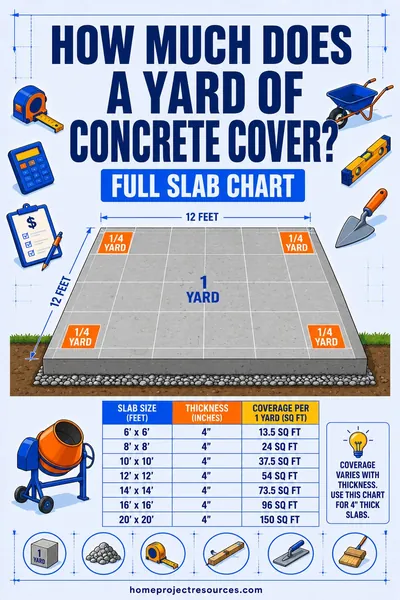
Here is what one cubic yard covers at common slab thicknesses:
| Slab thickness | Coverage per cubic yard | Yards needed for 400 sq ft |
|---|---|---|
| 3 inches | 108 sq ft | 3.7 yd |
| 4 inches | 81 sq ft | 4.9 yd |
| 5 inches | 65 sq ft | 6.2 yd |
| 6 inches | 54 sq ft | 7.4 yd |
| 8 inches | 40.5 sq ft | 9.9 yd |
The 4 inch line is the one worth memorizing: one cubic yard of concrete covers about 81 square feet at 4 inches thick. Most patios, sidewalks and shed pads are 4 inches. Driveways and anything that will hold a vehicle usually go to 5 or 6 inches.
If you are working backward from a patio footprint, our square footage calculator handles odd shapes and L shapes, and the cubic yard calculator converts any volume into orderable yards. We also broke the coverage question out on its own in how much does a yard of concrete cover.
What drives concrete cost per yard
Four things move the base number before a single fee is added, and they are worth ranking, because the first and the last are the ones homeowners control.
Region and haul distance. Concrete is heavy and cheap relative to its weight, so it cannot travel far economically. A loaded truck has a limited window before the mix starts to stiffen, which puts a hard radius around every batch plant. Dense metro areas, islands, mountain towns and anywhere far from a quarry sit at the top of the local range. A rural site down the road from a gravel pit sits at the bottom.
Mix strength. Every step up in compressive strength means more cement per yard, and cement is the expensive ingredient in the truck. The step from a patio mix to a driveway mix is real money per yard, and it is still one of the cheapest upgrades in residential construction.
Admixtures. Fiber, accelerators, retarders, water reducers, air entrainment and integral color are each priced per yard on top of the base mix. Some are optional. Some are dictated by the weather on the day you pour.
Order size against the plant minimum. This is the big one for homeowners, and it is the one nobody warns you about. Plants price a full truck efficiently, and a full truck is usually nine to ten yards. A two yard order ties up the same truck, the same driver and the same wash out, so the plant charges you for the capacity you did not use.
| Driver | What keeps the number lean | What pushes it up |
|---|---|---|
| Haul distance | Site inside the plant's normal radius | Long haul, extra mileage past a set radius, remote or island delivery |
| Mix strength | Standard flatwork mix for a patio | High strength structural mix, specified performance mixes |
| Admixtures | Plain mix in mild weather | Accelerator, retarder, hot water, fiber, integral color |
| Order size | An order that clears the plant minimum | A partial load that triggers a short load charge |
| Schedule | Midweek, normal plant hours | Saturday, before dawn, after hours, holiday weeks |
| Access | Truck backs to the forms, chute reaches | Pump truck, buggy, long wheelbarrow run, soft ground, weight limits |
| Unload speed | Crew ready, forms braced, tools staged | Truck waiting while you find help or fix a form |
| Season | Shoulder season, moderate temperatures | Winter heat and blankets, midsummer retarders, peak spring backlog |
Notice how few of those lines are about concrete. The mix is close to a commodity in any given market. The order size, the schedule, the access and the unload speed are where an invoice actually gets built, and all four are decisions you make before the truck leaves the plant.
Ready mix by PSI, and what to actually order
PSI is pounds per square inch of compressive strength at 28 days. It is the number that tells you how much load the cured slab can take, and it is the main thing separating one mix from another on a price sheet.
| Mix strength | Relative position on a price sheet | Common residential use |
|---|---|---|
| 2,500 PSI | The cheapest mix a plant will batch | Fill, non structural pads, footings in mild climates |
| 3,000 PSI | One step up, the volume seller | Patios, sidewalks, shed pads, most flatwork |
| 3,500 PSI | Modestly above the flatwork mix | Driveways, garage floors, freeze thaw climates |
| 4,000 PSI | Noticeably above flatwork | Heavy driveways, RV pads, exposed slabs in the north |
| 4,500 to 5,000 PSI | The most expensive residential mixes | Structural work, engineered specs, commercial jobs |
For most homeowners the call is simple: 3,000 PSI for a patio or walkway, 3,500 to 4,000 PSI for a driveway or anywhere the ground freezes. In freeze thaw regions you also want air entrainment, which puts microscopic bubbles in the paste so freezing water has somewhere to expand. Plants in cold states usually add it by default on exterior mixes, but say the words "air entrained, exterior exposure" when you order so nobody assumes otherwise.
Stepping a small driveway pour up from 3,000 to 3,500 PSI adds a modest amount per yard, and on a five yard order that is a rounding error against the job total. Replacing a spalled driveway is a demolition and a full repour. Of every upgrade available to you at the ordering stage, this one has the best ratio of small cost to large protection.
Our water cement ratio page explains the other half of strength, which is what happens if somebody adds water at the truck to make the mix easier to place.
The line items that show up on a ready mix invoice
The quoted per yard number is never what you pay. Plants publish a clean base price and then add charges for the things that cost them money. None of these are scams. They cover real trucks, real drivers and real disposal. They are simply invisible until the invoice arrives, and on a small pour they can rival the concrete itself.
| Line item | What it covers | When it applies |
|---|---|---|
| Short load fee | The truck capacity you booked but did not use | Orders below the plant minimum, usually 4 to 5 yards |
| Delivery or fuel surcharge | Running the truck to you and back | Nearly always, and it scales with distance |
| Extra mileage | Haul beyond the plant's standard radius | Sites past roughly 15 to 20 miles from the plant |
| Saturday delivery | Weekend crew and dispatch | Weekend pours, charged per load |
| After hours or early start | Batching outside normal plant hours | Deliveries before dawn or after the plant normally closes |
| Waiting time, also called demurrage | Driver and truck time past the included unload window | Anything past roughly 5 to 7 minutes per yard |
| Washout or environmental fee | Chute rinse, slurry containment and disposal | Most plants, on most loads |
| Cold weather package | Accelerator, hot water, sometimes blankets | Cold snaps, or when you need a faster set |
| Hot weather package | Retarder to keep the mix workable | Hot, dry, windy days |
| Fiber reinforcement | Synthetic fiber batched into the mix | Optional, helps with shrinkage cracking |
| Air entrainment | Freeze thaw durability | Exterior exposure in cold regions, often standard there |
| Integral color | Pigment batched into the whole load | Colored flatwork |
| Pump truck | A separate contractor and operator | Backyards, tight access, elevated pours |
Two of those deserve their own section, because they are the two that turn a reasonable order into a painful one.
The short load fee is the one that stings
Most plants set a minimum of four or five yards. Below that, you pay a short load fee, and it is often calculated per missing yard rather than as a flat charge. Order two yards against a five yard minimum and you may be billed for three yards you never received, on top of delivery and washout.
The proportions are what surprise people. On a small order the fees are frequently larger than the concrete line itself, which means the effective price per yard of what actually came off the chute can be several times the number on the plant's price sheet. Nothing about that is unfair. You reserved a truck and a driver for the morning either way.
That single fact drives three smart moves:
- Scale the pour up to clear the minimum. Pour the shed pad, the walkway extension and the trash can pad the same morning. Extra concrete you have a plan for is cheap. A phantom yard is not.
- Split a load with a neighbor doing work the same week. Plants will often make two stops on one ticket for a modest split delivery charge, which beats two short load fees.
- Ask about will call or trailer mix. Some suppliers let you tow a small trailer mixer yourself, which sidesteps delivery and short load charges entirely on genuinely small jobs.
Below roughly half a yard, none of this applies, because you should be buying bags instead. That crossover is worked out further down.
Waiting time punishes a disorganized site
Your delivery ticket includes free unload time, usually five to seven minutes per yard. A five yard load buys you roughly half an hour. After that the meter runs, typically billed by the minute or in fractions of an hour.
Half an hour sounds generous until you are wheelbarrowing concrete sixty feet through a gate with two helpers who showed up late. The fix is not to rush, it is to plan the placement route before the truck rolls in and to have enough hands that the truck is never the thing waiting.
Practical version: walk the route with a loaded wheelbarrow of gravel the day before. If that route is hard empty, it is impossible loaded, and you need a pump, a buggy or more people. Finding that out on pour morning is how waiting charges happen.
Bagged concrete vs ready mix: where the crossover really is
It takes 45 bags of 80 lb concrete mix to make one cubic yard. Each 80 lb bag yields about 0.6 cubic feet, and 27 divided by 0.6 is 45. If you are buying 60 lb bags, each yields about 0.45 cubic feet, so you need 60 bags per yard.
| Bag size | Yield per bag | Bags per cubic yard | Weight to move per yard | Batches in a 3.5 cu ft mixer |
|---|---|---|---|---|
| 40 lb | 0.30 cu ft | 90 | 3,600 lb | About 15 |
| 50 lb | 0.375 cu ft | 72 | 3,600 lb | About 15 |
| 60 lb | 0.45 cu ft | 60 | 3,600 lb | About 15 |
| 80 lb | 0.60 cu ft | 45 | 3,600 lb | About 15 |
Two things fall out of that table. First, a cubic yard weighs what it weighs no matter how it is packaged, so you are moving nearly two tons of material regardless of bag size, twice, once off the pallet and once into the form. Second, bagged mix is the pricier way to buy concrete by volume at every bag size, because you are paying for the bag, the pallet, the retail shelf and the convenience. Bags only win where ready mix fees dominate the ticket.
The honest threshold is about half a cubic yard. Below that, bags win. Above that, call the plant.
Half a yard is 13.5 cubic feet, or 23 bags of 80 lb mix. That is roughly 1,840 pounds of material to haul, cut open and mix. A 3.5 cubic foot mixer takes about three bags per batch, so half a yard is eight batches and a full yard is fifteen.
The physical labor is only half the argument. The real problem is continuity. A slab has to be placed in one continuous operation so each new batch bonds to concrete that is still plastic. Mixing 45 bags takes hours, and the first section will have started setting long before the last batch lands. What you get is a cold joint, a plane of weak, unbonded concrete inside the slab that shows up later as a crack you did not choose the location of.
Where bags genuinely make sense: setting fence posts, a small equipment pad, a three foot walkway repair, deck footings, or a mailbox base. Anything you can finish inside an hour with the mixing capacity you actually have on site.
Where ready mix wins: any slab over about 60 square feet at 4 inches, any driveway, any garage floor, and any pour you want to look uniform when it cures. Bagged mixes from different pallets can cure to slightly different shades, which is invisible in a post hole and obvious across a patio.
What a finished slab includes beyond the concrete
Most people asking about the cost of a cement slab are really asking what the finished thing costs. The concrete in the truck is a minority of that on almost every job, and a smaller minority when a contractor places it. Everything below sits on top of it, and every line is something to look for on a quote.
| Component | What it is | What makes it swing |
|---|---|---|
| Excavation and grading | Stripping sod and soil to the right depth and slope | Roots, rock, clay, poor access, haul off distance |
| Compacted gravel base | Crushed stone, not pea gravel, compacted in lifts | Base depth, soil quality, number of lifts, machine access |
| Compaction equipment | Plate compactor or jumping jack | Rental days, or included in a contractor's rate |
| Forms | Lumber, stakes and screws that shape the slab | Curves and radii, stepped grades, reusable versus scrap |
| Vapor barrier | Poly sheeting under interior slabs | Required under conditioned space, skipped on open patios |
| Reinforcement | Rebar on centers, or welded wire mesh, or fiber | Slab use, soil quality, whether vehicles park on it |
| Chairs and dobies | What keeps steel in the middle third of the slab | Quantity scales with area, and skipping them wastes the steel |
| Ready mix concrete | The delivered yardage plus its line items | Everything in the two tables above |
| Placing and finishing labor | Screed, float, edge, broom or trowel | Finish level, slab size, crew size, weather window |
| Control joints | Cut or tooled, at the right spacing and depth | Saw cutting is a separate trip, tooling is free while plastic |
| Curing | Blanket, cure and seal, or wet burlap | Weather at pour time, and it matters more than people think |
| Sealer | Penetrating or acrylic, applied after cure | Reapplied every few years outdoors |
| Tools | Screed, bull float, edger, groover, knee boards | Rent or buy, and the buy option pays off across two slabs |
Why the per square foot spread is so wide
Ask five contractors for a per square foot number on a slab and you will get five different answers, because a slab is not one product. The spread comes from a short list of real differences:
Thickness. A 6 inch driveway uses half again as much concrete as a 4 inch patio over the same area, and it usually carries heavier reinforcement.
Base depth and soil. Four inches of stone over stable soil is a different job from twelve inches of stone, geotextile fabric and an undercut through clay. The finished slab looks identical on day one.
Reinforcement. Fiber in the mix, mesh on chairs and rebar tied on centers are three different scopes and three different labor loads.
Finish level. A broom finish, a hard trowel finish and a stamped and colored finish are separated by hours of skilled labor and by whether the crew has to stay until dark waiting for the surface to be ready.
Access. A truck that backs to the forms, a wheelbarrow run around a house, and a pump truck over a roof are three entirely different labor pictures for the same yardage.
Site work. Removing an old slab, dealing with roots, importing fill, or fixing drainage before you pour can be larger than the slab itself.
A bid that comes in far below the others is not usually a better deal. It is usually a thinner slab, a shallower base, less steel or a simpler finish. Ask which one, and ask in writing. Our contractor red flags page covers the tells, and how to get contractor bids has the wording that produces comparable quotes.
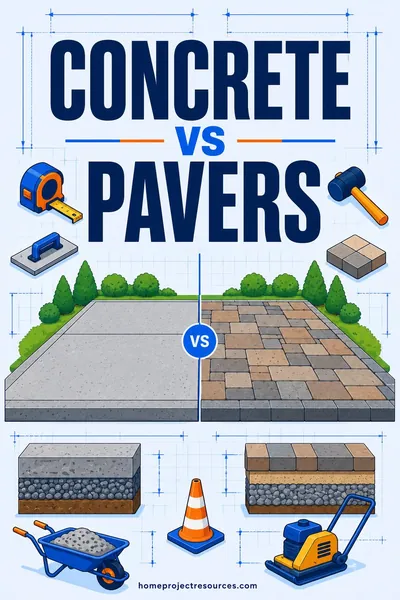
If you are weighing a poured slab against a paver installation for the same patio, the paver patio cost breakdown puts the two approaches side by side, our paver calculator handles unit counts, and concrete vs pavers is the direct head to head.
Worked example: a 20x20 four inch patio slab
Here is the whole thing as quantities, which is what you take to a plant and to a contractor.
Step 1: yardage. 20 ft x 20 ft = 400 sq ft. 4 inches = 0.333 ft. 400 x 0.333 = 133.3 cubic feet. 133.3 / 27 = 4.94 cubic yards.
Step 2: add waste. Forms bow slightly, the subgrade is never perfectly flat, and the chute leaves some behind. Add 10 percent on a slab this size: 4.94 x 1.10 = 5.43 yards. Order 5.5 yards.
Note what just happened. At 4.94 yards the order sat uncomfortably close to a common five yard minimum. Rounding to 5.5 yards buys a little extra concrete and clears the minimum, which removes a short load charge and the risk of running short in one move. That is the single most useful piece of ordering arithmetic on this page.
Step 3: the rest of the quantity list. These are the numbers to put in front of a supplier and a contractor so every quote covers the same job.
| Item | Quantity for this slab |
|---|---|
| Excavation | 400 sq ft stripped to about 8 in below finish grade |
| Crushed stone base | 4 in compacted, about 5 yd delivered, placed in two lifts |
| Compaction | Plate compactor, two passes per lift, in perpendicular directions |
| Forms | 80 linear ft of 2x4, stakes every 3 to 4 ft, braced at corners |
| Reinforcement | 400 sq ft of 6x6 W1.4 mesh on chairs, or fiber in the mix |
| Concrete | 5.5 yd, 3,000 PSI flatwork mix, air entrained if you freeze |
| Control joints | Joints every 8 to 12 ft, cut one quarter of slab depth |
| Cure | Cure and seal or blankets over the full 400 sq ft |
Step 4: what changes the DIY version. Doing it yourself replaces the placing and finishing labor with your own time plus tool rental, and it replaces the contractor's excavation with either a rented machine or a very long weekend. What it does not change is the concrete order, the base depth or the joint spacing. Those are specifications, not preferences, and getting them wrong is what makes a DIY slab look like a DIY slab in three years.
Step 5: what to ask for in writing from a contractor. Slab thickness, base material and compacted depth, reinforcement type and spacing, mix strength, joint layout and timing, curing method, and what happens to the spoil. Get all of that on all three bids and the comparison finally means something. Our concrete driveway cost page runs the same exercise for a drive.
Ordering advice: how to not get burned
Order 5 to 10 percent extra. On slabs under 3 yards, use 10 percent. On slabs over 6 yards, 5 percent is usually enough. A subgrade that is a half inch low across a 400 square foot slab eats an extra 0.6 yards all by itself, and nobody notices a half inch by eye.
Understand why running short is the real disaster. Having a little left over costs you almost nothing beyond the trouble of putting it somewhere useful. Running short mid pour means the plant has to batch and drive a second load, which is 45 to 90 minutes at best. In that time the concrete already placed starts to set, and when the second load arrives it does not bond. You get a cold joint running through the middle of your slab, a permanent weak plane that will crack, usually with a visible color change along it. There is no repair short of demolition.
Have a plan for the extra before the truck arrives. Form up a small pad for the trash cans, a stepping stone mold, or a fence post footing, and tell the driver where it goes. A driver who has to hunt for somewhere to dump the tail of a load is a driver on the clock.
Have the site ready before the truck rolls in. Forms braced and level, base compacted and damp, steel tied and on chairs, tools laid out, wheelbarrows staged, and at least two helpers for anything over 3 yards. A 5 yard pour with two people is hard. With three or four it is manageable.
Confirm truck access honestly. A loaded ready mix truck weighs in the range of 60,000 to 70,000 pounds. It will crack a residential driveway apron and it will sink in soft ground. Chutes reach roughly 16 to 18 feet from the truck. Past that you need a pump, a power buggy or wheelbarrows, and each of those is a decision to make in advance rather than in the driveway.
Ask these five questions when you call the plant. What is your minimum load? How is the short load charge calculated, per yard or flat? What delivery or mileage charges apply at my address? How much free unload time is on the ticket, and what is the rate after that? Which admixtures do you consider standard for exterior work this time of year? Those five answers explain most of the gap between a quoted price and an invoice.
Pour in the right weather. Ideal is roughly 50 to 80 degrees F with light cloud. Below about 40 degrees you need an accelerator, blankets and a plan. Above about 90 degrees with wind and sun the surface skins over before you can finish it, and you get crazing and plastic shrinkage cracks.
Cut or tool control joints within 6 to 18 hours, and most residential slabs land in the 6 to 12 hour window. Joint spacing in feet should be about 2 to 3 times the slab thickness in inches, so a 4 inch slab wants joints every 8 to 12 feet. Cut them one quarter of the slab depth. Concrete is going to crack. Joints decide where.
How to get a real number for your own slab
Published averages cannot price your job, because they cannot see your soil, your access or your plant. Here is the sequence that produces a number you can trust.
- Fix the scope on paper first. Dimensions, thickness, base depth, reinforcement, finish, joint plan. One page.
- Call two or three plants with identical yardage and ask the five questions above. Plants quote quickly and they quote consistently, which makes them the easiest half of the job to price.
- Get three contractor bids on the identical written scope. Same thickness, same base, same steel, same finish. Different scopes produce different numbers, and that difference tells you nothing.
- Read what is excluded. Spoil removal, permit, sawing, sealing and site restoration are the usual exclusions, and they are the usual reason a low bid climbs later.
- Ask each bidder what they expect to find. Soft subgrade, an old slab underneath, roots or a drainage problem are the four discoveries that change a slab job once it starts.
- Check the yardage on the bid against your own math. If the proposal's yardage does not match the thickness on the proposal, one of the two is wrong and you want to know which before the truck is booked.
A contractor who answers all six of those without hedging is telling you something useful about how the job will run.
Frequently asked questions
How much is a yard of concrete delivered?
That depends entirely on your local plant and your address, which is why we do not publish a figure. What you can do in ten minutes is call two or three plants with the same yardage, the same mix strength and the same delivery day, and ask each for the base rate plus every charge that will appear on the ticket. Plants quote this readily. The spread between them is usually smaller than the spread between two contractors.
How many 80 lb bags of concrete make a cubic yard?
Forty five. Each 80 lb bag yields about 0.6 cubic feet, and a cubic yard is 27 cubic feet. That is also about 3,600 pounds of material to buy, haul and open, which is the practical reason bags stop making sense above roughly half a yard. Below that threshold, bags avoid delivery and short load charges and usually come out ahead.
What is the minimum concrete delivery, and what does going under it cost?
Most plants set a four or five yard minimum. Below that you pay a short load charge, often calculated for each yard under the minimum rather than as a flat fee. On a very small order that charge can exceed the concrete itself, so it usually pays to scale the pour up to the minimum or split a load with a neighbor working the same week. Ask the plant how theirs is calculated, since the two structures behave very differently on a two yard order.
How much concrete do I need for a 24x24 garage slab?
At 4 inches: 576 sq ft divided by 81 sq ft per yard = 7.1 yards, so order 7.5. At 6 inches, which is what most garages should be: 576 divided by 54 = 10.7 yards, so order 11.25. Run your own dimensions through the concrete calculator before you commit, and add your waste allowance on top.
Is 3,000 PSI concrete strong enough for a driveway?
It will work in mild climates for cars only, but 3,500 to 4,000 PSI is the better call for any driveway and close to essential anywhere the ground freezes. The upgrade adds a modest amount per yard, which on a residential driveway is a small fraction of the job. Replacing a spalled driveway means demolition, disposal and a full repour, so the upgrade is one of the best value decisions available at the ordering stage.
What does a concrete slab cost per square foot?
There is no single answer, and any published one hides the variables that matter: thickness, base depth, reinforcement, finish level, access and site work. A 4 inch broom finished patio and a 6 inch stamped driveway are different products. Fix your scope, get three bids on it, and the spread you see will be a real one rather than an average pulled from someone else's market.
Can I pour a slab in sections to save money?
You can pour separate slabs with proper isolation joints between them, and that is a legitimate strategy for a large patio. What you cannot do is pour half a slab today and half next weekend and expect a monolithic result. That creates a cold joint. If you are splitting the work, design real joints in from the start, with independent forms and finished edges on each section.
Do I need rebar in a 4 inch patio slab?
For a residential patio on a well compacted base, 6x6 welded wire mesh or fiber reinforcement is usually enough, and many contractors use both. Rebar earns its keep on driveways, garage floors, anything carrying vehicle loads, and slabs over poor or expansive soil. Whatever you use, keep it in the middle third of the slab depth on chairs. Steel lying on the ground does nothing at all.
Related tools: Concrete Calculator | Cubic Yard Calculator | Square Footage Calculator | Paver Calculator