How Much Does a Yard of Concrete Cover?

One cubic yard of concrete is 27 cubic feet, so coverage depends entirely on how thick you pour it. At 4 inches thick a yard covers 81 square feet. At 5 inches it covers 65 square feet. At 6 inches it covers 54 square feet. The arithmetic is simple: take 27 cubic feet and divide by the thickness expressed in feet. Four inches is 0.333 feet, and 27 divided by 0.333 is 81.
Updated August 2026
A note on numbers. The coverage math here is fixed arithmetic and it does not change. Prices are the opposite, so we do not publish them: ready mix rates, delivery charges and short load fees vary by plant, by region and by season. Where money matters below, this page explains what lands on the invoice and what to ask the plant, rather than quoting a figure that would be wrong somewhere.
Skip the arithmetic. Drop your length, width, and thickness into our free concrete calculator and it returns the cubic yards to order, waste allowance included.
The math, shown once
Every number on this page comes from one calculation, so it's worth seeing it done.
A cubic yard is 3 feet by 3 feet by 3 feet, which is 27 cubic feet. A slab is just a very wide, very thin box. Its volume is area times thickness, so:
Coverage in sq ft = 27 ÷ (thickness in inches ÷ 12)
Run it at 4 inches: - 4 inches ÷ 12 = 0.3333 feet - 27 ÷ 0.3333 = 81 square feet
At 5 inches: - 5 ÷ 12 = 0.4167 feet - 27 ÷ 0.4167 = 64.8, call it 65 square feet
At 6 inches: - 6 ÷ 12 = 0.5 feet - 27 ÷ 0.5 = 54 square feet
There's a shortcut worth memorizing, because it collapses the whole thing into one division:
Coverage in sq ft = 324 ÷ thickness in inches
That 324 is just 27 x 12. It works for any thickness. Six inches: 324 ÷ 6 = 54. Ten inches: 324 ÷ 10 = 32.4. Two inches: 324 ÷ 2 = 162.
How much does a yard of concrete cover at each thickness?
Here's the full chart from 2 inches through 12 inches, plus how many yards you'd need for a few common footprints.
| Slab thickness | Coverage per cubic yard | Yards for 100 sq ft | Yards for 200 sq ft | Yards for 400 sq ft |
|---|---|---|---|---|
| 2 in | 162 sq ft | 0.62 | 1.24 | 2.47 |
| 2.5 in | 129.6 sq ft | 0.77 | 1.54 | 3.09 |
| 3 in | 108 sq ft | 0.93 | 1.85 | 3.70 |
| 3.5 in | 92.6 sq ft | 1.08 | 2.16 | 4.32 |
| 4 in | 81 sq ft | 1.23 | 2.47 | 4.94 |
| 4.5 in | 72 sq ft | 1.39 | 2.78 | 5.56 |
| 5 in | 64.8 sq ft | 1.54 | 3.09 | 6.17 |
| 5.5 in | 58.9 sq ft | 1.70 | 3.40 | 6.79 |
| 6 in | 54 sq ft | 1.85 | 3.70 | 7.41 |
| 7 in | 46.3 sq ft | 2.16 | 4.32 | 8.64 |
| 8 in | 40.5 sq ft | 2.47 | 4.94 | 9.88 |
| 9 in | 36 sq ft | 2.78 | 5.56 | 11.11 |
| 10 in | 32.4 sq ft | 3.09 | 6.17 | 12.35 |
| 11 in | 29.5 sq ft | 3.39 | 6.78 | 13.56 |
| 12 in | 27 sq ft | 3.70 | 7.41 | 14.81 |
Those yardage columns are the raw volume. They don't include the 5% to 10% waste you should be ordering on top, which the ordering section below covers.
Notice the 12-inch row: at one foot thick, a cubic yard covers exactly 27 square feet, because you're pouring one cubic foot per square foot. That's a useful sanity check if you ever doubt a number.
The reverse calculation: square feet to cubic yards
Coverage tables are handy, but most of the time you're going the other direction. You have a footprint and a thickness and you need to know what to order. Here's the formula written out:
Cubic yards = (length ft x width ft x thickness in) ÷ 324
Or if you already know the area:
Cubic yards = (square feet x thickness in inches) ÷ 324
That single 324 handles both the inches-to-feet conversion and the cubic-feet-to-cubic-yards conversion at once, which is why it's worth writing on the back of your hand before you call the plant.
Worked example: a 14x30 driveway at 5 inches
A 14 by 30 foot single driveway is a common size, long enough for two cars nose to tail.
Step 1: area. 14 ft x 30 ft = 420 square feet
Step 2: raw volume in yards. 420 x 5 = 2,100 2,100 ÷ 324 = 6.48 cubic yards
Step 3: add waste. This is a 6-plus yard pour, so 5% is enough: 6.48 x 1.05 = 6.81
Step 4: round up to what the plant sells. Most plants batch in quarter-yard increments. Order 7 yards.
Cross-check it against the coverage chart. At 5 inches, one yard covers 64.8 square feet. 420 ÷ 64.8 = 6.48 yards. Same answer, which is how you know you didn't fumble a decimal.
Second example: a 10x12 patio at 4 inches
Step 1: 10 x 12 = 120 square feet Step 2: 120 x 4 ÷ 324 = 1.48 cubic yards Step 3: small pour, so add 10%: 1.48 x 1.10 = 1.63 Step 4: order 1.75 yards.
This one carries a warning. A 1.75 yard order sits well under the 4 or 5 yard minimum most ready-mix plants set, so you'll pay a short-load fee on the missing yards. That fee can easily exceed the cost of the concrete itself. More on that below.
For odd shapes, L-shaped patios, or anything with a curve, get your area right first with the square footage calculator, then feed that number into the formula. And if you're working in raw volume rather than slabs, the cubic yard calculator converts any set of dimensions into yards.
Slab thickness by use: how thick should you pour?
Coverage is meaningless until you've picked the right thickness, and shaving an inch to save a yard of concrete is the worst trade on this page. The saving is one yard. The cost is a slab you replace.
| Use | Thickness | Coverage per yard | Notes |
|---|---|---|---|
| Walkway, garden path | 4 in | 81 sq ft | 3 in is possible for pure foot traffic, but 4 is standard |
| Patio | 4 in | 81 sq ft | Go to 5 in over clay or in hard freeze-thaw regions |
| Shed or AC pad | 4 in | 81 sq ft | 5 to 6 in for a shed holding heavy equipment |
| Car driveway | 5 in | 65 sq ft | 5 in is the practical residential minimum |
| Driveway with a truck or SUV | 6 in | 54 sq ft | Also the right call anywhere the ground freezes hard |
| Garage floor | 5 to 6 in | 65 to 54 sq ft | 6 in if you'll ever put a lift or a heavy vehicle on it |
| RV pad, boat, dump truck access | 6 to 8 in | 54 to 40.5 sq ft | Thicken the edges and add rebar, not just mesh |
| Footings, thickened slab edges | 8 to 12 in | 40.5 to 27 sq ft | Depth set by local frost line, check your code |
A few thickness rules that come up constantly:
Going from 4 inches to 5 inches costs about 25% more concrete. On a 400 square foot slab that's 4.94 yards versus 6.17 yards, so a little over one extra yard on the ticket. On a driveway that upgrade is worth it every single time.
Thickness doesn't replace base. A 6-inch slab on uncompacted fill will crack, and a 4-inch slab on 4 inches of properly compacted crushed stone often won't. If you have to choose where the money goes, put it in the base.
Thicken the edges rather than the whole slab where you need extra capacity at a driveway apron or under a wheel track. A thickened edge, meaning a trench along the perimeter deepened to 8 to 12 inches, adds a fraction of the yardage that thickening the entire slab does.
Ordering: why you add 5% to 10%
Your calculated yardage is the perfect-world number. Real sites are never perfect.
The subgrade under a slab is never dead flat. If your compacted base averages a half inch low across a 400 square foot slab, that alone eats an extra 0.6 cubic yards, more than 10% of the order. Forms bow outward slightly under the weight of wet concrete. Some concrete stays in the chute and the drum. Some ends up in the wheelbarrow you couldn't quite scrape out.
The working rule:
- Slabs under 3 yards: add 10%. Small orders have less margin for error and the extra concrete is cheap relative to the fees.
- Slabs over 6 yards: add 5%. The percentages average out over a bigger volume.
- Sloped or rough subgrade, or hand-dug excavation: add 10% regardless of size.
Why running short is far worse than a little waste
This is the whole reason for the waste allowance, and it deserves to be spelled out.
Extra concrete costs you the price of the extra yardage and 20 minutes of finding somewhere to dump it. That's the entire downside.
Running short mid-pour is a different category of problem. The plant has to batch a second load and drive it out, which is 45 to 90 minutes minimum even if a truck is free. In that time, the concrete you already placed starts to set. When the second load arrives, the fresh concrete doesn't bond to the stiffening concrete already down.
What you get is a cold joint: a plane of weak, unbonded material running through the middle of your slab. It's a permanent structural defect. It will crack along that line, usually within the first year, and often there's a visible color change too. There's no repair short of demolition.
So plan for the extra and have somewhere to put it. Form up a small pad for the trash cans, a stepping stone, or a fence post footing before the truck arrives, and tell the driver where it's going.
The short-load fee makes small orders expensive per yard
Ready-mix plants price a full truck efficiently, typically 9 to 10 yards. A 2-yard order ties up the same truck, driver, and hour of plant time, so they charge for it.
Most plants set a minimum of 4 or 5 yards. Below that you pay a short-load fee, charged either per missing yard or as a flat amount, and each plant does it differently.
Run the 10x12 patio from earlier through it. Order 1.75 yards against a 5-yard minimum and you're 3.25 yards short, so you are paying a penalty on more yardage than you actually receive. On a pour that small the fees routinely add up to more than the concrete itself, which is the single most surprising line on a first ready-mix invoice.
When you call the plant, ask these four questions before you book anything:
- What is the minimum load, and how is the short-load fee calculated? Per missing yard or flat, and where the threshold sits.
- Is delivery separate from the per yard rate, and is there a charge per additional stop?
- What is the free unload time, and what is the standby rate after it? Most plants allow a fixed number of minutes per load and bill by the minute after that, which is why your crew and your forms should be ready before the truck arrives.
- Is there a washout fee, an environmental fee, or a fuel surcharge? These are normal, and they should be disclosed before you order, not discovered on the invoice.
Two ways around the minimum:
Scale the pour up to hit the minimum. Pour the patio, the shed pad, and the walkway extension the same morning. You were going to do them eventually, and doing them together costs less than doing the patio alone.
Split a load with a neighbor doing work the same week. Plants will often make two stops on one ticket for a modest additional delivery charge.
Some plants also offer "will call" trailer mixers you tow yourself, which sidesteps delivery and short-load fees entirely on jobs of a yard or two. The full fee list, how PSI and mix design change the rate, and what actually lands on the invoice is in our concrete cost per yard guide.
Bags vs ready-mix: where the crossover really is
It takes 45 bags of 80 lb concrete mix to make one cubic yard. Each 80 lb bag yields about 0.6 cubic feet, and 27 ÷ 0.6 = 45.
| Bag size | Yield per bag | Bags per cubic yard | Bags per 100 sq ft at 4 in |
|---|---|---|---|
| 40 lb | 0.30 cu ft | 90 | 111 |
| 50 lb | 0.375 cu ft | 72 | 89 |
| 60 lb | 0.45 cu ft | 60 | 74 |
| 80 lb | 0.60 cu ft | 45 | 56 |
Per cubic yard, bagged mix costs roughly double what ready-mix costs in materials alone, before you count the fuel to haul it and the hours to mix it. Bags lose on price at every size. They win only on volumes small enough that ready-mix minimums and fees dominate the ticket.
The honest threshold is about half a cubic yard. Below that, use bags. Above it, call a plant.
Half a yard is 13.5 cubic feet, which is 23 bags of 80 lb mix, or 1,840 pounds of material to haul home, cut open, and mix. A 3.5 cubic foot mixer takes about 3 bags per batch, so half a yard is 8 batches. A full yard is 15 batches and 3,600 pounds moved twice.
The labor is only half the argument. The real problem is the same cold joint described above. A slab has to be placed as one continuous operation so each new batch bonds to concrete that's still plastic. Mixing 45 bags takes hours, and the first section will have started setting long before the last batch lands.
Bags make sense for: fence post footings, a 3 by 5 equipment pad, a mailbox base, deck footings, and small walkway repairs. Anything you can place in under an hour with the mixing capacity you have.
Ready-mix wins for: any slab over about 60 square feet at 4 inches, any driveway, any garage floor, and anything you want to cure a uniform color. Bagged mix from different pallets can dry slightly different shades.
Quick bag example. A 3 by 5 foot AC pad at 4 inches: 15 sq ft x 4 ÷ 324 = 0.185 cubic yards, which is 5 cubic feet. At 0.6 cubic feet per 80 lb bag that's 8.3 bags, so buy 9. Easy afternoon, no truck needed.
Don't forget the base under the slab
Your concrete yardage isn't the only volume you're ordering. Most slabs sit on 4 inches of compacted crushed stone, and that stone is sold by the ton, not the yard.
For the 420 square foot driveway above, 4 inches of base is 420 x 4 ÷ 324 = 5.19 cubic yards of gravel. Crushed stone runs roughly 1.4 tons per cubic yard, so that's about 7.3 tons, and you should order 20% to 25% extra because loose gravel compacts down. Call it 9 tons.
The gravel calculator handles that conversion, and if you need to move between volume and weight for any aggregate, cubic yards to tons explains the density factors.
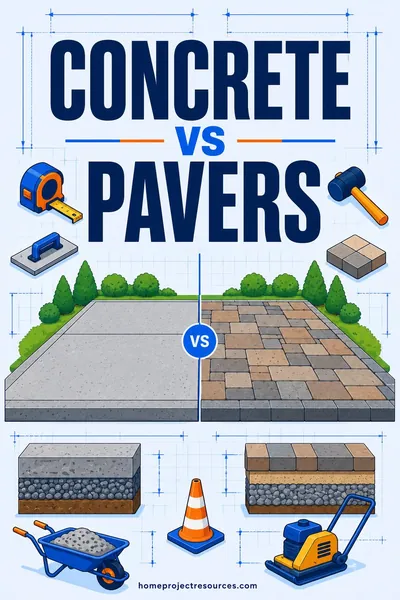
If you're still deciding between a poured slab and a paver surface for the same footprint, our concrete vs pavers comparison puts the costs, lifespans, and repair realities side by side.
Frequently asked questions
How many square feet does a yard of concrete cover at 4 inches?
Eighty-one square feet. A cubic yard is 27 cubic feet, and 4 inches is one third of a foot, so 27 divided by 0.333 gives 81. That's the number to memorize, since most patios, walkways, and shed pads are poured at 4 inches.
How do I convert square feet to cubic yards of concrete?
Multiply your square footage by the thickness in inches, then divide by 324. A 300 square foot patio at 4 inches is 300 x 4 ÷ 324 = 3.7 cubic yards. Add 5% to 10% for waste before you place the order.
How many yards of concrete do I need for a 20x20 slab?
A 20x20 slab is 400 square feet. At 4 inches that's 4.94 cubic yards, so order about 5.5 with waste included. At 6 inches it's 7.41 yards, so order about 7.75. Run your own numbers through the concrete calculator to confirm before you call the plant.
How many 80 lb bags of concrete equal a cubic yard?
Forty-five. Each 80 lb bag yields about 0.6 cubic feet and a cubic yard is 27 cubic feet. At typical bag prices that works out to roughly double the material cost of a yard of ready-mix, and it is 3,600 pounds you move twice, which is why bags only make sense under about half a yard.
How much extra concrete should I order?
Add 10% on pours under 3 yards and 5% on pours over 6 yards, and use 10% regardless of size if the subgrade is rough or hand-dug. Leftover concrete costs you almost nothing. Running short creates a cold joint through your slab, which is a permanent weak plane and a guaranteed crack.
What is the minimum concrete delivery?
Most plants set a 4 or 5 yard minimum. Below that you pay a short-load fee, charged either per yard under the minimum or as a flat amount depending on the plant. On a 2-yard order that fee often exceeds the price of the concrete itself, so it usually pays to combine pours or split a load with a neighbor. Ask how the fee is calculated when you call, because the two methods produce very different tickets on the same order.
How thick should a concrete driveway be?
Five inches for cars, and 6 inches if you park a truck or SUV, tow a trailer, or live where the ground freezes hard. At 5 inches a cubic yard covers 65 square feet; at 6 inches it covers 54. The extra inch on a 400 square foot driveway adds a little over a yard of concrete and is worth it every time.
Does a yard of concrete weigh the same as a yard of gravel?
No. A cubic yard of cured concrete weighs roughly 4,000 pounds, about 2 tons, while a cubic yard of crushed stone runs closer to 2,800 pounds, about 1.4 tons. That matters when you're checking whether a delivery truck or a trailer can legally carry your load.
Related tools: Concrete Calculator | Cubic Yard Calculator | Square Footage Calculator | Gravel Calculator
Related reading: Concrete cost per yard | Concrete vs pavers | Cubic yards to tons