Concrete Leveling Cost: Mudjacking vs. Polyfoam

Concrete leveling cost is driven by four measurements: the square footage of slab being lifted, how far it has to come up, how much empty space is hiding underneath, and which material fills that space. Access is the fifth factor, because a mudjacking rig needs a hose run from a truck at the curb while a foam crew works out of a much smaller setup. Any estimator who quotes your sunken slab without measuring the area, the drop at the low corner, and the reason it sank is guessing.
The good news is that lifting is usually the cheaper, faster branch of the decision. A crew can lift a driveway panel before lunch, and you can park on it the same day.
Updated September 2026
A note on numbers. This page gives specifications, quantities, and the line items that belong on a written quote, not dollar figures. Slab lifting is priced per square foot, per slab, or by material used, and those rates swing hard by region, soil, and crew. Compare three written bids using the checklist near the end.
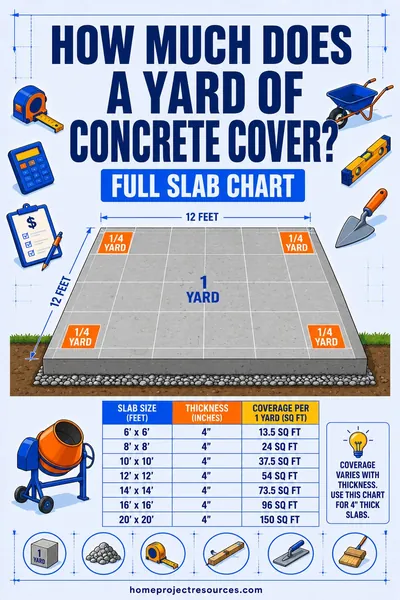
Measure before an estimator shows up. Write down the length, width, and thickness of every slab in question, then run those figures through our free concrete calculator so you know exactly how much concrete a full replacement would involve. That single number is your reality check on whether lifting or replacing is the sane choice.
How slab lifting actually works
Both methods do the same three things. They drill holes through the slab, pump a material into the space below, and use the pressure of that material to push the concrete back to where it started.
The slab itself is not repaired. It is repositioned. That is why the condition of the concrete decides whether the job is worth doing at all, and it is the first thing to check.
A 4-inch concrete slab weighs roughly 50 pounds per square foot, since concrete runs about 150 pounds per cubic foot. So a 10 ft by 12 ft driveway panel weighs about 6,000 pounds, or 3 tons. Lifting it takes real pressure, and that pressure has to push against soil that can take the load once the slab is up.
What drives concrete leveling cost on a quote
Here are the variables that move the number, roughly in order of impact.
Square footage of slab. Most contractors price per square foot of lifted surface. A sidewalk panel and a garage floor are the same job at very different scales.
Lift height. A slab that dropped 1/2 inch needs a fraction of the material a slab that dropped 3 inches needs. Material volume scales directly with the average lift.
Void volume under the slab. This is the part homeowners never see and estimators cannot fully measure from above. A slab can sit flat and still have a 2-inch cavity under the middle of it. The fill has to close that cavity before any lifting begins.
Method. Mudjacking slurry and polyurethane foam are priced differently, cure differently, and weigh wildly different amounts.
Number of separate slabs. Ten sidewalk panels take ten setups. Mobilization is a real cost, which is why small jobs carry a minimum and why bundling the driveway, walkway, and patio into one visit is cheaper per square foot than three visits.
Access. Mudjacking equipment is truck-mounted with a hose run, typically effective up to a few hundred feet. A backyard patio behind a 36-inch gate with no truck access pushes you toward foam, or toward a longer hose run and more labor.
The underlying cause. If a downspout has been washing out the subgrade for six years, lifting the slab without fixing the drainage buys you a repeat visit. Drainage correction is a separate line item and a separate trade.
Slab condition. Cracked slabs sometimes need stitching or staples before they can be lifted in one piece. Badly broken slabs cannot be lifted at all.
Mudjacking vs. polyfoam: the spec comparison
| Spec | Mudjacking (slurry) | Polyurethane foam |
|---|---|---|
| What gets pumped | Sand, soil, cement, and water slurry | Two-part expanding polyurethane |
| Drill hole diameter | About 1 5/8 to 2 inches | About 5/8 inch |
| Hole spacing | Roughly 3 to 8 feet apart | Roughly 4 to 6 feet apart |
| Material weight in place | Around 100 to 120 lb per cubic foot | Around 2 to 4 lb per cubic foot |
| Added load on the soil | 12.5 cu ft of fill adds well over 1,000 lb | The same fill adds under 50 lb |
| Expansion | None, it fills the volume pumped | Expands many times its liquid volume, so small holes work |
| Set time before use | 24 to 72 hours for vehicles | About 15 minutes, drive on it the same hour |
| Water sensitivity | Slurry can wash out where water moves | Closed cell foam is not affected by water |
| Patch appearance | Larger, more visible plugs | Small plugs, easier to blend |
| Best for | Driveways, garage floors, thick slabs on decent soil | Sidewalks, pool decks, poor soil, tight access, fast turnaround |
| Weak spot | Weight can settle again in soft soil | Needs a trained operator, overlifting cracks slabs |
The single most important row in that table is material weight. Mudjacking pumps a heavy slurry into ground that already failed to support a slab. On stable soil with a washout problem, that is fine. On soft, organic, or poorly compacted fill, adding more weight is asking for the same settlement again.
Foam solves that by being almost weightless. A cubic foot of cured lifting foam weighs about as much as a half gallon of milk, yet high density lifting foams commonly carry compressive strengths near 50 psi, which works out to more than 7,000 pounds per square foot of bearing capacity. That is a lot of holding power for very little added load.
Mudjacking is not obsolete, though. Where the void is large and the soil beneath is sound, filling that space with a cementitious slurry is durable, well understood, and often the better value on a thick driveway slab.
When leveling is the wrong call
Lifting only makes sense if you end up with a slab worth keeping. Walk the concrete and check these before you book anyone.
- Crack width. Hairline and tight cracks lift fine. Cracks wider than about 1/4 inch, or cracks with a vertical offset between the two sides, tend to move independently and can worsen during a lift.
- Number of pieces. A panel broken into two or three pieces can often be lifted with extra injection points. A panel that has become a puzzle of six or more pieces should be replaced.
- Surface condition. Spalling, popouts, exposed aggregate from salt damage, and crumbling edges mean the concrete is failing chemically. Lifting a deteriorated slab gives you a level deteriorated slab.
- Thickness. Slabs under about 3 inches thick flex too much and crack under injection pressure.
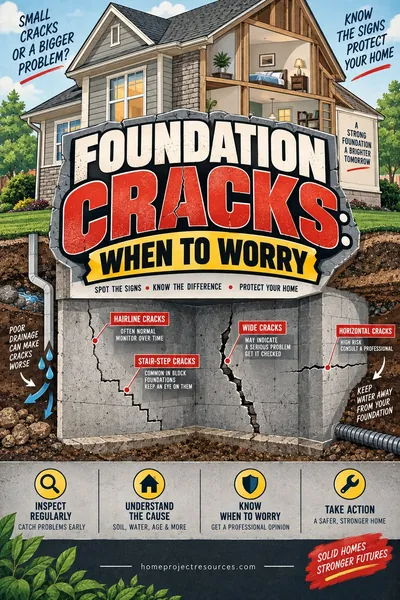
- The cause is structural. If the slab is attached to or supporting part of the house, you are into foundation work, not slab leveling. That crosses into licensed engineering territory. Our guide to crawl space foundation repair cost by problem type covers what that looks like, and basement wall repair cost by crack type covers the wall version.
A useful rule of thumb: if you would be happy with the slab's appearance once it was level, lift it. If you would still be unhappy, replace it and price the job with our guide to concrete driveway replacement cost.
Why the slab sank in the first place
Fixing this matters more than the lift. Concrete does not sink on its own, it sinks because the ground under it moved, washed away, or was never compacted properly.
Poor compaction at construction. The most common cause on newer homes. Backfill around a foundation settles for years, and any slab poured over that backfill goes down with it.
Water erosion. Downspouts dumping at the slab edge, a graded slope pushing runoff under the concrete, or a leaking irrigation line will tunnel out the subgrade. This is the cause that repeats if you do not correct it.
Soil washout at the edges. Slab edges lose support first, which is why sunken panels almost always tip toward the outside edge rather than sinking uniformly.
Tree roots. Roots lift concrete rather than dropping it, and when a root is removed the resulting void collapses.
Freeze and thaw cycling. Frost heave lifts a slab in winter and drops it in spring. Repeated cycles ratchet a slab out of level over several seasons.
Plumbing or sewer leaks. A leak under a garage or basement slab washes fines out of the soil continuously. If a slab keeps sinking after a good lift, get the line camera inspected before you lift it again.
Correcting drainage first is the highest-value thing you can do. Extending downspouts 6 to 10 feet from the slab, regrading so the ground falls about 6 inches over the first 10 feet away from the house, and sealing the joint between slab and foundation with a flexible sealant will protect the repair you just paid for.
Line items that belong on a slab lifting quote
| Line item | What it should specify | Why it matters |
|---|---|---|
| Slab inventory | Each slab by dimensions and current drop | Prevents "the driveway" from meaning different things in three bids |
| Total square footage | The lifted area, not the whole surface | This is the unit most contractors price on |
| Method | Mudjacking or polyurethane, stated plainly | You cannot compare bids across methods without knowing which is which |
| Estimated material volume or weight | Cubic feet of slurry, or pounds of foam | The best proxy for how big the void really is |
| Injection hole count and diameter | Example: 8 holes at 5/8 inch | Tells you how carefully the lift is planned |
| Hole patching | Type of patch material and finish | Cheap patches stand out on a visible walkway |
| Joint and crack sealing | Which joints, what sealant | The follow-up that keeps water out of the fixed void |
| Void fill only vs. lift | Some slabs need filling but not raising | Void filling is a smaller scope, price it separately |
| Warranty | Length, and whether it covers re-settlement | The real differentiator between bids |
| Site protection and cleanup | Slurry splatter is real | Especially near siding and garage doors |
| Access notes | Truck position, hose distance, gate width | Where surprise change orders come from |
Ask every bidder one question in writing: what happens if the slab settles again inside the warranty period, and does the warranty follow the slab or the customer? Answers vary a lot, and the answer tells you how confident the contractor is in the diagnosis.
Worked example: a 10 ft by 12 ft driveway panel
The outer edge has dropped 1 1/2 inches. The house side is still at grade, so the panel is tipped rather than sunk flat.
Step 1: area and weight. 10 ft x 12 ft = 120 square feet. At 4 inches thick, that is 120 x 0.333 = 40 cubic feet of concrete. At about 150 lb per cubic foot, the panel weighs roughly 6,000 pounds.
Step 2: lift volume. The drop runs from 1 1/2 inches at the outer edge to 0 at the house, so the average lift is 3/4 inch, which is 0.0625 feet. 120 sq ft x 0.0625 ft = 7.5 cubic feet of fill just to raise it.
Step 3: existing void. Probe or drill test holes usually reveal an existing cavity. Assume an average 1/2 inch gap under the panel: 120 x 0.0417 = 5 cubic feet.
Step 4: total fill. 7.5 + 5 = about 12.5 cubic feet, before any material that migrates sideways into soft soil. Estimators typically add 10 to 25 percent for that migration, so call it 14 to 16 cubic feet.
Step 5: what each method puts under there. Mudjacking: 14 cubic feet at roughly 110 lb per cubic foot adds about 1,540 pounds of new load to soil that already failed once. Polyurethane: the same 14 cubic feet at 3 lb per cubic foot adds about 42 pounds.
Step 6: hole count. On a 5-foot grid, a 10x12 panel takes 2 rows of 3 holes, so 6 injection points. Mudjacking on a tighter 4-foot pattern would use 6 to 9 larger holes.
Step 7: time on site. One panel like this is a couple of hours of work. With foam you can drive on it almost immediately. With mudjacking, plan on keeping the car off it for a full day or more.
Notice what this example did not need: a price. The volume, the weight, and the hole count are what let you compare two bids and spot the one that has not actually looked under the slab.
Sidewalk and trip hazard math
Public sidewalk panels are their own category, and municipal rules often apply. Many cities hold the adjacent property owner responsible for the walk in front of the house, and they cite vertical offsets between panels as trip hazards.
The accessibility standard is a useful benchmark. Under federal accessibility guidance from the US Access Board, changes in level up to 1/4 inch are allowed without treatment, and 1/4 to 1/2 inch must be beveled at a slope no steeper than 1:2. Anything above 1/2 inch has to be ramped or corrected.
For a homeowner, that translates simply. An offset under 1/4 inch can be left alone. Between 1/4 and 1/2 inch, grinding is often enough. Above 1/2 inch, lifting the low panel is the fix, and it usually beats replacement because the replaced panel would need a permit in the public right of way anyway.
Worked version: five sidewalk panels, each 4 ft by 5 ft, is 100 square feet total. If two of the five have dropped an average of 1 inch, the lift volume is 40 sq ft x 0.0833 ft = 3.3 cubic feet. That is a small, quick job, which is exactly why sidewalk work usually falls under a contractor's minimum charge and why it pays to bundle it with a driveway or patio lift on the same visit.
Permits, licensing, and what to flag
Slab leveling on private property rarely needs a permit, because you are not changing the structure or the footprint. Three situations change that.
Public right of way. Sidewalks, aprons, and the strip between the sidewalk and the curb usually belong to the city. Work there generally needs a permit, and sometimes a licensed and bonded contractor.
Anything supporting the house. Lifting a slab that carries a bearing wall, a garage foundation, or a stoop tied to the structure is foundation work. That deserves a structural engineer's evaluation, and many states require a licensed contractor for underpinning.
Pool decks and pool structures. Foam near a pool shell is routine work for a trained crew and a bad idea for anyone else, since injection pressure against a shell can crack it.
DIY foam kits exist, and for a single wobbly stepping-stone-sized slab they can work. For a driveway, they usually do not. The failure mode is overlifting, which means cracking a 6,000-pound panel you were trying to save, and there is no undo button on a cracked slab.
Lifting vs. replacing: how to decide
| Situation | Better choice | Why |
|---|---|---|
| Slab is sound, tipped, cracks under 1/4 inch | Lift | Same slab, one day, no cure time |
| Slab is spalling or crumbling | Replace | Leveling does not fix surface failure |
| Broken into 4+ pieces | Replace | Too many independent pieces to lift as one |
| Soft or organic soil under a driveway | Lift with foam | Adds bearing without adding weight |
| Large void, sound soil, thick slab | Mudjacking | Fills volume economically |
| Slab is at the wrong elevation by design | Replace | Lifting cannot fix drainage that was poured wrong |
| Repeated settlement after a good lift | Investigate first | Suspect a plumbing leak or an unfixed drainage path |
Timeline matters in that decision too. Leveling is typically a same-day job with immediate or next-day use. Replacement means demolition, disposal, forming, pouring, and then a wait: foot traffic after about 24 to 48 hours, and vehicles usually after 7 days, with full strength around 28 days.
Frequently asked questions
How long does concrete leveling last?
A properly executed lift lasts as long as the soil under it stays put, which for most homes means many years. The variable is not the material, it is whether the cause was corrected. Slabs that sank because of a downspout will sink again if that downspout is not moved.
Is mudjacking or polyfoam better?
Foam wins on speed, weight, small holes, and wet or weak soils. Mudjacking wins on filling large voids in sound soil, and it is a proven method on thick driveway slabs. If the ground under your slab is soft, the weight difference alone points to foam.
How much lift can a slab take?
Most contractors are comfortable lifting up to about 2 inches in one pass, more on thicker slabs, and they will step the lift in stages beyond that. Big lifts raise the odds of cracking, so a good crew works slowly and watches the slab with a level or laser as it moves.
Can I level a concrete slab myself?
For small slabs and DIY foam kits, sometimes. For a driveway, garage floor, or anything attached to the house, no. The pressure needed to move thousands of pounds of concrete is easy to misjudge, and overlifting cracks the slab permanently.
Do the drill holes show afterward?
Yes, but they are patched. Foam holes at roughly 5/8 inch are easy to blend, especially on a broom-finished driveway. Mudjacking holes at up to 2 inches are more visible, so ask to see finished examples if the slab is a front walkway you look at every day.
Does concrete leveling fix cracks?
No. Leveling repositions the slab, it does not repair it. Cracks should be routed and sealed as a separate step after the lift, and joints should be resealed so surface water stops feeding the void you just filled.
Will homeowners insurance cover a sunken slab?
Usually not. Settlement, soil movement, and gradual erosion are typically excluded. A sudden covered event, like a burst supply line washing out the subgrade, is worth a call to your carrier before you schedule the work.
How soon can I use the slab after leveling?
With polyurethane foam, roughly 15 minutes for foot traffic and vehicles in most cases. With mudjacking, plan on 24 hours for foot traffic and 24 to 72 hours before parking on it, since the slurry needs to set under load.
Related: How much does a yard of concrete cover helps you size a replacement pour if lifting is off the table, how to seal a driveway covers the crack filling and sealing that protects the slab afterward, and the concrete calculator plus the square footage calculator turn your tape measure notes into numbers an estimator can be held to.