Cost to Replace Driveway With Concrete: Scope and Specs

The cost to replace driveway with concrete is really two jobs priced together: getting the old surface out, and building a new slab that will not crack. Demolition is driven by what is there now and how it leaves the site. The new slab is driven by base depth, slab thickness, reinforcement, concrete strength and truck access. Change any one of those five and you are looking at a different driveway, which is exactly why two bids on the same rectangle can be far apart.
Most homeowners compare the totals. The useful comparison is the specification underneath them. A slab that is an inch thinner, on half the base, with mesh instead of rebar, is not a discount. It is a shorter service life, and you cannot add base back later without breaking the slab out again.
Updated September 2026
A note on numbers. This page gives you the specifications, quantities, scope items and bid questions, not dollar figures. Ready mix is a local product hauled by truck and crew rates are a local market, so a printed range would mislead most readers. Work out your yardage here, write one scope, and take it to three local contractors.
Know your yardage before the first bid. Concrete is sold by the cubic yard, and a 640 square foot driveway at five inches is close to eleven yards with waste. Run your dimensions through our free Concrete Calculator so you can check every proposal against the material the slab actually needs.
What Sets the Cost to Replace Driveway With Concrete
Rank a proposal in this order. The first four explain almost all of the spread between quotes.
1. What comes out, and how. Breaking out an unreinforced slab is straightforward. A reinforced slab has to be cut into pieces the machine can lift, and the steel fights you the whole way. Asphalt is thinner and lighter and often recyclable. Gravel or bare dirt means no demolition line at all. Disposal is a separate question: concrete is heavy, weight drives haul cost, and some recycling yards take clean rubble on far better terms than a landfill.
2. Base depth and subgrade condition. Four to six inches of compacted crushed stone is the residential standard, deeper on clay or in hard frost regions. This is the invisible line item, and the one most often thinned to win a bid. Base failure is the leading cause of early driveway cracking, and no amount of surface quality compensates for it.
3. Slab thickness and reinforcement. Four inches suits passenger cars on stable soil. Five to six inches is what you want if a truck, an RV or a delivery vehicle will ever sit on it. Reinforcement matters just as much as thickness: mesh lying flat on the ground does nothing, while rebar on chairs or mesh properly supported at mid slab holds a cracked slab together.
4. Concrete strength and air entrainment. Freeze and thaw climates want a higher strength air entrained mix, because entrained air gives freezing water somewhere to expand and prevents the surface scaling that turns a young driveway chalky. A cheaper low strength mix without air is a real saving on the invoice and a real loss in the fifth winter.
5. Access and site conditions. If trucks can chute straight into the forms, placement is quick. Long runs, backyard pours and tight approaches mean a pump or a wheelbarrow chain. Slopes, retaining edges and drainage that has to be rerouted all add scope.
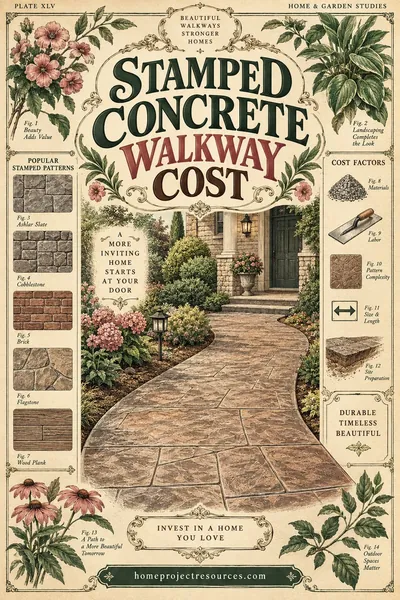
6. Finish. Broom finish is the default and the best value. Integral color, exposed aggregate, stain and stamping each add material, labor or both, and stamping adds a resealing commitment for the life of the slab.
| Driver | What keeps the estimate lean | What pushes it up |
|---|---|---|
| Demolition | Gravel or bare dirt, nothing to remove | Reinforced slab, saw cutting, heavy haul loads |
| Base | Existing compacted stone in good shape | Deep frost base, geotextile over clay, undercut and replace |
| Slab | 4 in for cars on stable soil | 5 to 6 in for trucks, RVs and trailers |
| Steel | Mesh on chairs, light duty | Rebar grid on tight centers |
| Mix | Standard strength, mild climate | High strength air entrained for freeze and thaw |
| Access | Truck chutes directly into the forms | Pump rental, long wheelbarrow runs, backyard pour |
| Finish | Broom finish, standard gray | Integral color, exposed aggregate, stamping and sealing |
| Street work | Existing apron stays | New apron built to municipal specification, separate permit |
Finish Options and What Each One Commits You To
| Finish | What it is | What it commits you to |
|---|---|---|
| Broom finish, standard gray | Textured with a broom while wet | Nothing beyond periodic sealing. The cheapest and the best traction |
| Float and trowel | Smoother closed surface | Slicker when wet. Better indoors than on a driveway |
| Exposed aggregate | Surface paste washed back to reveal stone | Excellent grip, hides stains, wants regular sealing |
| Integrally colored | Pigment batched into the mix | Color runs all the way through so wear does not expose gray. Pricier than plain |
| Stained | Color applied after cure | Refreshing every several years to keep the tone |
| Stamped and colored | Pattern pressed into the wet surface | Resealing every two to three years, and repairs that cannot be color matched |
| Heated slab | Tubing or electric mat under the concrete | The priciest option by a wide margin, plus a boiler or controller to maintain |
Stamping is where budgets stretch furthest. It is close to double the surface work of a plain pour and it locks in a maintenance cycle for as long as you own the house. If you want a driveway that looks better than plain gray without that commitment, integral color with a broom finish is the value pick.
Thickness, Base and Reinforcement, by How You Use It
| Use | Slab thickness | Base depth | Reinforcement | Concrete strength |
|---|---|---|---|---|
| Cars only, stable soil | 4 in | 4 in compacted stone | 6x6 wire mesh on chairs | Standard residential mix |
| Cars, freeze and thaw climate | 4 to 5 in | 6 in | No. 3 rebar at 18 in | Higher strength, air entrained |
| Light truck or RV occasionally | 5 in | 6 in | No. 4 rebar at 18 in | Higher strength |
| RV or trailer parked regularly | 6 in | 6 to 8 in | No. 4 rebar at 12 to 18 in | Highest residential strength |
| Expansive clay soil | 5 to 6 in | 6 to 8 in plus geotextile | No. 4 rebar at 12 in | Highest residential strength |
| Steep slope | 5 in | 6 in | No. 4 rebar, plus broom or tined finish | Higher strength |
Two specifications go with that table.
Control joints are spaced at 24 to 30 times the slab thickness in inches, so a four inch slab wants joints every 8 to 10 feet and a five inch slab every 10 to 12 feet. Joints get cut about one quarter of the slab depth. Concrete cracks. Joints decide where.
Expansion joints go where the new slab meets something that moves independently: the garage slab, a sidewalk, the street apron. Leaving them out is how a new driveway pushes into a garage floor over one hot summer.
The Yardage Math, Done for You
Every proposal has a concrete line and you can check it in two minutes.
Multiply length by width by thickness in feet, then divide by 27 to get cubic yards. Add roughly eight percent for waste, over excavation and thickened edges.
Worked example: a 16 by 40 double driveway
An older suburban home in a freeze and thaw climate. The existing driveway is original four inch unreinforced concrete, sixteen feet by forty feet, heaving at the garage slab, with several wide cracks and surface scaling from decades of de icing salt. It cannot be resurfaced. It has to come out.
The new slab is specified at five inches, high strength air entrained mix, No. 4 rebar on 18 inch centers, over six inches of compacted crushed stone.
Step 1: area. 16 x 40 = 640 square feet.
Step 2: slab volume. 5 inches is 5 / 12 = 0.4167 feet. 640 x 0.4167 = 266.7 cubic feet. 266.7 / 27 = 9.88 cubic yards.
Step 3: what to order. Add eight percent and you are at 10.7 yards, so the crew orders 11. That is the figure our Concrete Calculator returns, and it is the number to check every proposal against.
Step 4: base quantity. Six inches of stone across 640 square feet is 320 cubic feet, or 11.9 cubic yards, which is on the order of eighteen tons if the supplier sells by weight. Add ten percent for compaction.
Step 5: sanity check the bids. If a proposal on this driveway specifies a four inch slab on three inches of base with mesh, that is roughly eight yards of concrete and half the stone. It is not the same driveway, and the difference will show up as settlement rather than as savings.
Concrete Against the Alternatives
| Surface | Relative position | Lifespan | Maintenance | Repair |
|---|---|---|---|---|
| Concrete | Mid to high, decorative finishes highest | Longest of the common surfaces | Seal every few years | Patches are always visible |
| Asphalt | Cheapest of the paved options | Shorter than concrete | Seal coat on a regular cycle | Patches blend reasonably |
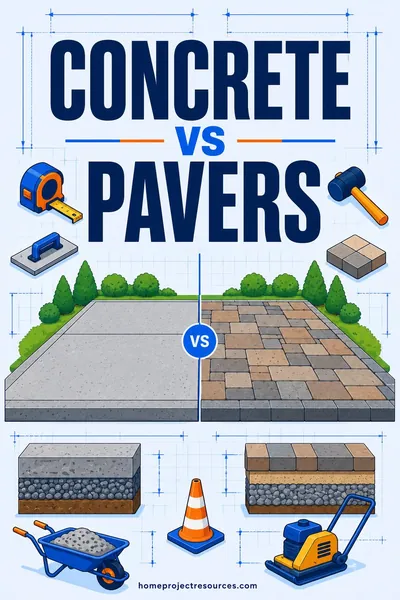
| Pavers | The priciest per square foot | Very long, units are replaceable | Re sand joints, occasional weeding | Lift and reset invisibly |
| Gravel | Cheapest of all | Indefinite with top ups | Regrade and add stone regularly | Trivial |
| Resin bound | High, close to pavers | Mid range | Low | Patch is visible |
The short version is that asphalt is cheaper up front and concrete is cheaper per year. Over the life of one concrete driveway, an asphalt drive gets replaced once and seal coated many times. For the head to head on the two premium options, see concrete vs pavers, and for the paver side in detail see paver driveway cost.
Permits, Setbacks and the Piece at the Street
Most cities require a permit to replace a driveway. What trips people up is not the driveway itself, it is the apron: the section between the sidewalk and the street sits in the public right of way, and the city usually has its own specification, its own permit, and sometimes its own approved contractor list. Raise it before signing, because it is separate scope with a separate inspection.
A permit review commonly checks these too.
- Impervious surface limits. Many municipalities cap the percentage of a lot that can be hard surfaced. Widening a driveway can push you over.
- Drainage. Water must not be directed onto a neighboring property or pond against the foundation. Slope the slab a minimum of an eighth to a quarter inch per foot away from the house.
- Setbacks from side property lines, commonly one to five feet.
- Sidewalk condition. Some cities require you to replace damaged sidewalk panels at the same time.
- Curb cut approval if the width or location at the street changes.
- Right of way restoration and the bond or deposit some cities collect for it.
Concrete flatwork is not licensed the way electrical and gas work are in most states, but the contractor should carry liability insurance and workers compensation, and a bonded contractor is worth asking for on a job this size.
What Belongs in the Scope of Work
Give every bidder the identical list so the comparison means something.
- Measured area in square feet with a sketch, including the apron if it is in scope.
- Demolition. What comes out, how thick, whether it is reinforced, how many loads, and where the rubble goes.
- Excavation and grading. Depth, spoil disposal, and the finished pitch with the direction water leaves.
- Base. Stone type, compacted depth, number of lifts, compaction method, any geotextile.
- Reinforcement. Mesh or rebar, bar size, spacing, and how the steel is held at mid slab during the pour.
- Concrete. Strength, air entrainment, slab thickness, thickened edges, and the yardage they expect to place.
- Placement. Chute, pump or wheelbarrow, and crew size on pour day.
- Joints. Control joint layout and depth, expansion joint locations and material.
- Finish. Broom, color, aggregate or stamp, and sealer type with timing.
- Curing. Method and duration, and who is responsible for protecting the slab.
- Apron and permits. Who pulls what, and to whose specification.
- Warranty. Duration, and specifically whether cracking, settlement and scaling are covered or excluded.
Items 4, 5 and 6 are the ones you can verify with the math above. If the yardage on the proposal does not match the thickness on the proposal, ask which one is wrong.
Questions to Ask Each Bidder
- What base depth, what stone, and compacted in how many lifts?
- Is the base proof rolled, and what happens if a soft spot appears?
- What slab thickness, and is the edge thickened?
- Mesh or rebar, at what spacing, and what holds it up during the pour?
- What strength mix, and is it air entrained?
- Where do the control joints fall and how deep are they cut?
- Where do the expansion joints go?
- How does concrete get from the truck to the forms on this site?
- Are you pulling the apron permit, or am I?
- What is specifically excluded here?
Our contractor red flags page covers verification, and how to get contractor bids has the wording that produces genuinely matched quotes.
Where You Can and Cannot Save
Worth doing. Demolition and hauling to a recycling yard yourself if you have the equipment and the back for it. Excavation and base spreading, which is heavy but not time critical. Sealing on schedule for the life of the slab. Choosing a broom finish over a decorative one. Scheduling in a shoulder season when crews are not booked solid.
Reasonable, with eyes open. Dropping from a five inch slab to four inches with properly supported mesh, if only passenger cars will ever park there and the soil is stable.
Not worth it. Thinning the base. Skipping air entrainment in a freeze and thaw climate. Dropping rebar on soil that moves. Leaving out expansion joints at the garage. Every one of those is invisible on the day the forms come off and irreversible two years later.
Timeline and What to Expect
| Day | What happens |
|---|---|
| Day 1 | Saw cutting, demolition, haul away |
| Day 2 | Excavation, grading, base stone placed and compacted |
| Day 3 | Forms set, steel placed on chairs, inspection if required |
| Day 4 | Pour, screed, float, broom finish, joints tooled or cut |
| Day 5 to 7 | Cure protection stays on, forms stripped, joints saw cut if not tooled |
| Day 7 | Foot traffic |
| Day 10 to 14 | Light passenger vehicles, if the contractor approves |
| Day 28 | Full design strength, heavy vehicles, earliest sensible date to seal |
Do not park on it early. Concrete reaches roughly seventy percent of its strength at seven days and full strength at twenty eight. Driving on a young slab is how you get a cracked driveway that nobody will warranty. And keep de icing salt off new concrete for the first full winter, because it accelerates scaling on a surface that has not fully cured or been sealed.
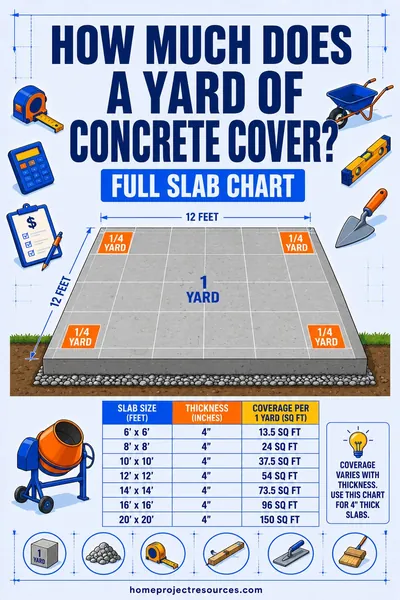
Once it has cured, upkeep is simple and the schedule is covered in how to seal a driveway. For volume questions in general, how much does a yard of concrete cover and concrete cost per yard are the two pages to read before you order.
FAQ
What drives the cost to replace a driveway with concrete?
Demolition of the old surface, base depth, slab thickness, reinforcement, mix strength and site access, in roughly that order. Removal is its own job with its own disposal loads, and the new slab is a specification rather than a commodity. When bids differ, compare those six items line by line before you compare totals, because the cheaper number is usually a thinner build.
Is it cheaper to repair or replace a concrete driveway?
Repair is cheaper whenever the base underneath is still sound. Crack sealing, slab jacking to lift a settled section, and polymer overlays all avoid demolition entirely. Replace when cracks are wide, sections have heaved or sunk unevenly, or scaling covers most of the surface, because those are base and freeze failures that an overlay will telegraph through within a year.
How thick should a concrete driveway be?
Four inches for cars on stable soil, five to six inches if a truck, RV or delivery vehicle will use it, and six inches on expansive clay. Going from four to five inches adds a quarter more concrete volume and no extra finishing labor, which makes it one of the best value decisions on the whole job.
How long does a concrete driveway last?
Several decades with a proper base, correct reinforcement and periodic sealing, which is longer than any other common driveway surface. Poor base preparation is the main reason driveways fail early. In freeze and thaw regions, de icing salt on unsealed concrete is the second. Asphalt in the same conditions has a noticeably shorter service life.
Do I need a permit to replace a driveway?
In most cities, yes. The apron between the sidewalk and the street usually needs a separate right of way permit and must be built to the city specification, which is its own scope and its own inspection. Check impervious surface limits too, because widening the driveway can push a lot over the local cap.
How long before I can drive on a new concrete driveway?
Seven days for foot traffic, ten to fourteen days for cars if the contractor approves, and twenty eight days before heavy vehicles. Concrete reaches about seventy percent of design strength at a week and full strength at four weeks. Parking early is the most common way homeowners crack a brand new slab.
Can I pour a concrete driveway myself?
A small single driveway is technically possible for an experienced DIYer, but it is a poor place to learn. Ten or eleven yards has to be placed and finished before it sets, which realistically takes four to six people working fast, and botched finishing cannot be undone. Most people who want to save do the demolition and base prep themselves and hire out the pour and finish.
How much concrete do I need for a driveway?
Multiply length by width by thickness in feet, then divide by 27. A 16 by 40 driveway at five inches is 640 x 0.4167 / 27, which is 9.9 cubic yards, and you order about eight percent extra for waste and thickened edges, so eleven yards. The Concrete Calculator does this and adds the waste factor for you.
Related: Get your yardage first with the Concrete Calculator, then read concrete cost per yard and coverage on how much does a yard of concrete cover. Comparing surfaces? See concrete vs pavers and paver driveway cost. After the pour, how to seal a driveway covers upkeep.