How to Hang Garland on a Staircase Without Damage

Measure the handrail along its slope, add 20 percent for the droop of each swag, and tie the garland to the balusters with soft ties instead of anything that bites the wood. That's the whole method for hanging garland on a staircase without leaving a mark: the measuring keeps you from running short halfway up, and tying to the balusters (not the handrail) keeps the rail free to grab and the garland off the treads.
If you're wondering how to hang garland on a staircase you'll still be able to use every day, the details below cover the three kinds of railing you might have, the ties that work on each, how to plan the swags so they come out even, and where the cord goes when the garland lights up.
Not sure what your stairs measure? Our stair calculator takes total rise and gives you the riser count, tread depth, and total run, which is the horizontal number you'll convert to slope length below.
Updated September 2026
Know the parts before you tie anything
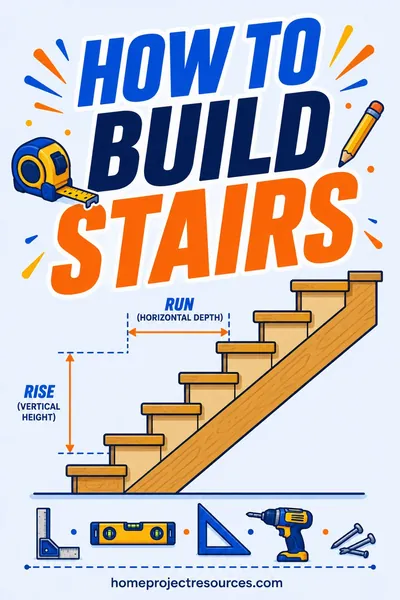
A staircase has more names than most people expect, and the garland goes on different parts depending on which you've got. The handrail is the part you hold. The balusters (also called spindles) are the vertical pieces under it. The newel post is the thick post at the bottom, and often at each turn. The whole assembly of rail, balusters, and posts is the banister. Our guide to how to build stairs walks through all of it with dimensions, if you want the full picture.
The reason the names matter is safety. The handrail is the thing that stops a fall. Building codes require it to be graspable along its whole length, and a rail wrapped in three inches of pine and a strand of lights is not graspable. So the rule for any staircase that has only one handrail is simple: the garland goes on the balusters and the outside face of the rail, never wrapped around the top where your hand goes. If you've got a rail on both sides, you can dress one fully and leave the other clear.
| Railing type | Where the garland attaches | Best tie | Avoid |
|---|---|---|---|
| Wood balusters, painted or stained | Base of each baluster, outside face | Chenille stems, floral wire, hook and loop ties | Zip ties pulled tight (they dent soft paint) |
| Wrought iron or metal balusters | Any baluster, top or bottom | Zip ties, floral wire | Adhesive hooks (they slide on smooth metal) |
| Cable or glass panels, no balusters | Top rail brackets or posts only | Hook and loop ties around the post | Anything on the glass or cable |
| Half wall with a cap rail, no balusters | Removable adhesive hooks on the wall side | Adhesive hooks rated for the weight | Hooks on textured or freshly painted drywall |
| Newel post | Wrapped, top to bottom | Floral wire tucked into the greenery | Tape of any kind on finished wood |
Measure the run and do the swag math
Garland always runs out three balusters from the top. Here's how to make sure it doesn't.
Measure along the slope, not the floor. Run a tape measure along the handrail from the bottom newel to the top, following the slope. That's your run length. If your stairs turn at a landing, measure each flight separately and add them. If you only know the total rise and total run (say, from the stair calculator), the slope length is the square root of rise squared plus run squared, which for a common 9-foot-rise staircase with a 12-foot run comes out to 15 feet.
Decide on the swag count. A swag is one dip between two attachment points. Most staircases look right with a swag every 3 to 4 feet, which usually lands on every third or fourth baluster. Divide the run length by your target spacing and round to a whole number.
Add for droop. A garland pulled straight along the rail looks flat. A garland that dips between points looks like the pictures, and the dip eats length. Add 20 percent to the run length for gentle swags. For deep, dramatic swags that hang a foot or more below the rail, add 40 to 50 percent instead.
Add for the posts. Wrapping a newel post takes about 3 feet of garland per post for a single wrap, more if you spiral it.
Written as a formula:
Garland needed = (run length × 1.2) + (3 feet × number of newel posts wrapped)
That's the answer to how much garland for a staircase. It's always a little more than you'd guess, which is why you should do the math before you buy rather than after you've hung the first half.
Worked example: a 14-step straight staircase
Here are the real numbers from a common layout.
The stairs have 14 risers at 7 inches each, so the total rise is 98 inches. The treads are 10 inches, and with 13 treads between 14 risers the total run is 130 inches. Slope length is the square root of 98² plus 130², which is the square root of 9,604 plus 16,900, or about 163 inches. Call it 13 feet 7 inches along the rail, and a tape measure held along the handrail confirms 13 feet 6 inches.
There's one newel post at the bottom and a half newel at the top, and the plan is to wrap the bottom one.
- Run length: 13.5 feet
- Swag spacing target: 3.5 feet, so 13.5 ÷ 3.5 = 3.9, rounded to 4 swags and 5 attachment points
- Droop: 13.5 × 1.2 = 16.2 feet
- Newel wrap: 3 feet
- Total: about 19 feet of garland
Garland is usually sold in 6-foot, 9-foot, and occasionally 12-foot lengths, so this staircase takes two 9-foot pieces and comes up a foot short on the newel wrap, or three 6-foot pieces with a foot to spare. Three 6-foot pieces is the better buy here because the joins land near the attachment points where they're easy to hide.
The 5 attachment points are at baluster 1 (bottom, beside the newel), and then at roughly 40-inch intervals along the slope, which lands at balusters 4, 7, 10, and 13 on a staircase with a baluster every 13 inches or so. Count your own balusters; the exact one doesn't matter as long as the spacing is even.
How to hang garland on a staircase: what works on each railing
Painted or stained wood balusters
Wood is the most common railing and the easiest to damage, because whatever you tie can rub the finish for six weeks. The gentlest ties are chenille stems (pipe cleaners), which bend around the baluster and hold with a twist, and hook-and-loop straps made for cables. Both come off in seconds and leave nothing behind.
Floral wire also works and holds a heavier garland better. Cut a 10-inch piece, wrap it around the garland's core wire and then the baluster, and twist the ends together on the back side where they don't show. Put a small square of felt or a fold of cloth between the wire and the wood if the finish is glossy.
Tie at the base of the baluster, an inch or two above the tread, and let the garland swag up from there. The garland then sits on the outside of the balusters, away from your feet.
Zip ties for garland: yes on metal, careful on wood
Zip ties are the fastest tie there is and the right choice on wrought iron, steel, or aluminum railings, where there's no finish to dent. Pull them snug, not tight, and clip the tail flush with the head, then rotate the head to the back of the baluster so the sharp edge faces away from ankles and dog noses.
On painted wood, a zip tie pulled tight can leave a ring. If you must use one, put a strip of cloth or a chenille stem under it, and don't cinch it past the point where the garland stops moving.
Command hooks on stair railing: when they hold and when they don't
Removable adhesive hooks, the ones most people call command hooks, are useful on the flat parts of a staircase: the side of a newel post, the underside of a cap rail, or the wall along a half-wall staircase that has no balusters at all. They're a poor choice on the round or turned surface of a baluster, because the adhesive only bonds where it touches flat, and on a round baluster that's almost nothing.
Where you do use them, the rules are the same as anywhere: a cured, smooth, clean surface, a firm 30-second press, and an hour before you load them. Check the package rating and buy hooks rated for at least twice the weight they'll carry. A single hook on a newel post carrying one end of a garland is holding more than you'd think, because the garland pulls sideways as well as down. To remove them, pull the tab straight down along the surface, never toward you.
How heavy is the garland?
Garland weight varies more than any other decoration, and it decides which tie you need. Artificial pine garland is fairly light per foot. Fresh cedar or fir garland is much heavier, especially the first week, and it's heavier still after you add lights and ornaments. The honest advice is to weigh what you bought: put the coiled garland on a bathroom scale and divide by its length to get a weight per foot.
Then think about each attachment point. In the example above, 19 feet of garland spread over 5 points means each tie holds roughly a fifth of the total, plus whatever ornaments hang near it. A light artificial garland is well within what a chenille stem holds. A fresh, lighted, ornamented garland at that spacing is a job for floral wire or zip ties.
Lighted garland on a staircase: where the cord goes
Lights make the garland, and they also create the one real hazard in this project: a cord across a step. Plan the power before you tie anything.
Battery packs. The simplest answer for a staircase. Tuck the pack behind the newel post wrap at the bottom or into the garland at the top, and use a timer so you're not climbing to switch it off. Most packs are small enough to hide inside the greenery with a twist of floral wire.
Plug-in strands. Start the strand at the end nearest the outlet. If the outlet is at the bottom of the stairs, begin at the newel post and run up. If it's at the top, begin there and run down. The cord should never cross a tread. Run it along the wall side of the stairs or straight down the outside of the newel post to the floor, and tape or clip it to the baseboard so it can't be kicked into the walkway.
Extension cords. Use one rated for the load, keep the connection off the floor where it won't get stepped on, and never run it under a rug on the landing. The U.S. Fire Administration's holiday fire safety page is the source for cord and light checks, and it's a two-minute read worth doing every year.
Check strands for cracked insulation and dead bulbs before they go on the stairs, because fixing them once they're wired into greenery is miserable. And switch to LED strands if you're still using the old incandescent kind: they run cool, which matters when the lights sit inside dry greenery.
Keeping the garland off the treads
The garland belongs on the outside of the balusters, hanging into the open side of the stairwell or against the wall, never across the walking surface. Three things pull it onto the treads: tying too high on the baluster so it flops over, making the swags too deep on a narrow staircase, and ornaments that swing.
Tie low, at the base of each baluster. Keep the deepest point of each swag above the tread nosing below it, which on most stairs means a droop of no more than 8 to 10 inches. And hang ornaments at the attachment points rather than mid-swag, where they'd swing into the walkway with every pass.
Walk the stairs with your hand on the rail before you call it done. If your hand or foot touches greenery anywhere on the way up, move it.
Taking it down without damage
Removal is where the marks usually happen. Cut zip ties with flush cutters rather than yanking them. Untwist floral wire rather than pulling the garland free, which drags the wire across the finish. For adhesive hooks, pull the tab straight down. Then wipe every baluster with a damp cloth, because fresh garland leaves sap and artificial garland sheds a fine dust that dulls a finish over time.
If a zip tie did leave a ring on a painted baluster, a little furniture polish usually lifts it. On stained wood, a touch of matching stain marker on a cotton swab blends a small mark.
Frequently asked questions
How much garland do I need for a staircase?
Measure the handrail along its slope, multiply by 1.2 for gentle swags (or 1.5 for deep ones), and add 3 feet for each newel post you'll wrap. A staircase with a 13.5-foot rail and one wrapped post needs about 19 feet.
Can you wrap garland around the handrail?
Only if there's a second handrail left clear. The handrail has to stay graspable for safety. On a staircase with a single rail, attach the garland to the balusters and the outside of the rail so your hand still has the top of the rail.
What do you use to attach garland to a stair railing?
Chenille stems or hook-and-loop straps on painted wood, floral wire for anything heavy, and zip ties on metal railings. Removable adhesive hooks work on flat surfaces like the newel post or a wall, not on round balusters.
How far apart should the swags be?
Every 3 to 4 feet along the slope looks right on most stairs, which usually lands on every third or fourth baluster. Divide the rail length by your spacing, round to a whole number, and that's your swag count.
Will command hooks damage a stair railing?
Not if the finish is fully cured and you remove the hook by pulling the tab straight down along the surface. They can pull paint that's less than a week old, and they don't grip round balusters well in the first place, so use them on flat spots only.
How do you hang lighted garland on stairs safely?
Start the strand at the end nearest the outlet so the cord never crosses a step, run the cord down the outside of the newel post or along the wall, and use LED strands. Battery packs with a timer avoid the cord problem completely.
The short version
Measure the slope, add 20 percent, add 3 feet per post, and buy a foot more than that. Tie low at the balusters with something soft, leave the handrail free to grab, and route the cord so it never crosses a tread. The same weigh-first, no-nail approach carries over to the other two big holiday jobs: our guides on how to hang a wreath on a door and how to hang garland on a mantel pick up where this one leaves off.