Christmas Tree Light Ideas: Colored, Warm White and How Many You Need

The best Christmas tree light ideas all start with one rule: use more lights than you think, about 100 mini lights per foot of tree, and tuck some deep into the branches so the tree glows from the inside. That works out to about 600 lights for a 6 ft tree and 750 for a 7.5 ft tree. After that, the look is up to you: warm white, colored, twinkly or a mix of sizes.
This guide covers how many lights to buy for your height and style, the three ways to put them on, how many strands you can safely connect, and a set of looks to choose from. Lights always go on first, before garland and ornaments, so it pays to plan them before you open a single box.
Key facts
- Classic look: about 100 mini lights per foot of tree.
- Soft look: about 50 per foot. Branch-wrapped glow: about 200 per foot.
- Big C7 or C9 bulbs: often only 10 to 25 per foot.
- Start at the bottom near the outlet, with the first strand plugged in.
- Never connect more strands end to end than the box allows.
Free calculator from Home Project Resources
Tree Light Planner: How Many Lights, How Many Strands, What Order
Pick your tree height and the lighting style you want. You get the bulb count, the number of strands and how to put them on.
Need more? Open the free Paint Calculator.
 Paint Calculator
 Square Footage Calculator
 Wallpaper Calculator
The Tree Light Planner needs two answers. Pick your tree height (4 ft, 6 ft, 7.5 ft or 9 ft) and your lighting style: classic wrap in a spiral around the outside, vertical sections up and down, branch-wrapped for a full designer glow, or soft and minimal. It gives you the bulb count, how many strands of 100 that means, and how to put them on in the right order for that style.
Quick reference: lights by tree height
| Tree height | Soft (50 per ft) | Classic (100 per ft) | Branch-wrapped (200 per ft) |
|---|---|---|---|
| 4 ft | 200 | 400 | 800 |
| 6 ft | 300 | 600 | 1,200 |
| 7.5 ft | 400 | 750 | 1,500 |
| 9 ft | 450 | 900 | 1,800 |
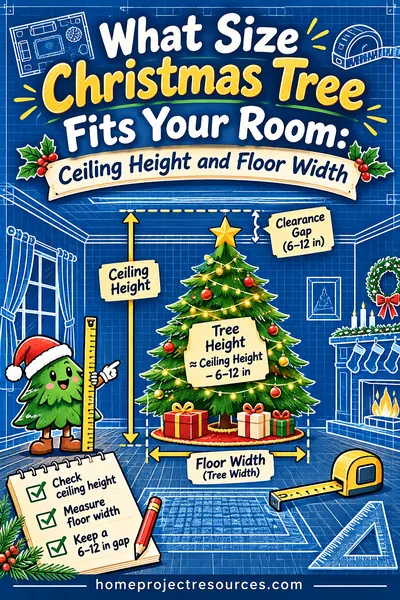
These counts are for mini lights. Larger bulbs, like the old-fashioned C7 and C9 shapes, need far fewer because each one is so much bigger. A wide, full tree can take a little more than the chart, and a slim pencil tree a little less. If you're still choosing the tree, our guide to what size Christmas tree fits your room helps you match height and width to your ceiling and floor space.
Spiral, vertical or branch-wrapped?
There are three ways to put lights on a tree, and the planner gives you steps for each. The one you pick changes how long it takes, how the tree looks and how easy it is to take down in January.
Classic spiral wrap
You start at the bottom and wrap the strand around the tree in a loose spiral, working upward. It's the fastest method. The trick is to tuck the strand about halfway into the branches as you go, so you see glow rather than wire. If you only run lights around the outside tips, the tree looks flat.
Vertical sections
Divide the tree into three or four wedges, like pie slices, and zigzag one strand from the bottom to the top of its wedge and back down. This is my favorite for a tree in a corner, because you can skip the back. It's also quicker to take down, and if one strand fails you only redo one wedge instead of unwinding the whole tree.
Branch-wrapped
You wrap each main branch from the trunk out to the tip and back. It takes the longest and uses the most lights, about 200 per foot, but it gives that bright, glowing look you see in magazines. It suits a light-only tree with just a star on top.
Step by step: lighting a 7.5 ft tree
Here's how a classic 7.5 ft tree comes together with 750 mini lights, which is about eight strands of 100 (you'll have a few lights spare). Set aside about an hour for a spiral wrap, longer for branch-wrapping.
First, test every strand on the floor. Swapping a dead strand once it's woven into the branches is no fun. If one is half dark, set it aside and fix it later with our guide on how to fix Christmas lights. If the tree is artificial, fluff every branch so the lights have somewhere to sit.
Next, check the box for the connection limit and plan your runs. With LED mini lights, eight strands end to end is often fine, but check. With incandescent strands, the limit is much lower, so you'll likely need to start a second run from a separate plug. Run each chain down to a power strip at the base rather than stacking plugs.
Now plug in the first strand and start at the bottom near the outlet. Keep it lit while you work so you can see where the light falls. Tuck the strand halfway in, with some bulbs near the trunk and some near the tips. Work up one section or spiral at a time, adding strands as you go. Every couple of strands, step back and squint. Dark patches jump out when your eyes are half closed. Fill them now, then add garland or ribbon, then ornaments, big ones first.
How many strands can you connect?
Every light set has a limit on how many strands can be plugged end to end, printed on the box, the tag or the plug. It's there because all the power for the chain runs through the first strand's thin wires and its plug fuse. Go past it and you risk blown fuses, hot plugs and, at worst, a fire.
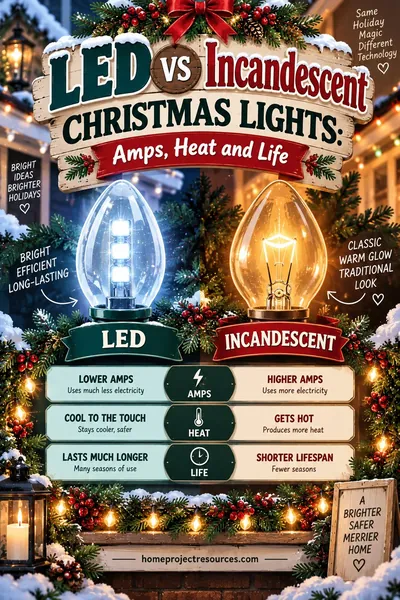
LED mini lights draw much less power than incandescent ones, so their limits are usually far higher. Older incandescent minis often allow only a few strands per run. If you need more lights than one run allows, start a second chain and plug it into its own outlet on the power strip. Don't link LED and incandescent strands in the same chain; they draw different amounts and usually look different in color. Our guide to LED vs incandescent Christmas lights explains amps, heat and lifespan if you're deciding which to buy.
Warm white looks
Classic warm white, with lots of it, goes with any ornaments and photographs beautifully. About 100 lights per foot, tucked deep, is all it needs. For a cozy tree, pair warm white with gold ornaments, wooden beads and pinecones. For a candlelight feel, use warm white lights on a soft, slow twinkle setting and skip anything flashy. It recalls an old-fashioned candlelit tree with none of the risk.
White on white uses warm white lights with white, cream and silver ornaments on a flocked or snowy tree. It's calm and bright, and it works well in a room with lots of natural wood. One firm rule: don't mix warm white and cool white on the same tree. Cool white looks blue next to warm white, and the tree ends up patchy.
Colored light looks
Retro multicolor, with red, green, blue, orange and yellow bulbs, tinsel and vintage-style glass ornaments, is pure nostalgia. If you love colored lights but want a calmer tree, let the lights carry the color and keep ornaments white or silver. A two-color tree, like red and white or blue and white, looks modern and tidy.
Kids usually vote for color. A rainbow tree with colored lights, paper chains and felt shapes is a happy family project, and the kids can decorate the bottom half. Jewel tones, with deep red, emerald and sapphire lights and matching glass ornaments, feel rich and cozy. Many families do warm white on the main tree and colored lights on a second, smaller one; our small Christmas tree decorating ideas cover light counts for tabletop and 4 ft trees.
Fun ways to mix sizes and effects
A string of big, old-fashioned bulbs on a 4 ft tree is charming and quick. Mixing sizes also works on a big tree: mini lights deep inside, then a strand of larger globe lights near the outside for sparkle and depth. Fairy lights on thin copper or silver wire look delicate on minimal and tabletop trees.
An ombre glow puts more lights low and fewer high, so the tree is brighter at the bottom and softer at the top. It makes a tall tree feel grounded. And a light-only tree, branch-wrapped at 200 per foot with just a star, is striking in a room with a big window. Wired ribbon can soften any of these; our Christmas tree ribbon ideas show how to weave it between the lights.
Pre-lit trees that look thin
Many pre-lit trees come with fewer lights than the classic 100 per foot. If yours looks thin, add one or two extra strands deep inside, near the trunk, in the same color temperature as the built-in lights. Plug the extra strands into the power strip, not into the tree's own accessory outlet, unless the tree's manual says that outlet can carry them.
If one section of a pre-lit tree goes dark, check the fuses in the plug first, then look for a loose bulb in that section, the same way you would on any mini-light strand. Follow the manual for your tree, since some newer sets use sealed bulbs.
Cords, outlets and safety
Use lights marked for indoor use with a safety-lab certification label, and check for cracked bulbs, frayed wires and loose connections before they go on. Plug the tree into one power strip with a built-in breaker, and never plug one strip into another. Keep cords out of walkways; run them along the wall behind the tree, and tape or cover any short run that has to cross a floor.
Keep a real tree watered every day, since a dry tree catches fire far more easily, and keep it away from heaters and fireplaces. Turn the lights off when you go to bed or leave the house; a plug-in timer makes it automatic. If a plug or cord ever feels hot, unplug it and retire the strand. Pets chew cords, so if you have a kitten or puppy, see how to keep cats out of the Christmas tree. Our electrical safety basics explain when an outlet problem needs a licensed electrician.
Common lighting mistakes
Too few lights is the number one reason a tree looks flat. Lights only on the tips is close behind; tuck some deep for depth. Putting ornaments on first means you'll take them all off again. Mixing warm and cool white makes the tree look patchy. And starting at the top leaves the plug far from the outlet, with an extension cord running up the trunk.
When the season ends, take lights off in reverse and wrap each strand around a piece of cardboard rather than balling it up. Our guide on when to take down Christmas decorations has a full packing order. Lighting the outside too? See how to hang Christmas lights on a house, and for ornaments and toppers, browse our Christmas tree decorating ideas. If you're rearranging the room around the tree, the square footage calculator and the rest of our free home project calculators can help.
Quick answers about Christmas tree lights
How many lights do I need for a Christmas tree?
A common rule is about 100 mini lights per foot of tree for a classic look. That's about 600 for a 6 ft tree, 750 for a 7.5 ft tree and 900 for a 9 ft tree. Use about 50 per foot for a soft look and 200 or more per foot for a branch-wrapped glow.
Should I use warm white or colored lights on my tree?
Either is right. Warm white feels calm and elegant and goes with any ornaments. Colored lights feel nostalgic and playful, and kids usually love them. The main rule is not to mix warm white and cool white on the same tree, because cool white looks blue beside warm white.
How do you put lights on a Christmas tree?
Test every strand, then plug in the first one before you start so you can see gaps. Begin at the bottom near the outlet and work up in a loose spiral or in vertical sections, tucking the lights partway into the branches. Lights go on first, then garland or ribbon, then ornaments.
Is it better to wrap lights vertically or around the tree?
Both work. Wrapping around in a spiral is quick and classic. Running strands up and down in three or four wedge-shaped sections is easier on a corner tree, faster to take down, and simpler to fix, because one dead strand only affects one section.
How do you make a Christmas tree look fuller with lights?
Add more lights, and tuck some deep into the branches near the trunk, not just on the tips. Light from inside makes the tree look thicker and brighter. Fluff an artificial tree well first, and squint at it from across the room to find dark spots.
Can I mix LED and incandescent lights on a tree?
You can have both on one tree, but don't connect them end to end. They draw different amounts of power and usually look different in color. Keep each type in its own chain plugged into the power strip, and follow each box's limit for how many strands can be connected.
How many strands of lights can I plug together?
Check the box, tag or plug for the maximum. LED mini lights usually allow far more strands than incandescent ones. If you need more lights than one chain allows, start a second chain from its own outlet on a power strip with a built-in breaker, and never plug one strip into another.