How to Hang Christmas Lights on a House: Roof, Gutters, Brick

Here's how to hang Christmas lights on a house without driving a single nail into it: match the clip to the surface (gutter clips on gutters, shingle tabs under the first course, ridge clips on the peak, magnetic clips on metal, mortar clips or outdoor adhesive clips on brick), measure the roofline before you buy a single strand, and plan every run so the male plug ends up at the outlet, not on the far corner of the garage. Clip first, plug plan second, ladder rules always. That order is the whole job.
Before you buy strands, get your roofline length with the free roofing calculator. It works out eave and rake lengths from your footprint and pitch, which is exactly the number you need for strand count.
Updated September 2026
Pick the clip by surface, not by what the store has on the end cap
Almost every crooked, sagging, or fallen light display comes from the wrong clip on the wrong surface. The clip is doing all the work of holding the strand, so it has to grip what your house is actually made of. Here's the full map.
| Surface | Clip that works | How it attaches | Notes |
|---|---|---|---|
| Gutter (open, no guard) | Gutter clip (also sold as "all-in-one" clip) | Hooks over the front lip of the gutter | The workhorse. Fits most K-style gutters. Check the bulb slot: C7/C9 and mini clips are different sizes. |
| Gutter with guard or screen | Gutter guard clip | Slides between the guard and the gutter lip, or hooks the guard mesh | Standard gutter clips won't seat over a guard. Buy the guard version or use shingle tabs instead. |
| Shingle roof edge (no gutter) | Shingle tab | Slides under the bottom edge of the first shingle course | Never lift shingles in freezing weather; they crack. Push the tab in on a mild day. |
| Roof ridge or peak | Ridge clip | Straddles the ridge cap | Holds C7 and C9 bulbs pointing up. Same "mild day" rule as shingle tabs. |
| Metal or tin roof, steel gutters | Magnetic clip | Sticks to any ferrous metal | Test one first: aluminum gutters and some coated panels are not magnetic. |
| Brick or stone | Mortar clip (brick clip) | Spring-tension jaws grip the brick edges above and below a mortar joint | No drilling, no adhesive. Sized for standard brick height; measure yours first. |
| Brick, stucco, or smooth siding | Outdoor-rated adhesive clip | Peel-and-stick pad | Only the outdoor-rated pads survive freeze-thaw. Apply above 50°F and give it an hour before loading. |
| Vinyl siding | Siding hook | Slips into the horizontal seam between panels | Pulls out clean in January. Never screw into vinyl. |
| Columns, railings, tree trunks | Zip ties or light-duty twist ties | Wrap around | Cut zip ties off, don't yank, so you don't nick the cord jacket. |
Two habits that save you a second trip up the ladder. First, buy clips for the bulb style you own: a C9 clip won't hold a mini strand straight, and a mini clip won't close over a C9 base. Second, buy about 10 percent more clips than your math says. A few will snap in the cold, and corners always eat extras.
Gutter clips for Christmas lights, done right
Gutter clips are the easiest install on the house, and also the easiest to do badly. Hook the clip over the front lip of the gutter with the bulb slot facing out, then snap the cord or bulb base into it. Space them evenly, one clip every bulb for C7/C9 (roughly every 12 inches) and one every 12 to 18 inches for mini strands, or the strand will sag between clips and look like a smile.
If you have gutter guards, don't fight it. A gutter guard clip is the same idea with a thin tab that slips between the guard and the lip. If your guard is a solid hood type, skip the gutter entirely and use shingle tabs on the first course above it.
Shingle tabs and ridge clips
Shingle tabs slide under the bottom edge of the first row of shingles and hold the strand right at the drip edge. They work on any asphalt roof with or without gutters. The one rule: only lift shingles when the roof is above about 40°F. Cold asphalt cracks when you flex it, and a cracked shingle is a leak in March.
Ridge clips straddle the peak and point C7 or C9 bulbs straight up. They look great on a simple gable. On a hip roof with several ridges, outline the eaves and skip the ridges; ridge lines on a hip roof read as clutter from the street.
Magnetic clips for metal roofs and steel gutters
Magnetic clips stick to any ferrous surface: steel roofing panels, steel gutters, drip edge, and metal trim. They're the fastest install there is, and they come off in January in about a tenth of the time. Test one on your surface before you buy a bag. Aluminum gutters, copper, and some stone-coated steel panels either aren't magnetic or are coated too thick for the magnet to grip.
Christmas lights on brick without drilling
You have two good no-drill options on brick. Mortar clips (sold as brick clips) are spring steel and grip the top and bottom edges of a single brick, straddling the mortar joint. They hold a surprising amount and leave nothing behind. They're sized for standard modern brick, so measure the height of your brick first; older or oversized brick may not fit.
The second option is an outdoor-rated adhesive clip. The key word is outdoor-rated. Indoor removable hooks fall off after the first freeze. Stick the pad to a clean, dry brick face (not the mortar) on a day above 50°F, press for 30 seconds, and let it cure for an hour before you hang weight on it.
Measure the roofline before you buy anything
The single biggest mistake is buying strands by feel. Measure first. You need three numbers: the total length you're outlining, the number of runs (a run is one continuous chain of strands from a single plug), and where each run has to start so the plug reaches power.
Here's how to measure roofline for Christmas lights without climbing anything:
- Walk the perimeter of the house at ground level with a tape and note each eave length. Eaves are the horizontal edges where gutters sit. Ground length equals eave length.
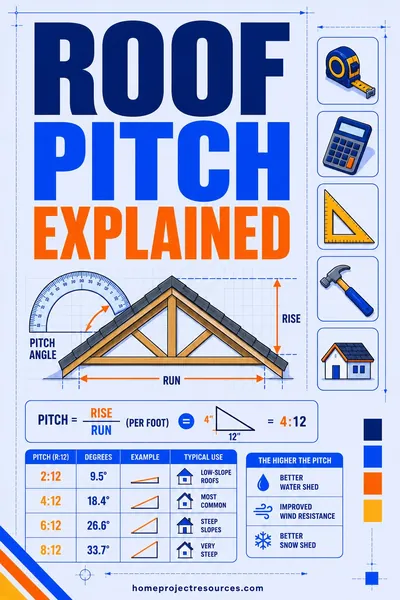
- For gable ends, you're outlining the sloped rake edge. The rake is longer than the wall below it. Multiply the horizontal run by the pitch factor: 1.12 for a 6/12 roof, 1.20 for an 8/12, 1.30 for a 10/12, 1.41 for a 12/12. If you don't know your pitch, roof pitch explained shows how to read it from the ground.
- Add 3 feet per outside corner and 2 feet per inside corner for the strand to wrap without pulling.
- Add the drop to the outlet for each run: the strand has to travel from the roofline down to the plug, and that length is "wasted" but still needed.
Worked example: a 40 by 28 ranch with one gable
Say your house is 40 feet across the front, 28 feet deep, with a front-facing gable over the garage that spans 20 feet of the front, on a 6/12 pitch. You want lights along the front eave, both side eaves, and up and over the gable.
- Front eave (the part not under the gable): 40 minus 20 = 20 feet
- Two side eaves: 28 + 28 = 56 feet
- Gable rakes: horizontal run is 10 feet per side; 10 × 1.12 = 11.2 feet per side, so 22.4 feet up and over
- Corners: 2 outside corners at the front × 3 feet = 6 feet; 2 gable transitions × 2 feet = 4 feet
- Total roofline: 20 + 56 + 22.4 + 10 = 108.4 feet, call it 110 feet
Now the runs. The outlet is at the front left corner near the garage. Run 1 goes from that outlet up 9 feet to the eave, across the 20 feet of front eave, then up and over the 22.4-foot gable: that's 9 + 20 + 22.4 = 51.4 feet, so a 25-foot strand and two 15-foot strands, or two 25-foot strands with a couple feet tucked at the end. Run 2 starts at the back corner on a second outlet and covers one side eave (28 feet). Run 3 does the other side from a third outlet.
If C9 strands come in 25-foot lengths with bulbs every 12 inches, 110 feet means five strands plus the drops. Buy six. If you're using 100-count mini strands, check the length on the box because it varies by brand; most 100-count strands run somewhere between 20 and 35 feet depending on bulb spacing.
Plan where every plug lands
The strand's male plug goes at the outlet. That sounds obvious until you're on the ladder holding the wrong end. Lay each run out on the driveway first, plug the strands together end to end in the order they'll go up, and mark the starting end with a piece of tape. Then carry the whole chain up as one piece.
A few rules that keep the plan honest:
- Every run starts at an outlet or at the end of an extension cord. Nothing else counts as a starting point.
- Read the strand tag for the maximum number of strands you can connect end to end. It's printed right on the tag near the plug. Incandescent strands usually cap out at a small number; LED strands allow many more. Never exceed it, and never assume two brands share the same limit.
- Outdoor outlets should be GFCI-protected. If yours isn't, plug into a portable GFCI adapter at the outlet. Every outdoor lighting circuit should trip on a ground fault before it hurts anyone.
Amps per circuit gets one paragraph here because it decides how many runs one outlet can feed. A 15-amp circuit shouldn't carry more than 12 amps for hours at a stretch, and a 20-amp circuit no more than 16, and all your lights add up across every outlet on that circuit. Incandescent strands eat that budget fast; LEDs barely touch it. The full math, with watts per strand, amps per strand, and how many strands fit on 15 A and 20 A circuits, lives in LED vs incandescent Christmas lights. Read that before you daisy-chain anything, and read electrical safety basics if you're not sure which outlets share a breaker.
Hiding extension cords so the display looks clean
A great light job is ruined by a green cord snaking across a white wall. Route cords the way a pro does:
- Run cords along the bottom of the wall, behind shrubs, and up a corner or a downspout. Zip tie the cord to the downspout every 2 feet. Downspouts are already a vertical line, so the cord disappears into it.
- Use outdoor-rated cords only, and the shortest length that reaches. A 100-foot cord coiled behind a bush is a heat and trip hazard, and the voltage drop over a long, thin cord dims the far end of your run.
- Match the cord gauge to the load. For lights, a 16-gauge outdoor cord handles a typical LED display easily; step up to 14-gauge for long incandescent runs. The amperage rating is on the cord tag.
- Keep every connection off the ground. Wrap the plug junction in a cord connection cover, or hang it on a clip so it can't sit in a puddle.
- Never run a cord through a window or door. Pinched cords are the classic cause of holiday cord fires, and the ESFI holiday safety page lists it as one of their top warnings each year.
- Cover exposed cord runs across a walkway with a low-profile cord cover, and staple nothing. Staples pierce insulation.
Color matters too. Green cords vanish in shrubs and against dark siding. White cords vanish against white trim and snow. Brown cords vanish against brick. Buy the cord color that matches the surface it runs on.
Timers and switches
An outdoor timer at the outlet is the difference between a display that runs itself and one you forget to turn off at 2 a.m. Three types work well:
| Timer type | Best for | Setup |
|---|---|---|
| Mechanical dial timer | One outlet, simple on/off | Push down the pins for on hours. Dead simple, works in the cold. |
| Photocell (dusk to dawn) with countdown | "On at dark, off 6 hours later" | Set the countdown once. No clock to adjust after a power blip. |
| Smart outdoor plug | Multiple zones, phone control | Needs Wi-Fi reach to the outlet. Schedule sunset-based on and a fixed off time. |
Whatever you pick, the timer must be outdoor-rated and plugged into a GFCI outlet, with the strand load under the timer's rating. That rating is on the timer body. A photocell timer set for dusk plus 6 hours covers the evening and shuts everything off before you're asleep, which also keeps the total run hours down, and fewer hours means the lights last longer.
Ladder safety for hanging Christmas lights
Falls are the injury that actually sends people to the emergency room every December. The CPSC holiday decorating safety page tracks them every year, and ladder falls lead the list. The rules aren't complicated, they just have to be followed every single time.
- Use the 4-to-1 rule: for every 4 feet of height to the top support point, the ladder base sits 1 foot out from the wall. A ladder reaching a 12-foot eave sits 3 feet out.
- Extend the ladder at least 3 feet past the roof edge if you're stepping onto the roof. If you're only working from the ladder, the top should rest against the fascia or on a ladder standoff, never on the gutter. Gutters bend and slip.
- Feet on solid, level ground. Frozen mud that melts by noon isn't solid. Put the feet on a wide board if the ground is soft.
- Keep your belt buckle between the rails. If you have to reach past that, climb down and move the ladder. Every single time.
- Three points of contact climbing. That means your hands are empty going up. Wear a tool belt or a bucket on a rope for clips and strands.
- Nobody hangs lights alone. A second person foots the ladder and hands up strands.
- No lights work in wind, rain, or when the roof is icy. It'll still be there tomorrow.
- Power off at the outlet while you're handling strands near the gutter, and never touch a strand and a metal gutter or downspout at the same time if the strand is live.
If your eaves are above what a single extension ladder reaches comfortably, or the roof is steep enough that you'd be working on the pitch, that's the job to hand off. A light-hanging pole with a clip attachment lets you hang gutter clips and shingle tabs from the ground on single-story eaves, and it's the tool most first-timers should start with.
How to hang Christmas lights on a house, start to finish
- Measure the roofline and count runs. Work out the outlets you'll use and confirm they're GFCI.
- Buy strands for the total length plus 10 percent, clips for the bulb type plus 10 percent, outdoor cords in the right color and gauge, cord connection covers, and a timer.
- Test every strand on the ground. Replace dead bulbs now, not on the ladder.
- Assemble each run on the driveway in order. Tape the starting end.
- On a mild, dry, calm day, put clips up first, empty. Do the whole eave, then go back with the strand. Clips first is faster and keeps you from wrestling a live strand while you fumble for a clip.
- Snap the strand into the clips from the outlet end outward, so the plug is always where you left it.
- Route cords along the downspout and wall base, cover the connections, plug into the timer, plug the timer into the GFCI outlet.
- Step back to the street at dusk. Fix sags now.
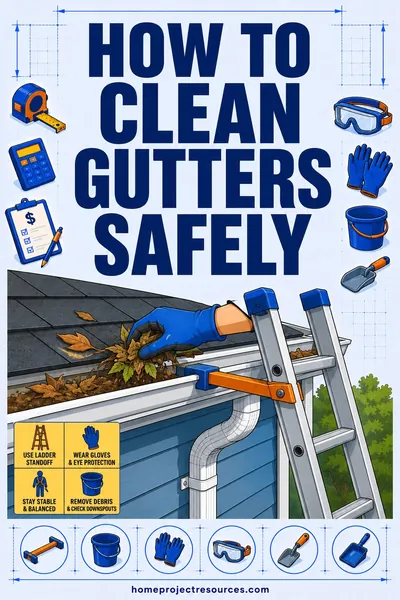
Clean gutters before you start if leaves are packed in; a full gutter won't seat a clip, and you'll be up there anyway. How to clean gutters covers that in ten minutes of reading.
Taking them down without wrecking anything
Unplug at the outlet first. Unclip each strand from the far end back toward the plug, coiling as you go. Leave the clips on if you'll use the same layout next year; gutter clips and shingle tabs live outdoors just fine. Cut zip ties with snips, never pull them through. Store each run coiled around a piece of cardboard with the plug end labeled, and you'll skip the driveway layout next December entirely.
FAQ
What's the best way to hang Christmas lights on gutters with guards?
Use gutter guard clips, which have a thin tab that slips between the guard and the gutter lip. If your guard is a solid hood, skip the gutter and use shingle tabs on the first course of shingles above it. Standard gutter clips won't seat over a guard, and forcing them bends the guard edge.
Can I hang Christmas lights on brick without drilling?
Yes. Mortar clips (brick clips) grip the top and bottom edges of a standard brick with spring tension and hold C7, C9, and mini strands with no drilling or adhesive. For smooth brick or stucco, outdoor-rated adhesive clips work if you apply them above 50°F on a clean, dry surface and let them cure for an hour.
How many strands of Christmas lights can I plug together?
Read the tag near the plug on the strand. It states the maximum number of strands you can connect end to end for that specific product. Incandescent strands usually allow only a few; LED strands often allow dozens. Never exceed the tag, and don't assume two brands share a limit. The circuit-level math is in our LED vs incandescent Christmas lights guide.
Do I need a GFCI outlet for outdoor Christmas lights?
Yes. Outdoor outlets are required to be GFCI-protected in current code, and a GFCI trips in a fraction of a second if a strand shorts to a wet gutter. If your outdoor outlet isn't GFCI, plug a portable GFCI adapter into it and run everything through that.
How far apart should Christmas light clips be?
One clip per bulb for C7 and C9 strands, which is usually every 12 inches. For mini strands, one clip every 12 to 18 inches keeps the line straight. Add a clip at each corner and at each point where the strand changes direction. Spacing wider than that lets the strand sag between clips.
Is it safe to put a ladder against a gutter to hang lights?
No. Gutters bend under a ladder's point load and can slip out from under it. Rest the ladder against the fascia board below the gutter using a ladder standoff, which spreads the load and holds the ladder away from the gutter. Or stay on a light-hanging pole from the ground for single-story eaves.
When should I take Christmas lights down?
Most clips and strands tolerate winter fine, but leaving lights up past late winter shortens their life through UV and freeze-thaw on the cord jackets, and adhesive clips left through spring will bake on. Take them down on a mild, dry day in January, coil each run with the plug labeled, and leave gutter clips and shingle tabs in place if you'll reuse the layout.