Composite vs Wood Decking: How They Age and Wear

Composite decking holds its shape and color far longer than wood but scratches, gets hot in the sun, and cannot be sanded back to new. Wood looks better on day one, moves and splinters as it dries, and needs cleaning and refinishing every year or two, but it can be repaired and refinished indefinitely. The real difference is not which is better, it is which kind of aging you would rather live with: a surface that slowly loses its shine and keeps its geometry, or a surface that keeps its character and demands your weekends.
Both last decades if the framing under them is right. Most decks fail at the joists and the ledger, not at the boards.
Updated September 2026
Working out board rows, joists and footings for your layout? Use our free Deck Calculator to get boards by length, joist count at 12, 16 or 24 inch on center, and footing concrete for the exact deck you are planning.
Composite vs wood decking at a glance
| Factor | Pressure treated wood | Cedar or redwood | Capped composite |
|---|---|---|---|
| Look on day one | Green or brown, wet, sometimes wet-stacked | Warm, natural grain | Uniform, repeating grain pattern |
| Look at year 10 | Gray unless refinished | Silver-gray unless refinished | Slightly faded, still uniform |
| Yearly work | Clean and reseal every 1 to 2 years | Clean and reseal every 1 to 2 years | Wash twice a year |
| Movement | Cups, twists, checks as it dries | Milder movement, still moves | Expands and contracts with heat, not moisture |
| Scratches | Sand them out | Sand them out | Permanent on most caps |
| Mold and mildew | Feeds it if left dirty | More resistant, still not immune | Grows on the surface film, not in the board |
| Heat in sun | Coolest of the three | Cool | Noticeably hotter, especially dark colors |
| Splinters | Yes, increasingly with age | Fewer | None |
| Span limits | 16 in OC standard, 24 in OC for 2x | 16 in OC standard | 16 in OC standard, 12 in OC for stairs and diagonal |
| Repairability | Excellent | Excellent | Board swap only, and color may not match |
| End of life | Refinish or replace boards | Refinish or replace boards | Replace |
Notice how many rows are about time rather than the first year. That is the whole point of the comparison.
How composite ages, honestly
Modern composite decking is a wood flour and plastic core with a hard polymer cap on the top and sides. Uncapped composite from the early years of the product stained badly and grew mold in the wood fibers at the surface. Capped boards fixed most of that, and the cap is what you are really buying.
Years 1 to 3. Almost no visible change beyond a slight lightening. Manufacturers expect some initial fade as the cap's pigments settle. Boards stay flat. Fasteners stay tight if the hidden clip system was installed to spec.
Years 4 to 10. Fading is now measurable but usually even, so it reads as a color you chose rather than damage. Traffic lanes start to look slightly different from the edges. Scratches from patio furniture, dog claws and a dragged grill accumulate, and they do not go away. Some brands allow very light scuffing with a nylon pad on embossed boards, but sanding a capped board is not an option.
Years 10 to 25. The cap is still doing its job on the top surface. The places that fail first are the cut ends, especially uncapped ends on a stair nosing or a board cut short at a picture frame. Water gets into the exposed core, and on a north facing shaded deck, mold takes hold in that cut end. Movement at the fasteners can create small gaps at butt joints.
What actually kills a composite deck: shaded, wet, dirty boards; a grease fire under a grill; hot embers from a fire pit without a mat; deicing salt on some caps; and pressure washing at too high a setting, which erodes the cap and voids most warranties.
Heat is the complaint nobody expects. A dark composite board in full afternoon sun gets hot enough to be uncomfortable on bare feet. Light colors run cooler. If the deck faces south with no shade and children will use it barefoot, that single fact decides the color choice.
How wood ages, honestly
Pressure treated southern yellow pine is the default deck board in most of the country. It arrives wet with preservative, and its first year is mostly about losing that water.
Months 1 to 12. The boards dry and shrink across their width. A 5.5 inch wide board can lose a noticeable fraction of that width, which is why you install treated boards tight or nearly tight and let the gaps open, while composite gets its full gap from day one. Some boards cup, some crown, some twist at the ends. Checking (small surface cracks along the grain) appears and is normal.
Years 2 to 6. With a finish, the deck looks intentional. Without one, it goes silver-gray, which some people want. Ends and edges start to fuzz. Fastener heads back out slightly as boards move, which is the moment to walk the deck with a driver and set them again.
Years 7 to 15. Splinters become a real issue on high traffic boards, especially where the deck stays wet. Boards over a poorly ventilated area rot from the underside first, which you cannot see from above. Stair treads and the boards nearest the house usually go first because they take the most water and the most foot traffic.
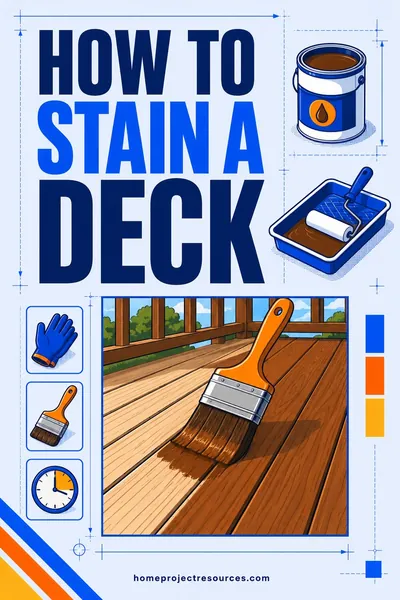
Years 15 and up. The framing becomes the story. Ledger flashing, joist tops and post bases determine whether the deck is repairable or a teardown. A deck with sound framing can take an entirely new set of boards and start over. Refinishing details are in how to stain a deck.
Cedar and redwood age more gracefully than treated pine. They are softer, so they dent more easily, but they move less and resist decay in the heartwood. They still go gray and still need a finish to stay brown.
Worked example: a 16 by 12 deck, both ways
Take a rectangular deck 16 feet along the house and 12 feet out from it. Boards run the 16 foot direction, joists run out from the house, and the standard 1/8 inch gap is used between boards.
With 5/4x6 treated wood (5.5 inches actual width):
- Each row covers 5.5 + 0.125 = 5.625 inches.
- Deck width out from the house is 12 feet = 144 inches.
- Rows needed = 144 / 5.625 = 25.6, rounded up to 26 rows.
- At 16 foot boards, each row is one board, so 26 boards before waste.
With a narrow composite board (5.25 inches actual width):
- Each row covers 5.25 + 0.125 = 5.375 inches.
- Rows needed = 144 / 5.375 = 26.8, rounded up to 27 rows.
- At 16 foot boards, 27 boards before waste.
That one extra row is the part people forget when they price out a switch. A narrower board means more rows, more fasteners, and more clips.
The framing is the same either way at 16 inch on center:
- Joists = (16 ft x 12) / 16 = 12, plus 1 for the last joist = 13 joists, each 12 feet long.
- Joist material = 13 x 12 = 156 linear feet.
- Rim joists front and back = 2 x 16 = 32 linear feet.
- Ledger against the house = 16 linear feet.
- Blocking: at 12 feet of span you get one mid-span row, so 12 bays x 16 inches = 16 linear feet.
Where the framing is not the same: if you run boards diagonally at 45 degrees, every board gets longer by a factor of about 1.41, and most composite manufacturers require 12 inch on center instead of 16. That takes joists from 13 to (16 x 12) / 12 + 1 = 17 joists. Diagonal composite is the single change that adds the most framing to a deck, and it is easy to miss until the lumber is already on site. Our deck calculator recalculates both the board rows and the joist count when you flip the diagonal option, so you can see it before you order.
Fasteners and gaps: where the two systems really differ
| Detail | Wood | Composite |
|---|---|---|
| Fastening | Screws through the face, or hidden clips on grooved boards | Hidden clips in the board groove, or brand approved screws |
| Gap between boards | Install tight if wet treated, roughly 1/8 in if dry | Set by the clip, usually 3/16 in to 1/4 in |
| End to end gap | 1/8 in, more in cold weather | Follow the brand's temperature chart, can be 1/8 in or more |
| Overhang past rim | Up to a few inches, then trimmed | Follow brand limits, often 1 in or less unblocked |
| Stair treads | Same board, 16 in OC or tighter | Usually 12 in OC required under treads |
| Picture frame border | Optional, easy | Needs blocking under every seam |
Two rules cause most composite callbacks. First, the gap is not optional. Composite grows lengthwise with heat, not with moisture, so the end gap matters more than the side gap and it changes with the temperature on installation day. Boards installed tight on a cold morning will push and buckle in July. Second, every seam needs blocking under it. A butt joint floating between joists on a composite deck telegraphs as a soft spot within a season.
Cutting and working the two materials
- Blades. Composite wants a fine tooth blade and a slower feed. A framing blade tears the cap and leaves fuzz. Wood is forgiving with anything sharp. If you are building the saw kit, see types of saws.
- Dust. Composite dust is plastic and static. It clings to everything and does not sweep well. Cut off the deck if you can.
- Heat. Composite cut in high heat can gum the blade. Cut in the morning.
- Screws. Composite needs the fastener the brand specifies. A regular deck screw mushrooms the cap and leaves a permanent ring.
- Ends. Cut ends on premium boards may need a color matched cap or edge treatment, particularly on stairs where the end grain faces up.
- Fasteners in wood. Treated lumber is corrosive to standard steel. Use hot dip galvanized or stainless fasteners and connectors rated for treated wood, or the hardware fails long before the boards do.
Which one fits your situation
Choose composite if:
- The deck sits in full sun in a light color, or in a spot you cannot easily reach with a sander every other year.
- You want no splinters, which matters with young children and bare feet.
- You dislike annual maintenance more than you dislike a manufactured look.
- The deck is large, low to the ground, and unpleasant to refinish.
Choose wood if:
- You want a natural look and are willing to keep it up.
- You expect to modify the deck over time. Wood forgives changes, composite does not always have matching stock years later.
- The deck is in deep shade with heavy leaf fall, where composite ends and shaded caps hold mold.
- You want to be able to sand out damage rather than replace a board.
- The framing is already there and you are just replacing boards, since board replacement on old framing is straightforward in wood.
A hybrid worth considering: composite for the deck surface, wood for the framing under it. Almost every composite deck is built exactly this way, because composite is not a structural material. The joists, beams and posts are treated lumber regardless of what the top surface is. That is also why the answer to "which lasts longer" is usually decided by ledger flashing and post bases, not by the boards. Full framing sequence is in how to build a deck.
The maintenance year, side by side
| Season | Wood deck | Composite deck |
|---|---|---|
| Spring | Sweep, wash, inspect fasteners, check for soft boards, sand splinters | Sweep, wash with soap and water, check clips at seams |
| Early summer | Reseal or restain if water no longer beads | Nothing |
| Summer | Keep leaves and planters off, move furniture pads | Use a mat under grills and fire pits, watch for grease |
| Fall | Clear leaves before they mat down, check ledger flashing | Clear leaves, especially at shaded ends and stair nosings |
| Winter | Avoid salt, shovel with the grain, keep snow off if you can | Avoid deicers not approved by the brand, plastic shovel only |
The one line that captures both columns: wood asks for a full weekend once every year or two, composite asks for two hours twice a year forever. Neither is zero. A deck marketed as maintenance free is really fade resistant and rot resistant, not care free.
Deciding between a deck and something else entirely
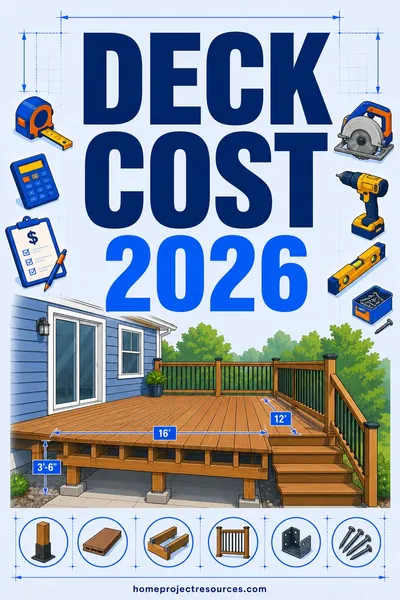
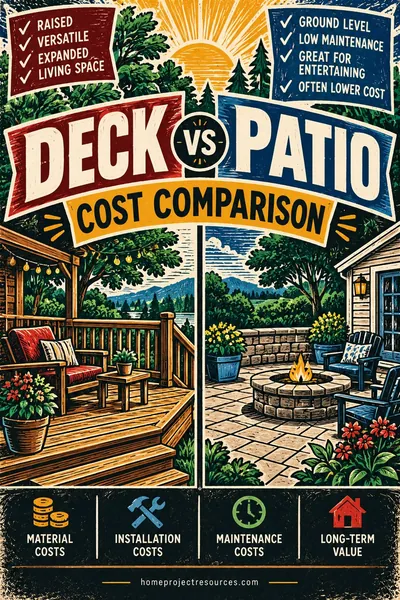
If the surface itself is the thing you are unsure about, the comparison sometimes belongs one level higher. A ground level deck and a paver patio solve similar problems with completely different maintenance profiles and completely different failure modes. That trade-off is covered in deck vs patio cost, and the planning side of scoping a deck build is in deck cost, which walks through the line items that make one bid different from another.
Frequently asked questions
Does composite decking really fade?
Yes, all of it fades, and manufacturers say so in their warranties by specifying a maximum acceptable color change rather than promising none. Capped boards fade far less than uncapped ones, and most of the change happens in the first few years then slows. The fading is usually even across the deck, so it reads as a slightly softer version of the original color rather than as damage.
Is composite decking hotter than wood?
Noticeably, especially in dark colors and full sun. The cap absorbs heat and the board does not breathe the way wood does. Light colors and shade help a lot, and so does orienting the deck so it gets afternoon shade. If barefoot use in July is important, the color choice matters more than the brand.
Can you sand or refinish composite decking?
No, not in the way you refinish wood. Sanding removes the cap, which is the part doing the protecting, and it usually voids the warranty. Light scuffing with a nylon pad is allowed on some embossed boards for scratch blending. A damaged composite board is replaced, not repaired, which is why keeping a few spare boards from the original run is smart.
What joist spacing does composite decking need?
Most brands require 16 inch on center for standard perpendicular installation, 12 inch on center for diagonal boards and under stair treads, and none allow 24 inch on center. Wood 2x decking can span 24 inch on center, and 5/4 boards want 16 inch. Always confirm against the specific brand's installation sheet before you frame, because the spacing is a warranty requirement.
How long does each type of decking actually last?
Treated wood boards commonly give 15 to 25 years with regular cleaning and refinishing, and much less if left dirty and wet. Capped composite commonly gives 25 to 30 years of service on the surface. In both cases the framing sets the ceiling, because a deck with rotted joists or a failed ledger is replaced no matter what the boards look like.
Is composite decking slippery when wet?
Some boards are, particularly smooth surface products and any board with a film of algae on it. Embossed and wire brushed surfaces grip better. Regular washing is the real fix, since the slipperiness usually comes from what is growing on the board rather than the board itself. Shaded, north facing decks need this more often than sunny ones.
Can I put composite boards on an existing wood deck frame?
Sometimes, and only after inspecting the frame. The joists must be sound, straight, and spaced at the composite brand's required on center distance, which is often tighter than the original frame was built to. Adding sister joists or extra blocking to close 24 inch spacing down to 16 inch is common on older decks. Board replacement on a bad frame is money spent twice.
Which one is better for a shaded, wet yard?
Wood is easier to live with in deep shade if you keep up with cleaning, because a mildewed wood board can be washed and sanded back to clean. Composite in shade grows surface mold too and the cut ends are the weak point. Either way, airflow under the deck and keeping leaves off the surface matter more than the material choice.