Home Improvement ROI: What Actually Adds Value

The projects with the best home improvement ROI are almost never the ones people want to do. Garage door replacement, manufactured stone veneer, a new entry door, new siding, and a minor kitchen refresh consistently recoup the highest share of their cost, often 70 to 100 percent or better. Big-ticket interior work sits at the bottom: upscale primary suite additions, major gut kitchens, and bathroom additions commonly return 25 to 55 percent of what they cost.
The pattern behind that list is simple. Curb appeal and condition sell houses. Personal taste does not. A buyer decides how they feel about your home in the first 15 seconds from the driveway, and that is exactly where the cheap projects live.
Updated September 2026
A note on numbers. We do not publish prices. Contractor and supplier pricing varies by region, by season and by the specifics of your house, and anything printed here would be wrong somewhere and out of date everywhere within months. What this page gives you instead is the ranking, the percentage of cost each project gives back, and what to put in a scope so three local quotes are actually comparable.
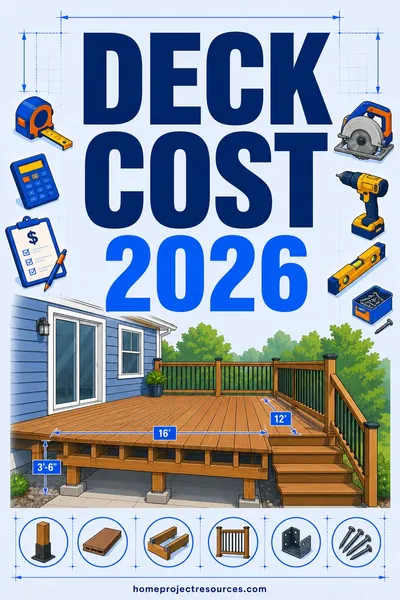
One consistent exception in the upper half of every list is an outdoor living space. If a deck is on your list, size it and pull a materials list first with our free deck calculator so you are taking bids on a defined job instead of a vague one.
What ROI actually means here (and what it does not)
Two numbers get confused constantly, and mixing them up leads to bad decisions.
Cost recouped is the share of your project cost that shows up in resale price. A garage door replacement that adds its own cost back to the sale price recoups 100 percent. You did not make money. You broke even, and you got a nicer door for free.
Profit is rare in home improvement. Almost no renovation returns more than it costs on a normal house in a normal market. Anyone promising that is selling something.
So the honest way to think about this: home improvement ROI tells you how much of your money you get to keep, not how much you make. A 90 percent project costs you 10 cents on the dollar to enjoy. A 30 percent project costs you 70 cents on the dollar. Both can be worth doing. Only one of them is an investment argument.
Three more things the percentage does not capture:
- Days on market. A house that sells in 12 days instead of 60 saved you two mortgage payments, insurance, taxes, and a price cut.
- Deal-killers. A failing roof or a 20 year old furnace does not lower your price by its replacement cost. It scares off financing and produces a bigger repair credit at inspection.
- Enjoyment. You live there. A kitchen you love for eight years is worth real money to you even at a 40 percent return.
Home improvement ROI by project, ranked
The figures below reflect the general pattern that Remodeling magazine's annual Cost vs Value Report has shown for years, expressed as ranges because the actual numbers move every year and vary hugely by region. Treat them as tiers, not as promises. The projects are ordered cheapest to priciest as well as best to worst, which is the whole point.
| Project | Typical cost tier | Typical cost recouped | Why it lands there |
|---|---|---|---|
| Garage door replacement | Among the cheapest jobs here | 90 to 190 percent | Huge visual share of the front elevation for very little money |
| Manufactured stone veneer | Modest, because the area is small | 90 to 155 percent | Transforms a plain facade, small square footage |
| Entry door replacement (steel) | The cheapest item on this list | 75 to 190 percent | Cheap, and every buyer touches it |
| Minor kitchen remodel (midrange) | Mid tier, and a fraction of a gut job | 70 to 96 percent | Cabinet fronts, counters, appliances, not layout |
| New siding (fiber cement) | Mid tier, scales with wall area | 60 to 90 percent | Reads as maintenance-free to buyers |
| Wood deck addition | Mid tier, scales with height off grade | 50 to 85 percent | Adds usable square footage cheaply |
| Vinyl window replacement | Mid tier, scales with opening count | 60 to 75 percent | Efficiency plus appearance, but a big check |
| Roof replacement (asphalt) | Wide, driven by pitch and layers | 55 to 70 percent | Rarely adds price, frequently prevents a discount |
| Bathroom remodel (midrange) | Mid tier, jumps if plumbing moves | 50 to 70 percent | Buyers notice dated baths immediately |
| Basement finishing | Wide, driven by egress and moisture work | 50 to 70 percent | Depends entirely on ceiling height and daylight |
| Major kitchen remodel (upscale) | Several times a minor remodel | 30 to 55 percent | Personal taste, and the price ceiling of the block |
| Primary suite addition (upscale) | The most expensive line here by far | 22 to 45 percent | The worst return in almost every study, every year |
Two patterns run through the whole table.
Cheap and visible beats expensive and hidden. A new entry door outperforms an upscale suite addition by a factor of four or five on percentage recouped, and it is the smallest check on the list.
Midrange beats upscale in the same category. A midrange kitchen remodel returns far more than an upscale one, because everything you spend above midrange buys finishes that the next buyer would have chosen differently.
The five best-value projects, in detail
1. Garage door replacement
On many suburban homes the garage door is 25 to 35 percent of the visible front of the house. Replacing a dented, sun-faded, three-panel door with an insulated carriage-style unit changes the entire first impression for less than most people expect, which is exactly why it tops the rankings.
Insulated steel doors also cut noise and help an attached garage stay usable. Installation is a one day job for a crew. Torsion springs store enough energy to injure someone badly, so this is not a DIY item. If yours is merely broken rather than ugly, our garage door repair guide covers what is worth fixing first.
What moves the number on a quote: door size (single or double), insulation value, whether the panels are steel or a composite, window inserts, and whether the opener and tracks are being replaced with it.
2. Entry door replacement
A 20 gauge steel door in a new frame with fresh hardware is the cheapest item in this whole guide and it shows up in every listing photo. Fiberglass runs a bit more and holds paint better in strong sun.
The trick is the whole opening: door, jamb, threshold, weatherstripping, and hardware together. Hanging a new slab in an old racked frame looks like exactly what it is. Sealing the opening properly also removes one of the biggest air leaks in most houses, and our how to weatherstrip a door guide covers the cheap version if replacement is not in the budget.
What moves the number on a quote: slab material, whether sidelights or a transom are involved, whether the framing is rotted, and the hardware and lockset grade.
3. Minor kitchen remodel
"Minor" is the operative word, and it is why this project outperforms its big brother by 30 to 50 points.
A minor remodel keeps the layout and the cabinet boxes. You replace doors and drawer fronts, add new counters and a sink, swap appliances for matching midrange units, update the backsplash, hardware, and lighting, and repaint. Nothing moves. No plumbing relocates. No walls come out.
Cabinet refacing alone is a small fraction of a full remodel and delivers most of the visual change, which our cabinet refacing cost breakdown covers in detail. Compare that against the full picture in our kitchen remodel cost guide before you commit to moving a single wall.
What moves the number on a quote: counter material, whether the sink and plumbing stay put, appliance tier, and whether any cabinet boxes are replaced rather than refaced.
4. Siding replacement
Fiber cement and quality vinyl both read to buyers as "I will not have to deal with this." That perception is worth real money at the negotiating table, and rotted or chalked siding is one of the fastest ways to lose an offer.
Cost tracks the wall area, not the floor area, so a two story house with a simple footprint is cheaper per square foot than a sprawling ranch. Our siding cost guide walks through material tiers and where the labor goes.
What moves the number on a quote: total wall area, the number of corners and gables, house height and staging, whether sheathing or house wrap has to be replaced, and how much rotted trim is found once the old siding comes off.
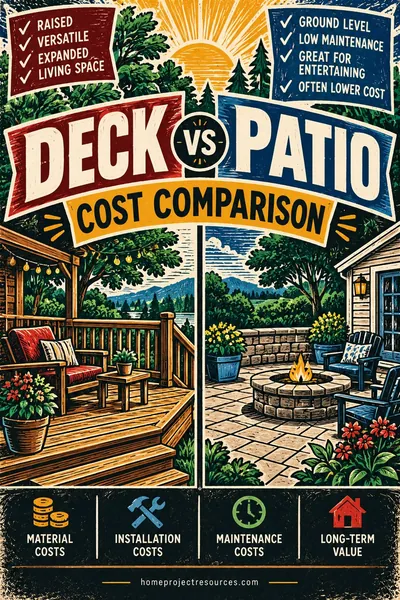
5. Deck or patio addition
Outdoor living space adds usable area at roughly one third the cost per square foot of conditioned interior space. That math is why decks have stayed near the top of value rankings through every market cycle.
Composite decking costs more upfront and returns slightly less on paper, but it removes annual staining from the buyer's mental math. Pressure-treated lumber is the value play. Compare both in our deck cost breakdown, and run your dimensions through the deck calculator to get board counts and footing quantities before you take bids.
Decks over 30 inches above grade almost always need a permit and an inspection, and the ledger connection to the house is the single most common failure point. Unpermitted deck work reliably becomes a problem at closing.
What moves the number on a quote: square footage, height off the ground, footing depth and soil, whether stairs and railings are involved, decking material, and site access for materials.
Worked example: one budget, three ways to spend it
Here is the same renovation budget split three ways, with realistic recouped ranges. Everything below is expressed as a share of that budget, so it scales to whatever number you are actually working with. This is the comparison that changes people's plans.
| Plan A: one big room | Share of the budget | Recouped |
|---|---|---|
| Upscale primary bath remodel | All of it | 40 to 60 percent |
| Total added at resale | 100 percent | 40 to 60 percent |
| Plan B: curb appeal package | Share of the budget | Recouped |
|---|---|---|
| Insulated carriage garage door | About 14 percent | 90 to 165 percent |
| Steel entry door and hardware | About 8 percent | 75 to 165 percent |
| Exterior paint, full house | About 25 percent | 60 to 95 percent |
| Stone veneer on the front elevation | About 30 percent | 90 to 145 percent |
| Landscaping, walkway, lighting | About 23 percent | 58 to 100 percent |
| Total | 100 percent | 74 to 127 percent |
| Plan C: condition and function | Share of the budget | Recouped |
|---|---|---|
| Roof replacement, 1,800 sq ft | About 47 percent | 57 to 71 percent |
| Attic insulation to R-49 | About 9 percent | 64 to 100 percent, plus lower bills every year |
| Minor kitchen refresh, refacing and counters | About 44 percent | 68 to 95 percent |
| Total | 100 percent | 63 to 84 percent, plus lower bills |
Plan B wins on paper by a wide margin. Plan C wins if the roof is at end of life, because a failing roof is not a value question, it is a sale-blocking question. Plan A wins only if you are staying eight more years and you will use that bathroom every day.
That last point is the real lesson. Choose Plan A on purpose, for your own life, not because someone told you bathrooms add value.
The projects that quietly lose money
None of these are bad projects. They are just bad investment arguments, and it helps to know that going in.
- Swimming pool. Recoups roughly 20 to 40 percent in most markets, and can shrink your buyer pool in cold climates. In Phoenix or Orlando it approaches normal. In Minneapolis it is a liability line item. The ongoing maintenance, insurance and utility load is a second cost that never shows up in the recouped percentage.
- Upscale primary suite addition. The most expensive project most homeowners ever consider and the worst percentage in nearly every annual study. You are building new square footage at premium cost.
- Sunroom addition. Often unconditioned, often not counted in appraised square footage, which is why an expensive room can appraise as almost nothing.
- Highly personal finishes. Bold tile, a wine cellar, a home theater with fixed seating, a converted garage. Each one narrows the buyer pool.
- Solar. Real energy savings, real payback over 8 to 15 years, but resale credit varies enormously and a leased system can complicate a sale outright.
- Anything that over-improves the block. This is the big one.
The neighborhood sets a price ceiling. If your home would already appraise near the top of what comparable houses on your street sell for, a lavish kitchen does not lift it above that ceiling. Appraisers work from comparable sales, and there are no comparable sales above the ceiling. As a rough guide, keep any single project under 10 to 15 percent of your home's value, and keep the whole house within about 20 percent of the top sale on the street.
Regional variation is larger than most people expect
National averages hide a lot. The same project can recoup 130 percent in one metro and 55 percent in another, driven by four things.
Labor cost. Coastal metros run 30 to 60 percent above rural and Midwest labor rates. That inflates the cost side without moving the value side much.
Climate expectations. A deck is standard equipment in the Pacific Northwest and Northeast. A pool is standard in Arizona and Florida. Buyers pay for what their region expects and discount what it does not.
Housing stock age. In a neighborhood of 1950s homes, an updated kitchen is a genuine differentiator. In a 2018 subdivision it is table stakes and buys you nothing.
Market temperature. In a fast market, buyers overlook dated finishes and condition problems get bid past. In a slow market, condition is everything and the value of updates rises sharply.
The practical move: look at what actually sold near you in the last six months. If every closed listing has quartz counters and yours has laminate, that is your project. If half of them have original tile and still sold fast, put your money somewhere else.
Repairs, maintenance, and the invisible ROI
Deferred maintenance is the highest-return category nobody puts on a list, because it does not add value. It stops value from leaving.
| Item | What drives the number | What it prevents |
|---|---|---|
| Roof replacement at end of life | Pitch, layers to tear off, number of penetrations, material tier | Financing problems, and an inspection credit that usually exceeds the roof itself |
| Water heater at 12 plus years | Tank versus tankless, fuel type, whether venting or gas line changes | A flooded finished basement and a mold remediation bill |
| Foundation and drainage correction | Access, depth, whether piers or only grading and gutters are needed | The single scariest line on any inspection report |
| Electrical panel update | Amperage, whether the service drop and meter change, panel location | Insurance refusals on old fuse and certain panel types |
| Attic insulation to code R-value | Square footage, existing depth, air sealing needed first, access | Ongoing energy loss, ice dams, comfort complaints |
| HVAC replacement at 18 plus years | Tonnage, efficiency tier, ductwork condition, refrigerant line changes | A price concession that exceeds the equipment cost |
Attic insulation deserves a special mention. It is one of the few upgrades where the energy savings alone pay it back in 3 to 8 years, and it is genuinely DIY-friendly. Our how to insulate an attic guide covers R-values by climate zone and the air-sealing that has to happen first. The US Department of Energy publishes zone-by-zone R-value recommendations at energy.gov, which is the right primary source for your region.
One more thing that costs nothing and protects everything: pull the permits. Unpermitted additions, finished basements, and electrical work show up in title searches and appraisals. The fix at closing is expensive and slow, and some lenders simply will not finance the square footage. Permit fees scale with the scope of the job and are trivial next to the cost of unwinding unpermitted work later, and structural, electrical, gas, and main-line plumbing work belongs with a licensed contractor.
DIY changes the math completely
Labor is 40 to 65 percent of most renovation costs, and on the finish trades it is higher than that. Removing it changes the ROI calculation more than any product choice you can make.
| Project | How much of a pro price is labor | DIY difficulty | ROI shift |
|---|---|---|---|
| Interior painting, whole house | Nearly all of it | Beginner, slow, mostly prep | Enormous |
| Cabinet painting | Nearly all of it | Beginner, fussy prep, unforgiving finish | Enormous |
| Landscaping and mulching | Most of it | Beginner, heavy, one weekend | Large |
| Click-lock flooring install | About half | Beginner to intermediate, subfloor is the risk | Large |
| Backsplash tile | Most of it | Intermediate, cuts and outlets are the hard part | Moderate |
| Deck build | About half | Intermediate to advanced | Large, but permits and structure apply |
| Electrical panel, gas lines, main plumbing | Varies | Do not | None. Hire it out |
Painting is the highest-return work in the entire house, DIY or not. A neutral, current color on clean walls does more per dollar than any other single change. Our DIY home improvement guide has the honest list of what a beginner can take on and where the line sits.
Flooring is the other big lever. A continuous, current floor across the main level reads as a renovated house even when nothing else changed. Our hardwood vs engineered wood comparison covers which one belongs in your subfloor conditions.
How to get a number you can trust
Since no published range will match your street, build your own. The method takes about a week and it beats any national average.
- Collect three written bids, not two. Two bids give you no way to tell which one is the outlier. Three almost always cluster, and the odd one out tells you something.
- Give every bidder the same written scope. Same materials, same brand and model where it matters, same square footage, same demolition and disposal responsibility. Bids on different scopes are not comparable, and that is the single most common reason homeowners pick wrong.
- Ask what is excluded. A lowball bid usually leaves out permits, disposal, surface prep, unforeseen rot, and the final coat. Ask each contractor to list exclusions in writing.
- Ask how change orders are priced before anything is signed, because the discovery items are where the surprises live.
- Get the value side locally. Ask an agent for a comparative market analysis on your street, before and after the project. That number, not a national report, is what determines your actual return.
- Check the ceiling. Look at the highest closed sale on your block in the last year. If your finished house would exceed it, the last part of your budget is not coming back.
Frequently asked questions
Which home improvement has the highest ROI?
Garage door replacement has topped or nearly topped the rankings in most recent years, frequently recouping 90 to 190 percent depending on the market. Entry door replacement and manufactured stone veneer sit right behind it. All three share the same traits: low cost, high visual impact, and they are the first things a buyer sees.
Does a kitchen remodel pay for itself?
A minor midrange remodel comes close, commonly recouping 70 to 96 percent. A major upscale remodel does not, typically returning 30 to 55 percent. The gap is layout: keeping cabinet boxes and the existing plumbing locations is what preserves the return.
How much value does a finished basement add?
Roughly 50 to 70 percent of the finishing cost, and it depends almost entirely on ceiling height, egress windows, and dryness. Below-grade square footage is usually appraised at a discount to above-grade space, and a basement with moisture history can subtract value. Fix water problems before you finish anything.
Do new windows increase home value?
They recoup roughly 60 to 75 percent, so no, they rarely pay for themselves at resale. They do reduce energy bills, remove a common inspection complaint, and matter more in older homes with single-pane or failed seals. Our cost to replace windows guide covers when partial replacement makes more sense.
Is a new roof worth it before selling?
If the roof is at end of life, yes, though not because it adds price. It typically recoups 55 to 70 percent, but a visibly failing roof triggers appraisal conditions, insurance problems, and inspection credits that usually cost more than the roof did. Our roof replacement cost breakdown covers material and pitch factors.
What renovations should I avoid before selling?
Anything highly personal, anything that removes a bedroom, and anything that pushes your home well above the top sale on your street. Converting a garage, installing a pool in a cold climate, and gut-remodeling to your own taste weeks before listing are the classic money-losers.
How do I calculate ROI on my own project?
Take the added resale value, subtract the total project cost, and divide by the total project cost. Get the added value from a local agent's comparative market analysis, not from a national average, because the neighborhood ceiling matters more than the project.
Should I renovate or just price the house lower?
Run both numbers. Buyers discount a dated kitchen by far more than it costs to refresh it, so cosmetic work is usually worth doing. Structural, roofing, or system replacements are often better handled as a credit at closing, since buyers rarely pay full replacement value for work they did not choose.
The short version
Spend on the outside first: door, garage door, paint, siding, landscaping. Keep interior remodels midrange and keep the layout. Fix the roof, the water heater, and the panel before they become negotiating chips. Stay under the neighborhood ceiling.
Then spend the rest on the things you actually want, with clear eyes about the return. A deck you use every weekend for a decade is a good decision at 60 percent recouped. Size yours with the deck calculator and compare it honestly against the bathroom remodel cost you were also considering.