Cost to Build a Fence

Fencing is priced per linear foot, and that per foot number is set by four things: the material, the height, what is under your yard, and how straight and level the run is. Chain link sits at the bottom of the ladder, pressure treated privacy fence above it, then cedar, then vinyl, then ornamental aluminum, with composite at the top. Gates are priced separately, each one, because every gate is a small standalone project.
Labor is roughly half of a fence bill, which is why doing it yourself removes about half the cost, and why anything that slows the crew down (rock, slope, poor access) moves the total more than the material choice does.
Updated August 2026
A note on numbers. We do not publish prices. Lumber, vinyl, and labor pricing move by region, by season, and by how deep the local frost line is, and any figure printed here would be wrong somewhere and stale everywhere within months. What this page gives you instead is what a fence bid is made of, which variables move it, and how to get quotes that can be compared to each other.
Get your post, rail, picket, and concrete bag counts in one shot with our free fence calculator. Fence material lists are easy to get wrong by 20 percent, and at 150 feet that is a lot of pickets.
Cost to build a fence by material
Wood, vinyl, and composite are normally bought and quoted at a 6 ft privacy height. Chain link is normally 4 ft and aluminum 4 to 5 ft ornamental, so compare each material at the height people actually buy it.
| Material | Where it sits on the ladder | Realistic lifespan | Maintenance | What you are actually buying |
|---|---|---|---|---|
| Chain link, 4 ft galvanized | The cheapest fence that contains a dog | 20 to 30 years | Essentially none | Containment and a property boundary, with no privacy and no visual appeal |
| Pressure treated wood, 6 ft privacy | The privacy baseline everything else is compared to | 15 to 20 years | Stain or seal every 2 to 3 years | The cheapest full privacy, with a recurring weekend attached to it |
| Cedar, 6 ft privacy | Modestly above pressure treated | 20 to 30 years | Seal every 3 to 4 years, or let it gray | Better stability, straighter boards, fewer gaps opening in year two |
| Vinyl, 6 ft privacy | Roughly double pressure treated | 30 years plus | Wash it occasionally | No refinishing, ever. Rigid panels that do not cup |
| Aluminum, 4 to 5 ft ornamental | Similar to vinyl, sometimes above it | 40 years plus | None, the powder coat holds up | Sight lines, code compliant pool fencing, and almost no upkeep |
| Composite, 6 ft privacy | The most expensive on this list | 25 to 30 years | None beyond washing | The look of wood with none of the staining, at the top of the ladder |
Two notes that change how you read that table.
Lifespan is the real price. Divide the installed cost by the years of service and the ladder flattens dramatically. A pressure treated fence and a vinyl fence often land within a hair of each other on a cost per year basis, because the vinyl lasts roughly as much longer as it costs more. The difference between them is not really money. It is whether you want to spend a weekend staining every few years.
Wood is the only material where quality varies wildly at the same price. Pressure treated pickets from two different yards can differ hugely in moisture content and straightness. Wet, freshly treated lumber shrinks, cups, and opens gaps in a privacy fence within a season. Buy from a yard that stacks and stickers its stock, and let the material sit at your house for a week before you build.
Height is a multiplier, not an add on
Going taller raises every part of the cost at once: longer posts, deeper holes, more concrete, an extra rail, and more picket square footage.
| Height | Multiplier vs a 6 ft privacy baseline | What changes |
|---|---|---|
| 3 to 4 ft picket | 0.55x to 0.70x | 6 ft posts, 2 rails, short pickets |
| 5 ft | 0.85x | 8 ft posts, 2 or 3 rails |
| 6 ft privacy | 1.0x baseline | 8 ft posts, 3 rails, standard everything |
| 8 ft privacy | 1.4x to 1.6x | 10 or 12 ft posts, 4 rails, deeper holes, often 6x6 posts |
An 8 ft fence is not 33 percent more than a 6 ft fence. It is 40 to 60 percent more, and many jurisdictions cap residential fence height at 6 ft in back yards and 4 ft in front yards anyway. Check before you design around a tall fence.
Gates are priced each, and they are not small
Every gate is a small standalone project. It needs two oversized posts set deeper and in more concrete, a frame that will not sag, and hardware.
| Gate type | Where it sits | Why |
|---|---|---|
| Single walk gate, 3 to 4 ft, matching the fence | The cheapest gate, and still a real line item | Two upsized posts, a braced frame, hinges and a latch |
| Heavy or tall single gate with a frame kit | Above a standard walk gate | The kit and the heavier hardware needed to stop the sag |
| Double drive gate, 10 to 12 ft | Several times a walk gate | Two leaves, drop rod, much larger posts, and precise alignment |
| Vinyl or aluminum manufactured gate | Above a matching walk gate | Bought as an assembly, priced as an assembly |
| Automated gate with opener, sensors, and power | The most expensive item in the entire project | An electrician, a trench, safety sensors, and a controller |
Gate posts are where DIY fences fail. A gate hangs its whole weight off one post, all day, forever, and it swings, which adds a repeated shock load. Gate posts should be one size up (6x6 where the fence uses 4x4), set deeper, and set in noticeably more concrete than a line post. Skimping here shows up as a gate that scrapes the ground within a year.
Plan for at least one gate per fenced area, and two if the yard is large enough that you will ever need to get a mower, a wheelbarrow, or a delivery through it. A second walk gate is the cheapest thing on the bid and it saves years of carrying things around the house.
What makes a fence quote go up
This is the part homeowners need, because two bids on the same 150 feet can be thousands apart and both be honest.
Terrain and slope. A flat, straight run is the cheapest fence there is. Slopes have to be either stepped (each panel level, stair stepping down, leaving triangular gaps at the bottom) or racked (the panel follows the grade, which only some products allow). Both add labor, and stepping adds post height. Figure 10 to 25 percent more on a sloped run.
Rocky or hard soil. This is the biggest wildcard in fencing. A post hole auger that hits rock at 18 inches turns a ten minute hole into an hour with a rock bar and a breaker. Contractors either quote it high to protect themselves or write in a rock clause billed by the hour. Clay that turns to concrete in August has the same effect. If your neighbors fought rock, tell every bidder up front, because a rock clause you knew about is much cheaper than one you discover on day two.
Tree removal and root cutting. Roots in the fence line are slow work, and a tree that has to come out is a separate line item that can rival a section of fence. Stumps that stay put force post repositioning, which throws off the whole spacing plan.
Length of run and number of corners. Corners and ends need bracing and are slower than line posts. A yard with eight corners costs more than one with four for the same total footage.
Access. If the truck cannot get to the back yard, every post, bag of concrete, and bundle of pickets is carried by hand. Fifty bags of concrete is 4,000 pounds of carrying, and crews price that honestly.
Demolition of an old fence. Pulling posts set in concrete is genuinely hard work, and it is quoted per linear foot on top of the new fence. It costs more if the old concrete has to go to a dump rather than get buried on site.
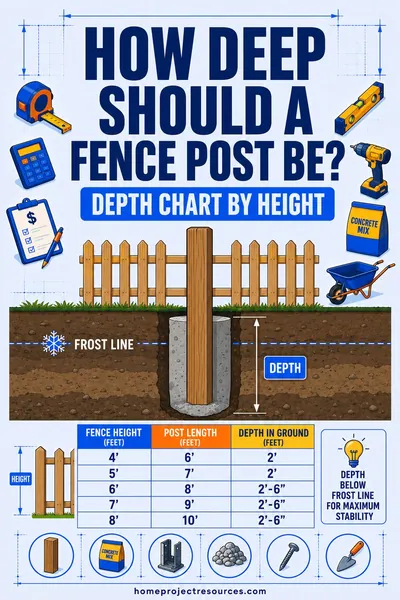
Frost depth. Cold climates require posts below the frost line, which can mean 42 or 48 inch holes instead of 30. That is more digging and roughly double the concrete per post. Fence post depth has the full depth by climate breakdown.
Metro labor rates. Fence crews bill more in high cost of living metros and less in rural areas, and labor is about half the total, so the same fence genuinely costs different amounts in different zip codes.
Permits, setbacks, HOA, and the 811 call
None of these are large line items. All of them can cost you the fence.
Permits. Most municipalities require a permit for a fence over 6 ft, and many require one for any fence. Some jurisdictions want a plot plan showing exactly where the fence sits. The fee is minor against the project.
Setbacks. Local code usually dictates how close to the property line, sidewalk, and street a fence can be, and it often caps front yard height at 3 or 4 ft for sight lines at driveways and corners. A fence built past a setback gets a removal order, not a fine.
Property lines. Do not build to a fence line you inherited or to where you think the line is. A survey is the cheapest insurance in this entire project, and it is a rounding error against the cost of moving a finished fence. Building 8 inches onto a neighbor's land is a legal problem that outlives the fence.
HOA approval. If you have an HOA, submit before you buy anything. Many restrict material, color, height, and which side the finished face has to point. Approval commonly takes 30 to 60 days, which makes it the longest lead time in the whole project.
Call 811. It is free, it is legally required in most states before you dig, and locators typically need 2 to 3 business days. That makes it schedule critical rather than cost critical: it costs nothing, and starting the call on a Saturday morning means you are not digging that weekend. File online at 811.com or dial 811, then wait for the paint and flags. Hitting a buried gas or fiber line is an enormous mistake and, with gas, a dangerous one.
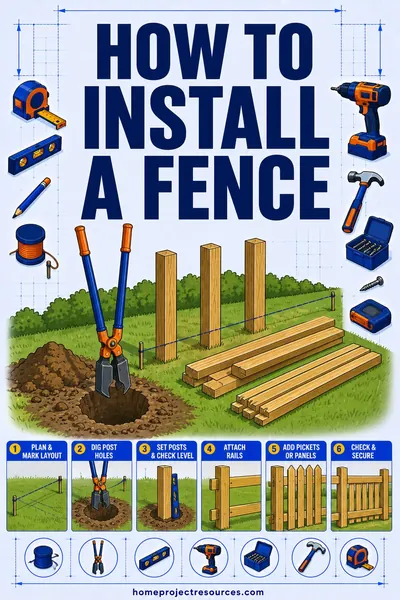
The full sequence, including string lines and post setting, is in how to install a fence.
DIY vs hired: where the saving is and where the difficulty is
The labor saving on a fence is one of the best in home improvement. DIY typically removes 40 to 50 percent of the cost, because labor is roughly half the project and fence materials have no professional only pricing advantage.
What is genuinely easy:
- Setting a string line and marking post positions
- Attaching rails and pickets, which is repetitive and forgiving
- Staining or sealing afterward
What is genuinely hard:
- Digging the holes. This is the whole job. Twenty holes at 30 to 42 inches deep is a real physical day even with a powered auger, and it is brutal by hand in clay or rock. Rent a two person auger for the day, or a towable hydraulic auger if the soil is bad, and get a helper.
- Setting posts plumb and in line. Every post has to be plumb in two directions and dead on the string, and it has to stay there while the concrete sets. Brace every post. Concrete that sets around a post leaning half a degree is permanent.
- Gate posts. Oversized, deeper, more concrete, and the one place a mistake is visible daily.
- Sloped runs. Stepping a fence down a grade takes planning before the first hole.
Post depth is the piece most first timers get wrong, and it is what determines whether the fence is standing straight in year eight. Fence post depth covers the one third rule, frost line depths, and the gravel in the bottom detail that keeps wood posts from rotting at the concrete line.
Worked example: 150 linear feet with one gate
The project: 150 ft of 6 ft pressure treated privacy fence along the back and one side of a suburban yard. Three corners, one 4 ft walk gate. Level ground, normal soil, 30 inch post depth with no deep frost line. Posts at 8 ft on center.
Layout math
- 150 ft at 8 ft spacing = 18.75, so 19 sections and 20 posts
- Of those 20, 2 are gate posts (6x6) and 18 are line posts (4x4)
- Rails: 3 per section x 19 sections = 57 rails, 2x4x8
- Pickets: 5.5 in wide dog ear. 150 ft x 12 in = 1,800 in / 5.5 = 327.3, so 330 pickets with a few spare
Concrete math
Using the standard hole sizes:
- Line posts: 12 in diameter x 30 in of concrete = 1.75 cu ft each = 3 bags of 80 lb each
- Gate posts: 16 in diameter x 36 in of concrete = 3.56 cu ft each = 6 bags of 80 lb each
An 80 lb bag yields about 0.60 cubic feet, so:
- 18 line posts x 3 bags = 54 bags
- 2 gate posts x 6 bags = 12 bags
- Total: 66 bags of 80 lb mix
Sanity check on whether to use bags at all: 45 bags of 80 lb equals 1 cubic yard, so 66 bags is about 1.47 cubic yards. Bags stop making sense past roughly 40 to 50 holes or about 2 cubic yards, and this job is 20 holes and 1.5 yards. Bags are the right call, but only just. Run the numbers through the concrete calculator and read concrete cost per yard for how ready mix is ordered if your run is longer than this one.
Also budget 4 to 6 inches of crushed gravel in the bottom of each hole so water drains away from the post base. That is about one bag of stone per two holes, and it subtracts roughly half a bag of concrete per hole.
The complete DIY takeoff
This is the shopping list. Price it at your own yard on the day you buy, because that is the only price that is real.
| Item | Quantity | Notes |
|---|---|---|
| 4x4x8 PT line posts | 18 | Buy a couple spare. Reject anything with a twist or a large edge knot |
| 6x6x8 PT gate posts | 2 | Do not substitute 4x4 here |
| 2x4x8 PT rails | 57 | Crown up, and stagger the joints across posts |
| 6 ft dog ear pickets | 330 | Order about 3 percent extra for culls |
| 80 lb concrete mix | 66 bags | Fast setting mix if you are bracing posts alone |
| 3/4 in crushed stone | 12 bags | 4 to 6 inches under every post |
| Exterior screws and fasteners | 1 job lot | Hot dipped galvanized or stainless. Electroplated screws will bleed rust down the pickets |
| Gate hardware kit and gate frame lumber | 1 | Buy the anti sag kit with the gate, not after it sags |
| Two person auger rental | 1 day | Book it, and book the helper too |
Time for two people with a rented auger: 30 to 40 hours, realistically three weekends. Day one is 811 flags, string lines, and all 20 holes. Day two is setting and bracing posts. Then you wait: concrete needs 7 days for load bearing use and 28 days for full design strength, though rails and pickets can go on after 24 to 48 hours because they add almost no load.
What the hired bid should contain, same scope
| Line | What to require in writing |
|---|---|
| 150 ft of 6 ft PT privacy fence | Post size, post spacing, rail count per section, picket type, and hole depth |
| One 4 ft walk gate | Post size, frame type, hardware brand, and the anti sag detail |
| Post setting | Concrete or gravel set, hole diameter and depth, and gravel under the post |
| Permit | Who pulls it, and whether the fee is included or billed through |
| Old fence removal | Included or excluded, and whether old concrete leaves the site |
| Rock clause | The hourly rate if rock is hit, and at what depth it triggers |
| Cleanup and grade repair | Auger spoil hauled off or spread, and ruts repaired |
What that means: three weekends and a shopping list on one side, two to three days and a bill that is about half labor on the other. DIY reliably removes 40 to 50 percent of the total. The honest caveat: that saving assumes normal soil. If you hit rock at 20 inches, the hired crew has a breaker and you have a rock bar and a bad Saturday. That risk is the real reason people hire fences out.
Cost to fence a yard by yard size
Perimeter, not area, is what you pay for, and a lot of people are surprised by how much fence a small yard needs.
| Yard size | Approximate perimeter to fence | What tends to drive the number here |
|---|---|---|
| 1/8 acre back yard | 120 ft | Access. Small lots often mean a narrow side yard and everything carried by hand |
| 1/4 acre, back only | 165 ft | The best value option on most suburban lots. One gate, few corners |
| 1/4 acre, full perimeter | 320 ft | Front yard height caps and corner sight lines add design constraints |
| 1/2 acre, full perimeter | 480 ft | Slope and drainage swales start to matter across a run this long |
| 1 acre, full perimeter | 660 ft | Grade changes, trees in the line, and whether the crew can drive the perimeter |
Doubling the lot size does not double the fence. Perimeter grows with the square root of area, so a 1 acre lot needs only about twice the fence of a 1/4 acre lot despite being four times the land. That is why fencing large properties is proportionally cheaper per acre, and why fencing just the back yard is usually the best value move.
How to get a real fence quote
- Walk and measure the line first. Total footage, number of corners, number of gates and their widths, and the worst slope on the run. Every bidder should price the same footage.
- Confirm the property line before you bid it. Pins, a plat, or a survey. Moving a finished fence costs more than the survey by a wide margin.
- Collect three bids on an identical written scope, including height, post size, post spacing, rail count, picket type, hole depth, and set method.
- Ask the rock question explicitly. What happens if you hit rock, at what rate, and does the price change or does the schedule change.
- Ask what happens to the old fence and the auger spoil. Both are real labor, and both are commonly excluded quietly.
- Ask who pulls the permit and who handles the HOA submission. Then start the HOA submission immediately, because it is the longest lead time you have.
- Tie payments to milestones: posts set and cured, fence complete, gate hung and adjusted, site cleaned. Hold the last portion until you have swung every gate yourself.
A bid that comes in far under the others is usually a different fence: shallower holes, wider post spacing, two rails instead of three, gravel set instead of concrete, or a thinner picket. Ask for those five specifications in writing and the low bid either matches or explains itself.
Related calculators and guides
- Fence calculator: posts, rails, pickets, and concrete bags for your run
- Concrete calculator: cylinder math for any hole size and post count
- How to install a fence: 811, string lines, and the full build sequence
- Fence post depth: the one third rule, frost lines, and gravel drainage
- Concrete cost per yard: when bags stop making sense and a truck starts
- Deck cost: the same footing logic where getting it wrong costs more
Frequently asked questions
What should a bid for a 150 ft fence spell out?
Height, post size and spacing, hole depth and diameter, whether posts are set in concrete or gravel, rail count per section, picket type and thickness, gate size and hardware, permit responsibility, old fence removal, rock clause, and cleanup. With those eleven items written down, three bids become comparable. Without them, the lowest number is usually the smallest job.
What is the cheapest fence to build?
Galvanized chain link, by a clear margin, in both material and labor. For a fence that actually gives privacy, pressure treated wood is the cheapest option. Split rail and welded wire farm fencing go lower still per foot but do not provide privacy and will not contain a small dog.
How many concrete bags do I need per fence post?
A 12 in diameter by 30 in deep hole for a 4x4 line post takes about 1.75 cubic feet, which is 3 bags of 80 lb mix at 0.60 cubic feet per bag. A 16 in by 36 in gate post hole takes about 3.56 cubic feet, or 6 bags. Adding 4 to 6 in of gravel in the bottom subtracts roughly half a bag per hole.
When should I buy ready mix concrete instead of bags for a fence?
Bags stop making sense past roughly 40 to 50 holes or about 2 cubic yards, since 45 bags of 80 lb mix equals 1 cubic yard. Below that, bags are more convenient and there is no truck minimum or short load fee. Above it, mixing that many bags by hand becomes the longest part of the job.
Is it cheaper to build a fence yourself?
Yes, usually by 40 to 50 percent, because labor is about half of a fence bill and there is no contractor only pricing on fence materials. The saving assumes normal soil. Rock, heavy clay, a steep slope, or a yard the auger cannot reach can erase it fast, and those are exactly the conditions where a crew earns its money.
How long does concrete need to cure before I attach fence panels?
You can hang rails and pickets after 24 to 48 hours because they add almost no load to the post. Do not lean on, pull against, or hang a gate from a post until the concrete has had 7 days for load bearing use. Full design strength takes 28 days.
Do I need a permit to build a fence?
Usually yes, especially over 6 ft. Local setbacks also dictate how close you can build to property lines, sidewalks, and corners, and front yard height is often capped at 3 or 4 ft. An HOA adds its own approval on top, which can take 30 to 60 days, so start that submission before you do anything else.
How far apart should fence posts be?
Eight feet on center is standard for wood and covers most panel and rail products. Six feet on center is better for tall fences, windy sites, or heavy privacy panels, and it is what many vinyl systems require. Closer spacing costs more in posts and concrete and makes a noticeably stiffer fence.