How Much Firewood Do I Need for Winter? Cords Explained

The unit is the cord, and a full cord is 128 cubic feet of stacked wood, a pile 4 feet high by 4 feet deep by 8 feet long. How many of those you need comes down to one thing: how many cubic feet of wood your stove eats per day, times the number of days you'll burn. Evening fires a few nights a week use a fraction of a cord. Heating a whole house through a cold winter uses several.
That's why every quick answer you've read disagrees with the last one. The honest way to answer "how much firewood do I need" is to measure your own burn for a week and scale it up. This page shows you the math, the cord definitions that trip people up, and how to check that what gets delivered is what you ordered.
Updated September 2026
Turn any pile into cubic feet. Measure a stack, a truck bed or a storage bay as length by width by height and drop the numbers into our free Cubic Yard Calculator. It reports cubic feet alongside cubic yards, and cubic feet is the language of firewood. Divide by 128 and you've got cords.
What is a cord of wood? The 128 cubic feet rule
A cord is the only standard unit for firewood. It's defined as a tightly stacked pile that measures 128 cubic feet. The classic shape is 4 feet high by 8 feet long by 4 feet deep, but any stack whose three dimensions multiply to 128 is a cord: 2 feet high by 4 feet deep by 16 feet long works just as well.
Notice that a cord is a measure of stacked volume, wood and air together. It isn't 128 cubic feet of solid wood, and it isn't a weight. That's deliberate: nobody wants to weigh a truckload of wood, and weight changes with moisture anyway. Stack it, measure it, multiply.
Three numbers are worth memorizing:
- 1 cord = 128 cubic feet stacked.
- 1 cord = 4.74 cubic yards, since a cubic yard is 27 cubic feet and 128 divided by 27 is 4.74. That's the figure our calculator gives you for a 4 by 4 by 8 stack.
- A cord of 16-inch splits, stacked 4 feet high, is 24 feet long. That's the single most useful shape for planning a woodpile, because 4 feet by 1.33 feet by 24 feet is 128 cubic feet.
In most states, the cord is also the only unit a seller is legally supposed to use. The model rule most states adopt is in NIST Handbook 130, the federal weights-and-measures handbook, which calls for firewood to be sold by the cord or a fraction of a cord with the fraction spelled out. If someone's selling you a "load" or a "truckload," the burden is on you to turn that into cubic feet.
Face cord, rick, and the other names that aren't standard
A face cord (also called a rick, a stove cord, a rank or a run, depending on where you live) is a stack 4 feet high and 8 feet long, one piece deep. The catch is that "one piece deep" depends entirely on how long the pieces are. A face cord of 12-inch wood and a face cord of 24-inch wood have the same face and hold completely different amounts.
Because the depth isn't fixed, a face cord is not a standard unit. Two sellers can honestly call very different piles a face cord. Here's what each common length actually holds:
| Piece length | Stack dimensions | Cubic feet | Share of a full cord |
|---|---|---|---|
| 12 inches | 4 ft x 8 ft x 1 ft | 32 | One quarter |
| 16 inches | 4 ft x 8 ft x 1.33 ft | 42.7 | One third |
| 18 inches | 4 ft x 8 ft x 1.5 ft | 48 | Three eighths |
| 20 inches | 4 ft x 8 ft x 1.67 ft | 53.3 | About five twelfths |
| 24 inches | 4 ft x 8 ft x 2 ft | 64 | One half |
The 16-inch face cord is the most common, and it's exactly a third of a full cord, which is why you'll hear "three face cords to a cord." That's only true for 16-inch wood. If you're quoted in face cords, ricks or any regional name, ask the piece length, then use the table.
"Bush cord" usually means a full cord. "Half cord" should mean 64 cubic feet. A "truckload" means whatever fits in that truck. Convert everything to cubic feet before you compare.
Stacked volume vs solid wood
A cord is 128 cubic feet of space, but wood doesn't stack without gaps. How much of that space is actually wood depends on how straight and uniform the pieces are, how carefully it's stacked, and how big the splits are. Forestry references usually put the solid wood in a well-stacked cord somewhere around 70 to 90 cubic feet, with the rest air.
Two things follow from that:
- Split, straight, uniform wood packs tighter. A cord of clean 16-inch splits holds more actual wood than a cord of crooked limbs and unsplit rounds, even though both measure 128 cubic feet.
- Thrown wood takes more room than stacked wood. A pile dumped loose off a truck occupies noticeably more space than the same wood once it's stacked. Never measure a loose heap and call it a cord. Stack it first, then measure.
This is also why dense hardwoods give you more heat per cord than light softwoods: a cord of oak holds a lot more wood fiber by weight than a cord of pine. Same box, heavier contents.
How much firewood do I need? Start from your burn rate
Here's the method that actually works, because it's based on your stove, your house and your habits rather than someone else's.
- Build a test stack of known volume. Stack a section 4 feet high by 4 feet long, one 16-inch split deep. That's 4 x 4 x 1.33 = 21.3 cubic feet, exactly one-sixth of a cord.
- Burn from that stack only for seven days during a stretch of normal winter weather, using the stove the way you normally would.
- At the end of the week, estimate how much of the stack is gone. Half, two-thirds, all of it, whatever it is. Measure the remaining height and length if you want to be precise.
- Turn that into cubic feet per week. Fraction used times 21.3.
- Multiply by the weeks in your burning season, then divide by 128 for cords.
- Add a buffer. A cold snap, a longer season or wetter wood than you expected all push the number up. Rounding up to the next half cord is normal.
The formula in one line:
Cords needed = (cubic feet burned per week x weeks of burning) / 128
If your heating season is milder or colder than the week you tested, adjust up or down. A test week in January will overstate what you burn in October and March, so if you test in the coldest month, the number you get is a comfortable ceiling.
Estimating from stove size and burn hours
If you can't run a test week yet, you can get a planning number from the stove's firebox and how many hours a day it'll be running.
Stove makers publish the firebox volume in cubic feet on the spec sheet, and it's the figure to look up rather than guess. Small stoves are usually well under 2 cubic feet, mid-size stoves around 2, and large stoves 3 or more. A full load of wood doesn't fill the firebox to the roof, and split wood in a firebox has the same air gaps as wood in a stack, so a realistic load is a bit less than the firebox volume.
Then think about loads per day:
| How you burn | Typical loads per day | What that looks like |
|---|---|---|
| Occasional evening fires | 1 load on the nights you burn | A few hours of ambiance and a warm room |
| Supplemental heat, evenings and weekends | 1 to 2 loads on burn days | Takes the edge off the furnace bill |
| Primary heat, someone home all day | 3 to 4 loads | Stove running from morning to bedtime |
| Primary heat, 24 hours with overnight burns | 4 to 6 loads | Reloaded before bed and again at dawn |
Loads per day times load volume gives you cubic feet per day. Multiply by burn days in the season and divide by 128. These are your numbers to fill in, not ours: your stove's spec sheet gives the firebox size, and only you know your schedule.
Worked example: a whole season in cubic feet
Say you heat mostly with a mid-size stove that has a 2-cubic-foot firebox. Loads are realistically about 1.5 cubic feet of stacked-equivalent wood. Someone's home all day, so you run three loads a day from early November through mid-March, roughly 135 days. Weekends you sometimes push it to four.
- Per day: 3 loads x 1.5 cubic feet = 4.5 cubic feet.
- Per season: 4.5 x 135 days = 607.5 cubic feet.
- In cords: 607.5 / 128 = 4.75 cords.
- With a buffer for the four-load days and a late cold snap: plan on 5 to 5.5 cords.
Now the same house with a test-stack week instead. You stack 21.3 cubic feet, burn for seven days in December, and find about two-thirds gone. That's 14.2 cubic feet per week. Your season is 135 days, or 19.3 weeks. 14.2 x 19.3 = 274 cubic feet, which is 2.1 cords. Round up to 2.5.
Those two answers are far apart, and that's the point. The spec-sheet method assumed every load was full and the stove never idled. The test week measured what you actually did. When you have the choice, trust the measurement. When you don't, use the spec-sheet method and expect it to run high.
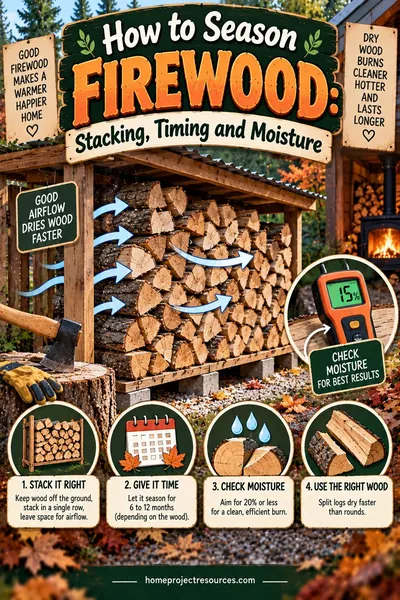
And if the wood is wetter than it should be, both numbers go up, because you'll burn more of it for the same heat. If you haven't yet, read how to season firewood before you put up a big pile.
Checking a delivery: cubic yards, pickup beds and stacks
Wood usually arrives dumped, not stacked, so you can't measure a cord as it comes off the truck. The reliable way is to stack it, then measure the stack. But you can sanity-check a load before it leaves the truck.
Measure the bed. Length between the tailgate and the front of the bed, width between the wheel wells, and the height of the wood above the bed floor. Put those into the Cubic Yard Calculator and read the cubic feet. A common full-size bed is roughly 6.5 feet long and about 4 feet wide between the wheel wells. Level with the bed rails at 1.5 feet high, that's 6.5 x 4 x 1.5 = 39 cubic feet. Heaped above the rails, maybe 50 to 55.
Now remember that's loose, thrown wood, which takes more room than stacked wood. So that "full pickup" is somewhere well under half a cord once it's stacked, not "about a cord" as the ad might suggest. A genuine full cord loose-thrown is more than one pickup bed for most trucks. If a seller promises a cord from a single half-ton pickup, the numbers don't work.
Measure the stack. Once it's stacked, measure length, height and depth, multiply, and compare to 128 times the number of cords you paid for. Small shortfalls happen because of how wood settles; a big one is a conversation with the seller.
The same calculator handles any shape. A bay in a shed that's 10 feet long, 6 feet high and 4 feet deep is 240 cubic feet, or just under two cords. Our cubic yards to tons page explains why we don't try to convert wood to weight: moisture swings it too much to be useful.
How to store firewood so it stays dry
Once you know how much you need, you need somewhere to put it. Use the 24-foot rule: a cord of 16-inch splits stacked 4 feet high runs 24 feet long in a single row. Plan the space from there.
| Cords to store | Single-row length at 4 ft high, 16-in splits | Alternative layout |
|---|---|---|
| 1 | 24 feet | Three 8-foot rows with air gaps |
| 2 | 48 feet | Six 8-foot rows, or two rows 24 feet long |
| 3 | 72 feet | A 12 x 8 foot shed bay stacked 4 feet high, three rows deep |
| 5 | 120 feet | A 20 x 8 foot open-front shed, three rows deep, 4 feet high |
A few storage rules that protect the volume you paid for:
- Off the ground. Pallets, rails or a rack. Wood on dirt wicks moisture and rots from the bottom row up.
- Roof over the burning stack, sides open. The wood you'll burn this winter wants a roof and, ideally, one wall on the windward side. Leave the rest open so air keeps moving.
- Keep next year's wood out in the open. Seasoning wood needs sun and wind more than it needs a roof, so the drying pile and the burning pile are two different places.
- Away from the house. A woodpile against the siding invites insects and traps moisture against the wall. Bring in a few days' worth at a time.
- Oldest first. Mark each row with the month you stacked it and burn in order.
If you're building a dedicated woodshed, our how to build a shed guide covers the base and framing, and it's worth sizing the bays in whole cords using the table above. If the wood lives in the garage, keep it well away from the water heater and off the main floor space; garage storage systems covers how to zone a garage so seasonal stock like firewood doesn't take over.
How long does a cord of wood last?
Exactly as long as your burn rate says it will, which is why we won't give you one number. Run the math backwards:
Days per cord = 128 / cubic feet burned per day
Take the worked example above. At 4.5 cubic feet a day, a cord lasts 128 / 4.5 = about 28 days. At the measured rate of 14.2 cubic feet a week, or 2 cubic feet a day, a cord lasts 128 / 2 = 64 days. Someone who burns one evening fire a week could make a cord last more than a season.
The single biggest variable, after how much you burn, is the wood itself. Dry, dense hardwood lasts longest per cord. Wet wood of any species goes fastest, because so much of every load is spent boiling off water.
FAQ
How many cords of wood do I need for winter?
Measure your own burn rate with a one-week test stack and scale it to your season, using the formula above. Homes that heat entirely with wood in a cold climate commonly run through several cords; supplemental burners often use one or two; evening-fire households may use a fraction of one. Your stove, your house and your weather set the number, so measure rather than guess.
What are the dimensions of a cord of wood?
Any stack that measures 128 cubic feet. The standard shape is 4 feet high by 4 feet deep by 8 feet long. A single row of 16-inch splits 4 feet high would need to be 24 feet long to equal a cord. Put your own stack's measurements into the Cubic Yard Calculator to get cubic feet and divide by 128.
Is a face cord the same as a rick?
Usually, yes. Both describe a stack 4 feet high by 8 feet long, one piece deep, and both are regional terms rather than legal units. Because the depth depends on piece length, a 16-inch face cord is about one-third of a full cord and a 24-inch face cord is half. Always ask the length.
How much wood is in a pickup truck?
Measure the bed and calculate it; don't take "about a cord" on faith. A full-size bed loaded level is often around 40 cubic feet loose, and even heaped it's well short of a stacked cord. Loose wood also takes up more space than stacked wood, so the stacked total is smaller still.
Does a cord of wood weigh a set amount?
No. Weight depends on species and, even more, on moisture. Green wood can weigh half again as much as the same wood seasoned. That's why firewood is sold and measured by volume, and why a scale is a poor way to check a delivery.
Should I buy more firewood than the math says?
Yes, a little. Round up to the next half cord to cover a longer or colder season, and add more if you're not sure the wood is fully seasoned, since wet wood burns faster for the same heat. Leftover dry wood keeps for next year if it's stored off the ground under a roof.
How much space do I need to store two cords?
A single row of 16-inch splits stacked 4 feet high would be 48 feet long. More practically, six 8-foot rows with a few inches of air between them, or a shed bay about 8 feet wide, 8 feet long and 4 feet high, stacked three rows deep, holds two cords with a little room to spare.