Asphalt Driveway Cost: What Changes Your Estimate

Asphalt driveway cost is set by five measurable things: the square footage you are paving, the depth of the compacted stone base under it, the tonnage of hot mix that goes on top, what has to come out first, and how water leaves the site. A contractor's number is really those five items priced together, so any two bids that differ are almost always bidding different depths, different base, or different drainage.
Once you know your area and your depths, you can calculate the tonnage yourself and check whether a proposal is even plausible. That single check catches the thin, underbuilt jobs that fail in three winters.
Updated September 2026
A note on numbers. This page gives you the quantities, depth specifications, scope items and bid questions, not dollar figures. Asphalt is a petroleum product hauled by truck, so pricing moves with oil, with your distance from a plant, and with the season, and a printed range would be misleading in most markets. Calculate your quantities here, then get three quotes on the identical scope.
Start with the base tonnage. The stone under the pavement is usually the largest single quantity in the whole job. Run your dimensions through our free Gravel Calculator to get cubic yards and tons of crusher run, then compare that figure to what each contractor says they are bringing in.
What drives asphalt driveway cost the most
Rank a bid in this order. The first three explain most of the difference between quotes.
1. Square footage. Everything scales off area. A single car drive is usually 10 to 12 feet wide. A double is 20 to 24 feet. Add a turnaround, a parking apron, or a wider approach at the street and the number climbs fast, because you are buying both stone and asphalt for every extra foot. Measure the real shape, including the flare at the road, with our Square Footage Calculator.
2. What is there now. Paving over compacted dirt that already drains well is the cheapest starting point. Tearing out failed asphalt, breaking up old concrete, removing tree roots, or excavating soft clay and hauling it away all add machine time and disposal loads.
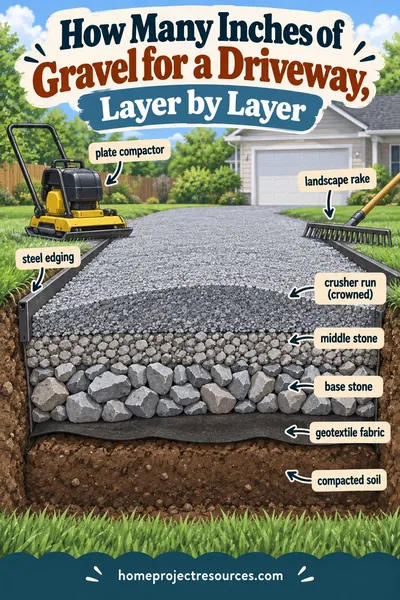
3. Base depth and subgrade condition. The base is the driveway. Asphalt is the wearing surface that keeps water out of the base. A driveway built on 4 inches of stone over wet clay will crack no matter how good the mix was. Soft subgrade means deeper stone, geotextile fabric, or both. Our guide to how many inches of gravel a driveway needs sets that base depth by soil type before any paving goes on top.
4. Asphalt thickness and number of lifts. Two inches compacted in one lift is a light residential surface. Three inches in two lifts, a binder course and a surface course, is a durable residential build. Four inches or more is what you want if a truck or an RV parks on it.
5. Drainage and grading. Water is what destroys asphalt. Pitch, swales, a trench drain at a garage door, culvert work at the street, and any retaining edge are all scope, and they are the items most often left off a cheap bid.
6. Access. A paver, a roller and a tandem dump truck need room. Narrow gates, low branches, tight turns, or a long hand work section around a landscape bed all add labor hours, and hand laid asphalt never compacts as evenly as machine laid.
| Driver | What keeps the estimate lean | What pushes it up |
|---|---|---|
| Area | Straight run, standard width | Turnarounds, wide aprons, curves, parking pads |
| Demolition | Bare, stable soil | Old asphalt or concrete removal, roots, wet clay excavation |
| Base | Existing compacted stone in good shape | 8 to 12 inches of new crusher run, fabric, undercut and haul off |
| Thickness | 2 inch surface on a light use drive | 3 to 4 inches in two lifts for heavy vehicles |
| Drainage | Natural fall away from the garage | Regrading, trench drain, culvert, retaining edge |
| Access | Open site, machine paved throughout | Hand work sections, tight gates, long haul from the street |
The tonnage math, done for you
Two quantities matter: the stone base and the hot mix. Both are sold by weight, and both are calculated from volume, so you need a density for each.
- Crusher run and road base weigh about 3,000 lb per cubic yard, which is 1.50 tons per cubic yard. That figure is the one used by our Gravel Calculator.
- Compacted hot mix asphalt weighs about 145 lb per cubic foot, which works out to roughly 1 ton per 80 square feet at 2 inches of compacted thickness.
Worked example: a 20 by 40 foot double driveway
Say you are paving a straight 20 by 40 foot drive with 8 inches of crusher run base and 3 inches of compacted asphalt in two lifts.
Step 1: area. 20 x 40 = 800 square feet.
Step 2: base volume. 8 inches is 8 / 12 = 0.667 feet. 800 x 0.667 = 533.3 cubic feet. 533.3 / 27 = 19.75 cubic yards.
Step 3: base tonnage. 19.75 x 1.50 = 29.6 tons of crusher run. Order about 10% extra for compaction and spillage, so call it 32 to 33 tons, which is two full tandem loads plus a bit.
Step 4: asphalt volume. 3 inches compacted is 3 / 12 = 0.25 feet. 800 x 0.25 = 200 cubic feet.
Step 5: asphalt tonnage. 200 x 145 lb = 29,000 lb. 29,000 / 2,000 = 14.5 tons of hot mix, split across a binder lift and a surface lift.
Step 6: sanity check the shortcut. At 2 inches, 1 ton covers about 80 square feet. At 3 inches it covers about 53 square feet. 800 / 53 = 15.1 tons, which lands within a rounding error of step 5. Both methods agree, so the number is good.
Now you have two hard quantities to compare against every bid. If a contractor's scope says 4 inches of base and 1.5 inches of asphalt on the same 800 square feet, that is roughly 15 tons of stone and 7.5 tons of mix, about half the material of the build above. That is not a better price. It is a different driveway.
If you want to double check the volume conversions on any odd shaped area, our cubic yard calculator handles the geometry and our gravel page converts it to tons at the right density.
Thickness specifications, by how you use the drive
| Use | Compacted asphalt | Aggregate base | Lifts |
|---|---|---|---|
| Light residential, cars only, firm subgrade | 2 to 2.5 in | 6 in | 1 |
| Standard residential, occasional heavy vehicle | 3 in | 8 in | 2 (binder plus surface) |
| Soft or clay subgrade | 3 in | 10 to 12 in, often with fabric | 2 |
| Regular truck, RV or trailer parking | 4 in | 10 to 12 in | 2 |
| Overlay on sound existing asphalt | 1.5 to 2 in | Existing, if stable | 1 |
Some rules that go with that table:
- Loose is not compacted. Asphalt compacts roughly 20 to 25% under the roller, so 3 inches compacted is laid at close to 3.75 inches loose. When a contractor talks depth, ask which one they mean.
- A tack coat goes between lifts and against any existing pavement edge, so the layers bond instead of sliding.
- Base gets compacted in lifts too. Dumping 10 inches of stone and rolling the top does not compact the bottom. Ask about lift thickness on the base, not just the total.
- Edges are where driveways die. An unsupported asphalt edge should be laid with a wedge, or supported by soil built up to the surface, or contained by a paver or concrete edge. Vertical, unsupported edges crumble first.
Grading and drainage: the part nobody itemizes
Water sitting on asphalt gets into hairline cracks, freezes, expands, and turns a crack into a pothole. Water under asphalt softens the subgrade and the pavement sinks. Every long lasting driveway solves both.
- Minimum pitch for surface drainage is about 1/4 inch per foot, or roughly 2%. Under about 1% and water will stand.
- Pitch away from the garage. If the drive falls toward the house, you need a trench drain across the apron or a regrade, and that is real scope with real cost.
- Crown or cross slope. A wide driveway usually gets a crown down the center or a consistent cross slope to one side, so water leaves sideways rather than running the full length.
- The street connection. Where the drive meets the road you may be dealing with a curb cut, a culvert, or a municipal apron specification. Some jurisdictions require a permit and inspection for work in the right of way.
- Roof runoff. A downspout that dumps onto the driveway edge will undermine it. Extend it or pipe it away before you pave.
Weather and timing
Asphalt is laid hot and it has to be compacted before it cools. That makes season and temperature real constraints, not preferences.
- Hot mix leaves the plant around 275 to 300 degrees F and has to be rolled while it is still workable.
- Most contractors will not pave below about 50 degrees F of ambient temperature, and thin lifts are more sensitive than thick ones because they cool faster.
- Many plants close for the season in cold regions, which is why the fall calendar gets crowded and spring bookings fill early.
- Rain stops the job. Paving onto a wet base traps moisture and ruins the bond.
- After paving, keep vehicles off for the first couple of days in cool weather and longer in hot weather, avoid sharp wheel turns while parked for the first month, and keep kickstands, trailer jacks and jack stands off the new surface without a plate under them.
- Wait at least a full season, commonly six to twelve months, before the first seal coat. Sealing new asphalt too early traps the oils that are still curing. Our driveway sealing guide covers the timing and the technique.
New driveway, overlay, or repair
You do not always need a full rebuild, and the honest contractor will tell you which of these you are in.
| Condition | Right fix |
|---|---|
| Surface is faded and dry with hairline cracks, structure is solid | Clean, crack fill and seal coat |
| Isolated potholes, base looks sound | Full depth patch of the failed areas, then seal |
| Widespread alligator cracking in one area | That area has a base failure, patch full depth including base |
| Alligator cracking across most of the surface | Base is failing, an overlay will telegraph through, plan a rebuild |
| Surface worn but flat and well drained, edges intact | Overlay of 1.5 to 2 inches over a tack coat |
| Standing water, sunken areas, edges crumbling everywhere | Full removal and rebuild |
The trap is the overlay. Paving a new layer over a failing base hides the problem for about two years and then the same cracks come back through the new surface. If a bid proposes an overlay, ask what they saw that tells them the base is sound.
If your existing surface is concrete rather than asphalt, that is a specific case with its own rules, and our asphalt over concrete driveway page covers when it works and when the joints will reflect through.
Asphalt compared to the alternatives
No prices here, just the practical differences that should drive the decision.
| Asphalt | Concrete | Pavers | Gravel | |
|---|---|---|---|---|
| Install time | One to two days, usable quickly | One day to place, days to cure | Longest, most labor | Fastest |
| Cold climate behavior | Flexible, tolerates freeze and thaw well | Can spall from salt and freeze cycles | Flexes at joints, individual units replaceable | No cracking to worry about |
| Hot climate behavior | Softens in extreme heat, can scuff | Stays rigid | Stays rigid | Fine |
| Repairs | Patches blend reasonably well | Patches always show | Lift and reset individual pavers | Rake and add stone |
| Maintenance | Seal every few years, crack fill | Occasional joint sealing | Joint sand, occasional resetting | Regrade and top up |
| Snow removal | Plow friendly, dark surface sheds snow faster | Plow friendly | Edges can catch a plow blade | Plow takes stone with it |
| Lifespan | Long with maintenance, shorter without | Longest | Very long, units are replaceable | Ongoing |
For a direct comparison of the two hard alternatives, see our concrete driveway cost drivers and the paver driveway cost breakdown, plus the head to head in concrete vs pavers.
What belongs in the scope of work
Do not accept a one line proposal. Ask for these items written out, and ask every bidder for the same list so the comparison means something.
- Measured area in square feet, with a sketch and dimensions.
- Demolition and disposal. What comes out, how deep, how many loads, and where it goes.
- Subgrade preparation. Proof roll or compaction method, any undercut, any geotextile fabric.
- Base material. Type of stone, compacted depth, number of lifts, and the tonnage they expect to place.
- Asphalt. Mix designation, compacted depth per lift, number of lifts, tack coat between lifts, and expected tonnage.
- Compaction. Roller type and weight, and how the edges and any hand work areas get compacted.
- Grading. Finished pitch, direction of drainage, crown or cross slope, and how the garage apron is handled.
- Edges. How the sides are supported or wedged, and whether shoulder backfill is included.
- Street connection. Apron detail, any permit for the right of way, culvert work.
- Site restoration. Regrading and seeding along the edges, cleanup, protection of adjacent surfaces.
- Schedule. Start window, working days, and what happens if weather moves it.
- Warranty. What is covered, for how long, and specifically whether settling and cracking are included or excluded.
Item 4 and item 5 are the two you can verify with the math above. If the tonnage on the proposal does not match the depths on the proposal, ask which one is wrong.
Questions to ask each bidder
- What depth of base are you placing, and how many tons is that?
- How many tons of hot mix, and at what compacted thickness per lift?
- Is that depth compacted or loose?
- What are you doing about the water that currently runs toward the garage?
- Are you proof rolling the subgrade, and what happens if a soft spot shows up?
- What mix are you using for the binder course and the surface course?
- How are the edges supported?
- Do you pull the permit for the apron at the street?
- How long before I can park on it, and how long before I should seal it?
- What is specifically excluded from this price?
Red flags on a driveway bid
Driveway paving is one of the most common home improvement scams in the country, largely because a bad job looks fine on day one.
- Door to door crews with leftover material from another job. Real paving companies do not have surplus hot mix driving around looking for a home.
- Cash only, deep discount, today only. Legitimate contractors will let you get another quote.
- No written scope with depths. If the proposal does not say how thick anything is, there is nothing to hold them to.
- A price far below the others without a scope difference that explains it. Usually the difference is thickness or base.
- No local address, no license, magnetic signs on the truck. Verify the license and check whether your state requires one for this trade.
- Pressure to skip the permit where one is required for the street apron.
Our contractor red flags page has the full list and the verification steps, and how to get contractor bids has the wording that produces matched quotes.
What makes an estimate go up after work starts
- Soft subgrade found during proof rolling, which means undercut, haul off and extra stone.
- Old concrete or a second layer of asphalt discovered under the surface.
- Tree roots that have to be cut back and the resulting voids filled.
- A drainage problem that only shows itself when the site is stripped and it rains.
- Utility conflicts, such as a shallow gas or water line in the way of an excavation.
- A municipal apron specification at the street that is stricter than what was assumed.
Asking about each of these before the contract is signed turns most of them from a surprise into a line item with a number next to it.
Keeping the driveway you paid for
- Seal coat on a sensible cycle rather than annually. Over sealing builds a brittle film that cracks on its own.
- Fill cracks as soon as they open, before water gets in and freezes.
- Keep the edges backfilled with soil so the pavement is supported.
- Do not park heavy trailers on jack stands without a plate, especially in summer heat.
- Clean up oil and gas drips promptly, since petroleum dissolves the binder in asphalt.
- Keep the surface clear of standing debris and check drainage after big storms. Our driveway pressure washing page covers cleaning without damaging the surface.
Frequently asked questions
How many tons of asphalt do I need for my driveway?
Multiply the area in square feet by the compacted thickness in feet to get cubic feet, then multiply by 145 pounds and divide by 2,000. As a shortcut, one ton covers about 80 square feet at 2 inches, or about 53 square feet at 3 inches. A 20 by 40 foot drive at 3 inches needs about 14.5 tons.
How thick should a residential asphalt driveway be?
Two to two and a half inches compacted over 6 inches of stone is the light duty minimum for cars on firm ground. Three inches over 8 inches of stone in two lifts is the standard build most homeowners should ask for. Go to four inches over 10 to 12 inches of stone if a truck, RV or trailer will park on it.
How long does a new asphalt driveway take to install?
Most residential driveways are a one to two day job once the site is prepared. Demolition and base work often take the first day, and paving the second. You can usually walk on it the same day and drive on it after a day or two, longer in hot weather when the mix stays soft.
When should I seal a new asphalt driveway?
Wait at least six months, and in many climates a full year. New asphalt needs time for the lighter oils in the binder to cure out, and sealing too early traps them and leaves a soft surface. After the first seal, every three to five years is typical, based on how the surface looks rather than the calendar.
Can I pave over my old asphalt driveway?
Only if the base under it is still sound. An overlay of 1.5 to 2 inches over a tack coat works well when the old surface is worn but flat, well drained, and free of widespread alligator cracking. If the old pavement is sinking or cracked across most of its area, an overlay just buys a year or two before the same cracks reappear.
Is asphalt or concrete better for a driveway?
Asphalt is more flexible, handles freeze and thaw cycles better, is quicker to install, and is easier to patch invisibly. Concrete lasts longer with less routine maintenance, holds up better in extreme heat, and offers finish options. Cold, wet climates often favor asphalt, and hot climates often favor concrete.
Do I need a permit for a new driveway?
The pavement itself often does not need one on private property, but the connection to the public road usually does, along with any culvert or curb cut work. Some jurisdictions also regulate the amount of impervious surface on a lot. Ask your building department before you sign, and confirm in writing who is pulling any permit that is required.
How much extra material should I order?
Add roughly 10% to the base stone for compaction, spillage and the uneven bottom of an excavation. Asphalt is normally ordered by the contractor with their own allowance, since it has to be placed hot in one delivery window, but you should still check that their tonnage matches the depths in the proposal.