How to Quote for a Painting Job

Here is the short version of how to quote for a painting job: measure the actual paintable surface, multiply the hours by your burdened labor rate, add materials at cost plus 10 to 20 percent, then add overhead and profit on top. The unit that makes any of that reliable is square feet of wall and ceiling surface, not square feet of floor, and every step below is built on it.
The number that kills painting contractors is not a low price. It is a fast price. A quote built from a walkthrough guess is wrong roughly half the time, and the half that is wrong low comes straight out of your own pay.
Measure before you price. Use our free Paint Calculator to turn room dimensions into wall area, ceiling area, and gallons per coat, with the doors and windows deducted and the waste allowance shown on its own line. Every rate below multiplies against that number, so if the area is wrong, the quote is wrong.
Updated September 2026. The production rates and ratios below are planning inputs for your own cost data, not a substitute for it. Labor is 70 to 85 percent of a painting bid and it is priced locally, so the same scope can bid at roughly double in a coastal metro what it bids at in a rural market.
A note on numbers. This page covers takeoffs, production rates, coverage, line items and the questions that make quotes comparable, not dollar figures. Paint, sundries, insurance and trade labor rates all move by region and by season, and we do not set any of them. Build the hours here, then price them against your own cost history and current quotes from your supplier.
The Four Ways Painters Price Work
Every quoting method is a shortcut to the same answer: hours plus materials plus markup. The methods differ in how much risk you carry when the job turns out harder than it looked.
| Method | What you are actually pricing | Best for | Risk to you |
|---|---|---|---|
| Per square foot of floor area | Floor area alone, with ceiling height and cut-up walls invisible | Fast quotes on standard rooms | High on tall or cut-up rooms |
| Per square foot of wall surface | The surface a roller and brush have to cover | Open plans, stairwells, commercial | Low, this is the honest unit |
| Per room, flat rate | Your own historical average room, whether or not this one matches it | Repeat residential work | Medium, depends on your average |
| Hourly plus materials | Hours as they actually happen, with the scope risk on the customer | Repairs, unknown scope, punch lists | Lowest, but customers resist it |
Most established residential painters quote a flat total to the customer and build that total from wall surface area internally. The customer sees one number. You see the hours behind it, which is the only way to know afterward whether the job made money.
Why floor area is the wrong internal unit
Floor area ignores ceiling height, and height is where the hours hide. Two 200 sq ft rooms with 8 ft and 12 ft ceilings have 480 sq ft and 720 sq ft of wall, a 50 percent difference in surface, plus staging time for the taller room. Price both at the same rate per square foot of floor and you lose money on the second one every time.
Use floor area only as a sanity check at the end. If a plain repaint comes out at roughly double your own normal rate per square foot of floor, you made an arithmetic error somewhere and it is worth finding before you send it.
How to Quote for a Painting Job, Step by Step
Six steps, in this order. Skipping step 2 is the most common cause of a bid that has to be revised after work starts.
- Measure the surface. Wall perimeter times ceiling height, minus door and window openings, plus ceiling area if it is in scope. Count trim in linear feet separately.
- Grade the condition. Walk every wall. Note nail pops, cracks, water stains, peeling, wallpaper glue, texture, and gloss levels. This decides your prep hours, and prep is where jobs go wrong.
- Set the coats. New drywall needs primer plus two coats. A same-color repaint over a sound eggshell wall may need one. A dark red going to white needs a tinted primer plus two, sometimes three.
- Convert to hours using production rates, not feel.
- Price materials from a real takeoff in gallons, then add your handling markup.
- Add overhead and profit as a percentage of the subtotal, and write the exclusions down.
Step 1: the takeoff that makes the rest work
For a room 12 ft x 14 ft with 9 ft ceilings, one 3 ft x 7 ft door, and two 3 ft x 5 ft windows:
- Wall perimeter: 2 x (12 + 14) = 52 linear feet
- Gross wall area: 52 x 9 = 468 sq ft
- Door deduction: 3 x 7 = 21 sq ft
- Window deductions: 2 x (3 x 5) = 30 sq ft
- Net wall area: 468 - 21 - 30 = 417 sq ft
- Ceiling: 12 x 14 = 168 sq ft
- Trim, baseboard plus door and window casing: roughly 90 linear feet
That takeoff is the spine of the quote. Do it the same way every time and your historical job costs become usable data instead of anecdotes.
Step 2: production rates that hold up
These are typical rates for one experienced painter working with standard tools. New crews run 20 to 30 percent slower for the first season. Track your own and replace these numbers as soon as you have ten jobs of history.
| Task | Production rate, per painter | Notes |
|---|---|---|
| Roll walls, one coat, smooth drywall | 200 to 300 sq ft per hour | Cut-in adds time, see next row |
| Cut in, brush, walls and ceilings | 60 to 100 linear feet per hour | Doubles on textured or crooked lines |
| Roll ceiling, one coat, flat white | 150 to 250 sq ft per hour | Slower overhead than walls |
| Spray walls, masked, empty room | 500 to 900 sq ft per hour | Masking time is separate, and it is real |
| Brush trim and baseboard | 25 to 45 linear feet per hour | Enamel is slower than latex |
| Doors, brush and roll, both sides | 45 to 90 minutes per door | Includes jamb and casing |
| Standard prep, patch, sand, caulk | 15 to 25 percent of paint hours | Light condition |
| Heavy prep, peeling, repairs, skim | 40 to 100 percent of paint hours | Estimate this room by room |
| Masking and floor protection | 20 to 40 minutes per room | More on furnished occupied jobs |
Two rows above carry the most estimating risk. Heavy prep is the first, because a wall that looks fine at 4 p.m. under a lamp shows every ridge under work lights. The second is masking on occupied homes, where moving and covering a full living room can burn an hour before a drop of paint moves.
Step 3: turn hours into a labor number
Multiply hours by your fully burdened labor rate, not the hourly wage you pay. Burdened rate includes payroll taxes, workers compensation insurance, liability insurance, vehicle cost, and paid non-billable time.
A painter's wage is not what that painter costs you. The burden items above typically add 40 to 55 percent on top of the hourly wage, and that loaded figure is the one your hours multiply against. Charge-out rates then sit well above the loaded cost, lowest in rural markets and highest in coastal metros, with roughly a threefold spread between the two ends of the country. The test that travels is the ratio, not the rate: if your charge-out rate is not at least 1.6 to 2.2 times the wage you pay, overhead is eating the difference and you will only find out at tax time.
Pricing Materials Without Guessing
Materials are usually 15 to 30 percent of a residential repaint. Getting the gallon count right is fast, so there is no excuse for rounding it in your head on the driveway.
Standard coverage is 350 to 400 sq ft per gallon on smooth, previously painted drywall. Drop that to 250 to 300 on textured walls, new drywall, or porous masonry, and to 150 to 200 on rough exterior surfaces like split-face block.
| Material | What moves its cost on your invoice | Coverage or unit |
|---|---|---|
| Contractor-grade interior latex | The cheapest wall option, and the one most likely to need a third coat over a color change | 350 to 400 sq ft |
| Mid-grade interior latex | Hides better per coat, so it often works out cheaper installed than contractor grade | 350 to 400 sq ft |
| Premium interior latex | The priciest wall paint, bought for one-coat hide and scrub resistance | 375 to 425 sq ft |
| Ceiling flat white | The cheapest gallon on the truck, and rarely worth trading down further | 350 to 400 sq ft |
| Waterborne trim enamel | Sits well above wall paint, and the leveling and open time are what you are paying for | 350 to 400 sq ft |
| Stain-blocking primer | Shellac and oil-based versions cost more than water-based, and only they stop the worst stains | 300 to 400 sq ft |
| Exterior acrylic | Pricier per gallon than interior latex and it covers less area, so it hits the quote twice | 250 to 350 sq ft |
| Caulk, painter's grade | Cheap per tube, and every job burns more tubes than the estimator wrote down | 25 to 35 linear feet |
| Tape, plastic, paper, rosin | Scales with how furnished and occupied the home is, not with square footage | Consumable |
| Roller covers, liners, sandpaper | Scales with coats and with the prep grade you graded in step 2 | Consumable |
Get current per-gallon and per-tube numbers from your own supplier on the day you quote, because that is the only pricing that is actually yours. Then mark materials up 10 to 20 percent. That is not a hidden fee. It covers the time you spend at the paint counter, the drive, the tinting mistakes, and the gallon left over that you cannot sell to anyone else.
The full room-by-room coverage math, including how many gallons a two-coat job actually takes, is in cost to paint a room, and the whole-house version is in cost to paint a house interior.
A Complete Worked Quote: Three-Bedroom Interior Repaint
Scope: 1,650 sq ft single story, walls and ceilings in six rooms plus a hallway, all trim and eight doors, two coats on walls, one on ceilings, light prep, occupied home, customer picks colors from one palette.
Surface takeoff
- Net wall area, all rooms and hallway: 2,980 sq ft
- Ceiling area: 1,480 sq ft
- Trim: 640 linear feet
- Doors: 8
Labor hours
- Wall rolling, two coats: 2,980 x 2 = 5,960 sq ft at 250 sq ft per hour = 23.8 hours
- Wall cut-in, two coats: 720 linear feet of cut at 80 lf per hour = 9.0 hours
- Ceilings, one coat: 1,480 at 200 sq ft per hour = 7.4 hours
- Trim and baseboard: 640 lf at 35 lf per hour = 18.3 hours
- Doors: 8 x 1.0 hour = 8.0 hours
- Prep at 20 percent of the 66.5 painting hours = 13.3 hours
- Masking and protection, 7 areas at 30 minutes = 3.5 hours
- Setup, cleanup, final walkthrough = 6.0 hours
Total: 23.8 + 9.0 + 7.4 + 18.3 + 8.0 + 13.3 + 3.5 + 6.0 = 89.3 hours
Labor cost: those 89.3 hours multiplied by your burdened charge-out rate. That one line is a little over half the finished quote, which is why the hour estimate above deserves more scrutiny than every other part of the process combined.
Materials takeoff
Count the containers, then price the containers. The arithmetic is the same on every job:
- Wall paint: 5,960 sq ft of coverage divided by 375 sq ft per gallon = 15.9 gallons, buy 16 gallons
- Ceiling paint: 1,480 divided by 375 = 4.0 gallons, buy 4 gallons
- Trim enamel: 3 gallons
- Stain-blocking primer for the patches and water marks: 2 gallons
- Caulk: 20 tubes
- Masking and consumables: 7 areas worth
Take that list to the counter and you have a real materials subtotal in a few minutes, priced today, in your zip code, at your contractor discount. Add handling markup on top of it, commonly 15 percent.
Build the price, in this order
- Labor hours multiplied by your burdened charge-out rate.
- Plus materials at your actual cost, plus the handling markup.
- Plus overhead, commonly 10 to 15 percent of that subtotal.
- Plus profit, commonly 10 to 20 percent of the new subtotal.
- Round the total up to a clean number. Never down, and never to make it feel more competitive.
The order matters. Applying profit to a subtotal that already includes overhead is standard and it is what the percentages above assume. Take profit on labor alone and you have quietly given away the margin on every gallon you carry.
On a job of this shape the finished split usually lands near 55 percent labor, low twenties for materials, and low twenties for overhead and profit combined. Those three percentages are the real output of this exercise, because they travel between jobs and between years in a way that any dollar figure cannot. If your own splits come out wildly different, find out why before you send more quotes.
Sanity check the result two ways. Divide the quoted total by the floor area, then divide it again by the total painted surface. Compare both against your own last ten jobs. Two numbers inside your normal bands mean the estimate is probably sound. A number well outside them almost always means a transposed digit, a room counted twice, or a missing coat, and it costs nothing to find that now instead of on the final walkthrough.
What Moves a Painting Quote Up or Down
- Ceiling height. Anything above 9 feet adds staging, ladder moves, and slower cut-in. Add 10 to 20 percent for 10 to 12 ft ceilings and 25 to 40 percent for open two-story stairwells.
- Color change severity. Same color or a close neighbor may go one coat. Dark to light almost always means primer plus two, and deep reds can need three.
- Surface texture. Knockdown and orange peel add 15 to 25 percent to roll time and eat 20 to 30 percent more paint.
- Occupied versus empty. An empty house is often 20 to 35 percent cheaper to paint because masking and furniture moving disappear and you can spray.
- Trim condition and sheen. Old oil-based trim needs deglossing and a bonding primer, which can double trim hours.
- Repairs in scope. Patching is painting work. Retexturing, replacing water-damaged board, and skim coating are drywall work, and they should be a separate line. The methods are in how to patch drywall.
- Access and parking. City work with no driveway, elevator buildings, and gated communities add real unbilled time. Add a line for it.
- Season. Exterior work in peak summer prices higher than late fall in most markets, simply because the schedule is full.
Exterior quotes carry more variables again, including siding type, story count, and how much scraping the old finish needs. Those ranges are broken out in cost to paint a house exterior.
Regional Variation, Honestly Stated
There is no single national painting rate, and any quoting guide that gives you one is guessing. The pattern that does hold: labor rates track local construction wages, and materials barely move.
| Market type | Where its repaint rate sits | What sets the charge-out rate there |
|---|---|---|
| Rural and small metro, Midwest and South | The lowest of the four, and the least room for error | Local construction wages, short drive times, low insurance and occupancy cost |
| Mid-size metro | Modestly above rural, with the widest spread inside the market itself | Wage floor plus enough competition to keep bids honest |
| Large metro, Northeast and West Coast | Roughly double the rural rate for identical scope | High wages, parking and access time, permit and building rules, expensive overhead |
| High-end and historic work, any market | The highest of the four in any market, rural ones included | Finish tolerance, specialty coatings, lead-safe work, protection of finished spaces |
Materials barely move between those rows. Labor moves a great deal, and it is the reason a national average is useless as a quote and useful only as context.
The practical move is to price three real jobs at your true costs, see where you land, and then get two competitor quotes on comparable scope in your own zip code. To make those comparable, hand each competitor the same written scope: rooms, surfaces, coats, product line and sheen, prep grade, and whether the home is occupied. A bid that comes back well under the others is almost always missing coats, prep, or trim, and the fastest way to prove it is to ask which of those three it includes.
Licensing, Insurance, and the Lead Rule
Three compliance items belong in every painting quote, because all three cost money and all three carry real penalties.
Contractor licensing. Requirements are set by state, and several states license painting specifically once a job passes a stated project-value threshold. Those thresholds differ widely from state to state, some states set none at all, and a handful license by trade regardless of size. Check your own state licensing board rather than assuming, and confirm any city or county registration separately.
Insurance. General liability is standard and customers increasingly ask for a certificate before work starts. If you have employees, workers compensation is required in nearly every state. Both belong in your burdened labor rate, not as a surprise later.
The EPA lead rule. For homes and child-occupied facilities built before 1978, the EPA Renovation, Repair and Painting rule requires a certified firm, a certified renovator on site, contained work areas, and specific cleanup and recordkeeping when the work disturbs painted surfaces above small thresholds. Full details are on the EPA's lead renovation page. Certification and containment add cost, so quote pre-1978 homes as a different product, not a discount.
Painting alone rarely needs a building permit. If your scope creeps into drywall replacement, structural repair, or anything electrical, that changes, and the permit belongs in the quote.
Writing the Quote So It Holds Up
A quote that lists only a price invites a fight later. A quote that lists scope wins the argument before it starts. Include:
- Surfaces included, room by room: walls, ceilings, trim, doors, closets, or the specific exclusions.
- Number of coats and the primer plan.
- Products by name and sheen, so a customer cannot compare your premium bid against someone else's builder-grade one.
- Prep level included, with a stated hourly rate for repairs found after the walls are stripped.
- Exclusions in writing: wallpaper removal, texture repair, mold remediation, moving pianos and large furniture, exterior repairs.
- Schedule and payment terms, commonly a deposit for materials, a progress payment, and the balance on completion.
- Change order language. One sentence saying additional work is priced separately and approved in writing before it starts saves entire jobs.
Wallpaper deserves its own callout because it destroys more painting quotes than any other surprise. Stripping paper and cleaning the adhesive is slow, uneven work, and the wall underneath is often unpainted drywall that needs a skim coat. Price it hourly or walk away from a fixed price on it. The process is in how to remove wallpaper.
Frequently Asked Questions
How much should I charge to paint a 12x12 room?
Build it rather than guess it, because the honest answer depends entirely on your own charge-out rate. A 12 ft x 12 ft room with 8 ft ceilings has about 384 sq ft of gross wall area, roughly 340 sq ft net once you deduct a door and a window, plus 144 sq ft of ceiling. Walls, ceiling, and trim with light prep and two coats works out to 9 to 14 labor hours and 3 to 4 gallons of paint. Multiply the hours by your burdened rate, add the paint, add overhead and profit, and that is the quote. Nine-foot ceilings add about an eighth more wall surface plus a little staging. Walls only, with no ceiling or trim, cuts the hours by roughly a third.
What percentage of a painting job is labor?
Labor is typically 70 to 85 percent of a residential painting bid, and materials are 15 to 30 percent. That ratio is why an accurate hour estimate matters far more than shopping paint prices. Shaving the price of a sixteen-gallon order saves you a small fraction of what underestimating prep by ten hours costs you, and the prep mistake happens far more often than the shopping win.
Should I quote painting by the hour or a flat price?
Quote a flat price for anything with a clear scope: repaints, new construction, standard rooms. Customers compare flat numbers and they hate open meters. Quote hourly when the scope truly cannot be known upfront, meaning wallpaper removal, damage repair, and restoration on older homes. A hybrid works well: a firm price for the painting, plus a stated hourly rate for repairs found once the walls are exposed.
How do I estimate paint quantity for a quote?
Divide total surface area by 350 to 400 sq ft per gallon for smooth previously painted drywall, then multiply by the number of coats and round up to full gallons. For 417 sq ft of wall at two coats: 417 x 2 = 834 sq ft, divided by 375 = 2.2 gallons, so buy 3 (or a 5 gallon bucket if other rooms share the color). Drop coverage to 250 to 300 sq ft per gallon on texture and new drywall. Our Paint Calculator does the deduction and rounding for you.
What overhead and profit percentage should a painting contractor use?
A common structure is 10 to 15 percent overhead and 10 to 20 percent profit on top of labor plus materials. Overhead covers rent, phones, software, advertising, and unbilled office hours. Profit is what pays for equipment replacement and slow months. Solo painters with low fixed costs sometimes fold overhead into a higher hourly rate instead, which is fine as long as the money is actually in the number.
Should I quote kitchen cabinets the same way I quote walls?
No. Cabinets are a different product with a different rate, and they are priced per door and drawer front, not per square foot. Count the openings, price each opening from your own history, and expect the total to land far above what the same kitchen's walls would come to. The hours go into degreasing, deglossing, hardware removal, spraying, and cure time between coats, not into rolling. Fold cabinets into a wall-painting square footage rate and you will lose money on every kitchen you win. The prep sequence is in how to paint kitchen cabinets.
How long should a painting quote stay valid?
Thirty days is the standard, and it is worth printing on the document. Paint prices move, your schedule fills, and a customer who accepts a spring quote in August is buying a job you priced for different conditions. A short validity window is normal in the trades and no reasonable customer objects to it.
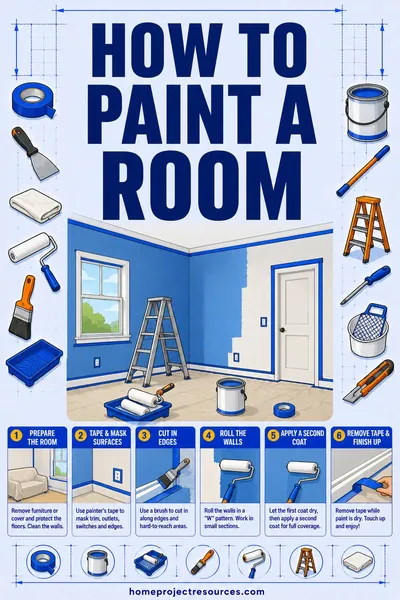
Related: Cost to paint a room gives the homeowner-side view of the same job your customers are comparing against. Cost to paint a house interior scales it to a whole home, and cost to paint a house exterior covers siding, stories, and scraping. How to paint a room covers the technique behind the production rates. The Paint Calculator turns your measurements into wall area, ceiling area, and gallons per coat.