How to Read a Tape Measure: Inches, Fractions and Rounding to the Nearest 16th

To read a tape measure, find the last inch number before your mark, then look at which small line your mark lands on. The longest small line between two numbers is the half inch. The next longest are the quarters. Shorter again are the eighths, and the shortest lines on most tapes are the sixteenths. Add that fraction to the inch number and you have your reading, like 5 and 3/8 inches.
That's really all there is to it. The trick is learning to recognize each line by its length, so you don't have to count every tiny mark. Once you can see a half, a quarter and an eighth at a glance, measuring for shelves, curtains, a door or a board cut becomes quick. If you just got a new set of tools, this is the very first skill I'd learn.
Key facts
- The numbered long lines are whole inches.
- The longest unnumbered line is 1/2; then 1/4 and 3/4; then the eighths.
- The shortest lines on most tapes are sixteenths: 16 in every inch.
- Between two lines, round to the nearer one.
- The sliding hook is meant to move. Don't bend it back.
Free calculator from Home Project Resources
Tape Reader: Turn a Mark Into an Inch Reading
Pick the kind of mark you landed on and the smallest mark on your tape. You get the fraction and how to round it.
Need more? Open the free Paint Calculator.
 Paint Calculator
 Square Footage Calculator
 Wallpaper Calculator
The Tape Reader above turns a mark into a reading. Under "The mark you landed on," pick the kind of line: the longest small line past an inch (a half), the next longest (a quarter or three-quarter), a shorter line (an eighth) or the shortest line (a sixteenth). Under "The smallest mark on your tape," choose 1/16 inch, which is most common, 1/8 inch for a simple tape, or 1/32 inch for a finer one. It tells you how to read the fraction and how to round when your edge falls between lines.
Quick reference: what each line means
| Line | Fraction | In sixteenths |
|---|---|---|
| Longest, numbered | 1 inch | 16/16 |
| Longest unnumbered | 1/2 | 8/16 |
| Medium | 1/4 and 3/4 | 4/16 and 12/16 |
| Shorter | 1/8, 3/8, 5/8, 7/8 | 2/16, 6/16, 10/16, 14/16 |
| Shortest | 1/16, 3/16, 5/16 and so on | Odd sixteenths |
Why the lines get shorter
A tape measure is really a ruler that splits each inch in half, then in half again, and again. The half-inch line is the longest unnumbered line because it splits the inch into two equal parts. Each half is then split into quarters, which get a slightly shorter line. Each quarter is split into eighths with a shorter line still, and each eighth is split into sixteenths with the shortest line of all.
That's why the pattern repeats in every single inch. Once you see the halfway line, you know where the quarters are, and the eighths sit right in between. You don't need to memorize sixteen separate marks. You just need to know the four line lengths and what each one stands for. Some finer tapes go one step further and split the sixteenths into thirty-seconds, but most household tapes stop at sixteenths, and some simple tapes stop at eighths.
Reading a tape measure, step by step
Here's the method I use every time, whether I'm measuring a window for blinds or a board for a shelf.
- Hook the end on the edge of the board or wall, and pull the tape straight and flat.
- Find the inch number just before your mark. That's your whole number of inches.
- Look at the line your mark lands on and name it by its length.
- Write it as a whole number and a fraction, like 5 3/8 inches.
If naming the line feels hard at first, count the shortest lines from the inch number instead. Each one is a sixteenth. Six of them past 5 inches is 5 6/16, which reduces to 5 3/8. After a few tries, you'll stop counting and start seeing the lines.
Sixteenths and how to reduce them
There are 16 sixteenths in an inch, so every fraction on a standard tape can be written with 16 on the bottom. Two sixteenths is 1/8, four is 1/4, six is 3/8, eight is 1/2, ten is 5/8, twelve is 3/4 and fourteen is 7/8. The odd ones, like 1/16, 3/16 and 5/16, can't be reduced any further.
The easy rule for reducing is to divide the top and bottom by 2 until the top is an odd number. So 12/16 becomes 6/8, which becomes 3/4. That's handy when your plans say 3/4 inch and your tape only makes you think in sixteenths. It also helps when you add measurements together. If you need 2 3/8 plus 1 1/4, change both to sixteenths: 2 6/16 plus 1 4/16 is 3 10/16, which is 3 5/8.
A worked example: measuring a shelf board
Say you're putting a shelf inside a closet, and you measure the space between the side walls. The tape passes 29 inches and your eye lands on a short line, two marks past the quarter. The quarter is 4/16, so two more sixteenths makes 6/16, which is 3/8. Your space is 29 3/8 inches.
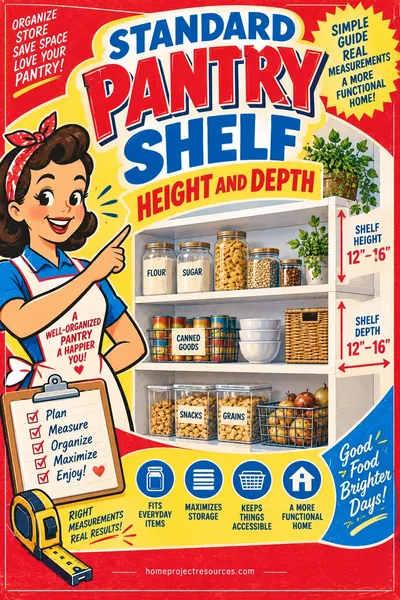
Now measure again at the back of the closet, since walls are rarely perfectly parallel. Say the back reads 29 1/4. Use the smaller number so the shelf slides in, and take off a hair, about 1/16, for easy fitting. So you'd mark the board at 29 3/16 inches. Mark with a sharp pencil, measure twice, and remember the saw blade has width, so cut on the waste side of the line. For more on shelf spacing, our guide to closet shelf height covers the usual heights for shelves and rods, and pantry shelf height does the same for the kitchen.
Feet, inches and longer measurements
Past 12 inches, most tapes keep counting in inches, so you'll see 13, 14, 15 and on up. Many also mark each foot, often with a small "1F" or "2'" next to the 12 and 24 inch lines, and some print feet and inches together, like 1'1" for 13 inches. Either way, the small lines inside each inch work exactly the same.
To change inches into feet, divide by 12. So 75 inches is 6 feet 3 inches, since 6 times 12 is 72 and 3 are left over. That's handy for rooms, since calculators and stores often want feet and inches. For a long room, have a helper hold the hook, or set it on a small nail, and keep the tape off the floor so it doesn't snake around furniture. When the room is longer than your tape, mark a spot with a pencil, measure to it, then measure on from it and add the two numbers.
Rounding to the nearest 16th
Real edges don't always land neatly on a line. When yours falls between two lines, pick the closer one. If it sits right in the middle, think about what you're making. Round up when you want a snug fit and can trim later, and round down when the piece has to slide into a space. A shelf that's 1/16 too short is fine. One that's 1/16 too long won't go in.
On a simple tape that stops at eighths, there are no sixteenth lines, so round to the nearest eighth. On a finer tape with thirty-seconds, you can read closer than you'll usually need for home projects. For most jobs around the house, the nearest sixteenth is plenty.
The sliding hook and the special marks
The metal hook at the end of the tape is loose on purpose. It slides a tiny bit, exactly the thickness of the hook. When you hook it over an edge and pull, it slides out so the reading starts at the inside of the hook. When you push it against a wall for an inside measurement, it slides in so the reading starts at the outside of the hook. Either way, the reading stays accurate. Please don't bend or tighten it to stop it moving.
Many tapes also mark stud spacing, often every 16 inches, with red numbers or highlighted marks. Some have small black diamonds for other spacing used in framing. Styles differ, so check the tape you own. If you're hunting for studs to hang a TV or shelves, our guide on how to use a stud finder pairs well with those marks.
Mistakes I see most often
The most common mistake is counting from the wrong inch number, especially when your mark is close to a numbered line. Always read the number just before your mark, not the one after it. The second is mixing up 3/8 and 5/8. They're the same length line on opposite sides of the half, so check which side of the half your mark is on: 3/8 is before it and 5/8 is after.
Other mistakes are bending the tape around a corner, which adds length, letting the tape sag over a long span, and looking at the mark from an angle instead of straight down. And the classic: forgetting the width of the saw cut. Use the same tape for every measurement in a project, too, since two tapes can differ a little.
Putting your tape to work around the house
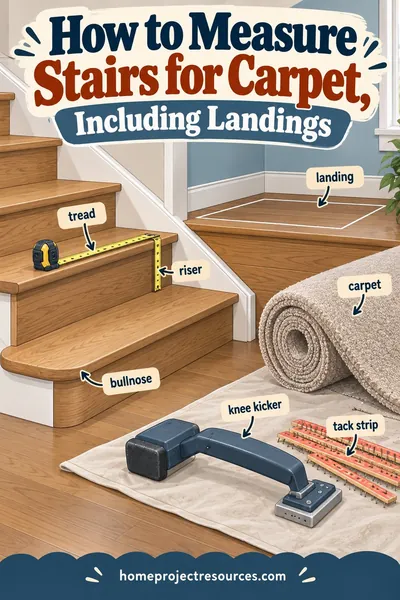
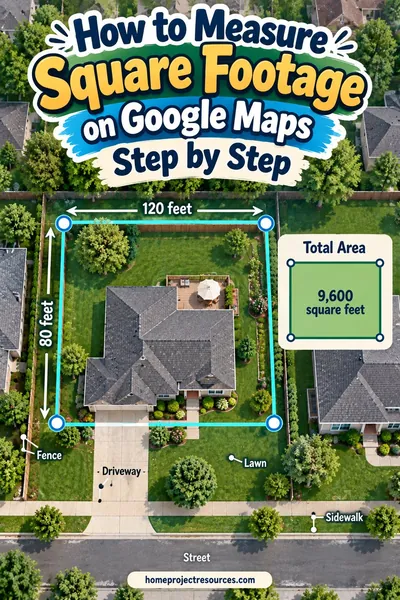
Once you can read a tape, a lot of home projects open up. Measuring a room for paint, flooring or carpet starts with two simple numbers, length and width. Our square footage calculator takes feet and inches for any shape, and our flooring calculator turns that into boxes to buy. For walls, the paint calculator works out gallons with doors and windows taken off.
Replacing a door or ordering blinds needs careful fractions, and our guide to standard door sizes shows how to measure a rough opening. Hanging a TV at the right height is another tape-and-pencil job, covered in how to hang a TV. For woodworking, types of wood explains nominal and actual sizes, and the board feet calculator helps when you buy lumber. A good tape is also one of the first items in our list of essential DIY tools.
Quick answers about reading a tape measure
How do you read a tape measure in inches?
Find the last inch number before your mark. Then look at the line your mark lands on. The longest small line is a half inch, the next is a quarter, then an eighth, then a sixteenth. Add that fraction to the inch number, so a mark three eighths past 5 reads 5 3/8 inches.
What are the little lines on a tape measure?
They're fractions of an inch. On most tapes the lines go down to 1/16 inch, and the shorter the line, the smaller the fraction. Simple tapes may stop at eighths, and finer tapes may go down to thirty-seconds. The pattern repeats in every inch.
How many 16ths are in an inch?
There are 16 sixteenths in one inch. So 8/16 is 1/2, 4/16 is 1/4 and 2/16 is 1/8. To reduce a fraction, divide the top and bottom by 2 until the top is odd. For example, 12/16 becomes 6/8, which becomes 3/4.
How do you round to the nearest 16th?
Find the closest line on your tape. If the edge falls between two lines, pick the nearer one. If it sits exactly halfway, many people round up for a snug fit they can trim, and down for a piece that has to slide into a space.
What do the red numbers and black diamonds mean?
Many tapes mark stud spacing, often every 16 inches, with red numbers or highlighted marks. Some also have small black diamonds for other spacing used in framing. Styles differ between brands, so check the tape you own to see what its special marks mean.
What does the tab at the end of a tape measure do?
The metal hook slides a little on purpose, by exactly its own thickness. It moves out when you hook it over an edge and in when you push it against a wall, so the reading stays accurate for both outside and inside measurements. Don't bend it to stop it moving.
Which side of the half is 3/8 and which is 5/8?
Both are eighth lines of the same length. 3/8 sits just before the half-inch line, between the 1/4 and the 1/2. 5/8 sits just after it, between the 1/2 and the 3/4. Check which side of the half your mark is on, and you'll never mix them up.
How do I measure accurately by myself?
Hook the tape firmly on an edge, or use the hook's nail slot over a small nail or screw for long spans. Keep the tape straight and tight with no sag, look straight down at the mark, and measure twice. Use the same tape for every measurement on a project.