Laminate vs Vinyl Plank

The choice between laminate vs vinyl plank comes down to one thing: water. Laminate has a compressed wood-fiber core that swells permanently the first time it gets soaked, and luxury vinyl plank is plastic all the way through, so it doesn't. That single fact decides most rooms before cost, looks, or warranty ever enter the conversation.
Put vinyl plank in kitchens, bathrooms, laundry rooms, basements, and any home with pets or small kids. Put laminate in bedrooms, hallways, offices, and living rooms, where it costs less and, at the mid tier, usually looks and feels more like real wood.
Updated August 2026
A note on numbers. This page compares the two floors on water behavior, wear layers, AC ratings, lifespan and quantities rather than dollar figures. Flooring pricing swings with the product line, the retailer, the promotion running that week and local install labor, and none of it is ours to set. Run your quantities here, then price both materials against that same square footage.
Figure out how much you need before you shop. Our free flooring calculator turns your room dimensions into boxes with waste included, so you can price both materials against the same square footage.
Laminate vs vinyl plank at a glance
Here's the head-to-head. The cost rows compare the two materials against each other rather than naming a price, because the range within each material is wider than the gap between them.
| Factor | Laminate | Luxury vinyl plank (LVP) |
|---|---|---|
| Relative material cost | The cheaper of the two at every tier, and the cheapest hard surface that still convinces | Runs above laminate tier for tier, and the top of its range goes much higher |
| Relative installed cost | Lower, and the labor rate is the lower of the two | Higher, because installers charge a little more per square foot for plank vinyl |
| Water resistance | Poor to fair. Core swells when saturated and the damage is permanent | Excellent. Waterproof through the full thickness |
| Scratch and dent resistance | Scratches better than LVP, dents worse | Dents better than laminate, scratches worse |
| Feel underfoot | Harder, more like real wood, slight click | Softer, slightly warmer, quieter |
| Sound | Hollow and clicky without good underlayment | Quieter, especially in thicker rigid-core products |
| Warmth | Cool, but less cold than tile | Slightly warmer, works with most radiant heat systems |
| Repairability | Replace a plank by disassembling back to it | Same for click-lock, individual glue-down planks pop out |
| Resale impression | Neutral. Budget-friendly, reads as builder-grade in a kitchen | Neutral to positive. "Waterproof" is a selling point in listings |
| Realistic lifespan | 10 to 20 years in dry rooms, 1 flood | 15 to 25 years, survives floods |
The honest summary: LVP wins on risk, laminate wins on price and, at the same budget, usually on looks. If you can afford to be wrong about water, laminate is a fine floor. If you can't, buy vinyl.
What actually happens when laminate gets wet
This is worth understanding, because "water resistant laminate" is now printed on a lot of boxes and it doesn't mean what shoppers think.
Laminate is a sandwich. The core is high-density fiberboard, which is wood fiber compressed with resin. On top of that sits a printed photographic layer and a clear melamine wear layer. The top surface genuinely repels water. The core does not.
When water gets past the surface, usually through a seam, an edge, or a gap at the dishwasher, the fiberboard absorbs it and swells. The plank grows at the edges and the joints lift into a rippled ridge you can feel with a bare foot. That swelling is not reversible. Drying it out does not shrink it back.
"Water resistant" laminate typically means the joints are wax-coated or the core is treated, and the manufacturer warrants it against spills sitting for 24 to 72 hours. That covers a knocked-over glass. It does not cover a supply line letting go while you're at work.
"Waterproof" laminate exists too, usually with a plastic or composite core instead of fiberboard. At that point you're paying LVP prices for a product that is closer to LVP than to laminate, and you may as well compare it directly with vinyl.
Vinyl plank has no wood in it. Soak it, dry it, and it's the same plank. Water that gets under it can still ruin the subfloor and grow mold, so a leak is still an emergency, but the flooring itself survives.
The two specs that actually predict durability
Nobody at the store explains these, and they matter more than brand name or price.
LVP wear layer, measured in mils
The wear layer is the clear top film that takes all the abuse. It's measured in mils, which is thousandths of an inch. This is not the same as the plank's total thickness, and a thick plank with a thin wear layer will look worn out fast.
| Wear layer | Where it belongs | What to expect |
|---|---|---|
| 6 mil | Closets, guest rooms, rentals you plan to replace | Scuffs visible in traffic lanes within a few years |
| 12 mil | Normal residential, low-traffic rooms | Fine for a bedroom or a quiet adult household |
| 20 mil | Kitchens, entries, family rooms, homes with dogs | The residential sweet spot. Buy this if you can |
| 28 to 30 mil | Light commercial, very heavy traffic | More than most houses need |
If you remember one number from this page, make it 20 mil. The price gap between a 12 mil and a 20 mil plank is small per square foot, and it roughly doubles the useful life in a busy room. Across a typical kitchen that upgrade is a rounding error against the cost of the job, and it is the cheapest real improvement available in it.
Total plank thickness is a separate spec, usually 4 mm to 8 mm. Thicker planks hide subfloor imperfections better and feel more solid, but thickness alone tells you nothing about how the surface will hold up.
Laminate AC rating
Laminate uses an AC rating, which stands for abrasion class. It's a standardized test of how much surface abuse the wear layer takes before the print underneath shows through. It runs AC1 through AC6.
| AC rating | Rated for | Real-world use |
|---|---|---|
| AC1 | Moderate residential | Closets and bedrooms only. Rare on shelves now |
| AC2 | General residential | Bedrooms, dining rooms, light traffic |
| AC3 | Heavy residential / light commercial | The residential standard. Buy at least this |
| AC4 | General commercial | Hallways, entries, homes with dogs. Worth the small upcharge |
| AC5 | Heavy commercial | Retail floors. Overkill at home |
| AC6 | Very heavy commercial | Not a residential product |
Buy AC3 minimum, AC4 for any room that gets shoes, dogs, or chairs rolling on it. An AC2 laminate in a hallway will show a dull path within a couple of years.
Here's the useful pairing to keep in your head at the store: AC4 laminate and 20 mil LVP are roughly equivalent tiers. Compare prices at that level, not between a bargain laminate and a premium vinyl.
Where laminate wins
Budget bedrooms and living areas. Laminate is the cheapest hard-surface floor that still looks convincing. Nothing else at the bottom of the market comes close.
The wood look at the mid tier. This surprises people. Spend the same amount per square foot on each and a good embossed-in-register laminate has deeper, more varied texture and a more convincing grain than the vinyl. The texture lines up with the printed grain, so the plank feels like wood under your hand. Vinyl closes the gap at the top of the market, but at the middle of the market laminate usually looks better.
Firmness underfoot. Laminate sits on a harder core, so it doesn't telegraph subfloor bumps the way thin flexible vinyl can, and it feels more like a real wood floor when you walk on it.
Scratch resistance. A melamine wear layer is harder than a vinyl one. Dog claws and grit under shoes mark vinyl before they mark a comparable laminate.
Where vinyl plank wins
Anywhere with a water source. Kitchen, bathroom, laundry, mudroom, wet bar. This is not close.
Basements. Concrete slabs give off moisture vapor even when they look bone dry, and below-grade humidity swings are brutal on a wood-fiber core. LVP over a slab, with a moisture barrier, is the standard answer.
Homes with pets. Vinyl shrugs off accidents that would destroy laminate seams, and it's quieter under claws.
Homes with kids. A dropped glass of juice that sits until you notice it isn't a flooring event.
Dent resistance and comfort. Vinyl compresses and recovers where laminate chips. It's softer on your feet and warmer on a winter morning.
Bathrooms specifically. Most laminate warranties exclude full bathrooms outright, which tells you what the manufacturer thinks.
Click-lock vs glue-down vs loose lay
Both materials come in more than one installation type, and this decision affects how the floor behaves as much as the material does.
| Installation type | How it works | Best for | Watch out for |
|---|---|---|---|
| Click-lock (floating) | Planks lock edge to edge and float over the subfloor. No adhesive | Most DIY jobs, both materials, over existing hard floors | Needs a 1/4 inch expansion gap at every wall. Can telegraph an uneven subfloor |
| Glue-down | Each plank is adhered to the subfloor with trowel-applied adhesive | Large open commercial-scale areas, heavy rolling loads, big sun-exposed rooms | Subfloor has to be near-perfect. Removal is a miserable job |
| Loose lay | Heavy vinyl planks with a friction backing sit in place, sometimes with perimeter adhesive | Rentals, rooms you may reconfigure, over old vinyl | Only works with products designed for it. Needs a flat, clean subfloor |
Click-lock is what most homeowners want. It's the fastest to install, the easiest to repair, and it doesn't commit you.
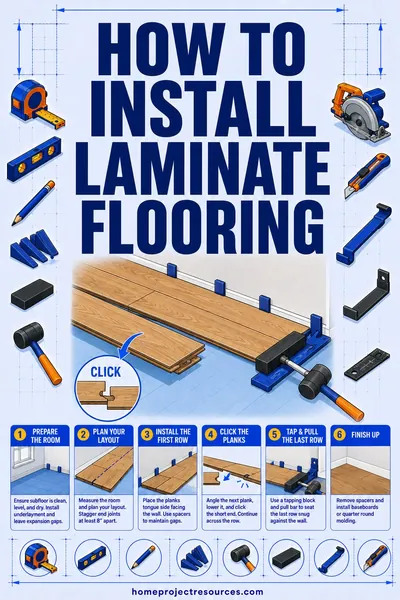
One important detail with floating floors of either material: they need room to move. Laminate moves with humidity, vinyl moves with temperature. Both need a 1/4 inch expansion gap at every wall and around every pipe and door jamb, hidden by baseboard or shoe molding. Our guide to installing laminate flooring walks through the gap, the stagger pattern, and the underlayment decision step by step, and almost all of it applies to click-lock vinyl too.
Rigid-core vinyl is worth knowing about here. SPC (stone plastic composite) has a mineral-filled core that's dense, stable in sunrooms and other temperature swings, and hides subfloor bumps well. WPC (wood plastic composite, though there's no real wood in most of it) is a bit thicker, softer, and quieter. SPC is the safer default; WPC feels better underfoot.
Worked example: a 12x14 kitchen and dining area
Say you're flooring a 12 by 14 foot space, which is 168 square feet. Order 10 percent extra for cuts and waste, so you're buying about 185 square feet.
| Option | Material you're buying | Underlayment | Installed labor | Where it lands overall |
|---|---|---|---|---|
| Budget laminate, AC3 | 185 sq ft at the bottom of the laminate range | A separate roll, a small added line per sq ft | Laminate labor rate | The cheapest of the four by a clear margin |
| Mid laminate, AC4, attached pad | 185 sq ft in the middle of the laminate range | Included in the plank | Laminate labor rate | Modestly above the budget option, and a much better floor |
| Mid LVP, 12 mil, SPC | 185 sq ft in the middle of the vinyl range | Attached, nothing to buy | Vinyl labor rate, slightly higher | Close to the mid laminate, with the waterproof core included |
| Better LVP, 20 mil, SPC | 185 sq ft toward the top of the mainstream vinyl range | Attached, nothing to buy | Vinyl labor rate, slightly higher | The most expensive of the four, and the only one built for a busy kitchen |
DIY removes the labor line entirely, and on a room this size labor is close to half the installed total. Click-lock plank is genuinely one of the most DIY-friendly projects in a house.
Notice the real spread: the gap between the cheapest laminate and the LVP you actually want in a kitchen is a fraction of what replacing a swollen floor costs. Against the risk of tearing the whole thing out after one dishwasher leak, that's a reasonable insurance premium. In a bedroom, where there's nothing to leak, it's money you don't need to spend.
For comparison, carpeting the same room lands in a similar bracket, but with a much wider spread, because pad quality and carpet grade move the number more than the room size does. Our cost to carpet a room breakdown explains where the pad decision fits.
How to evaluate a flooring quote
A quote for either material should separate these lines. If it doesn't, ask.
- Material, with the product name, and for vinyl the wear layer in mils, for laminate the AC rating
- Underlayment, or a note that it's attached to the plank
- Installation labor per square foot
- Old flooring removal and disposal, priced per square foot and much higher for glued-down tile, so ask what the existing floor is assumed to be
- Subfloor prep and leveling, priced as an allowance because nobody knows until the old floor comes up
- Transitions, thresholds and trim, charged per piece with one per doorway, so count your doorways before you compare bids
- Toilet pull and reset in a bathroom, which is a separate line and sometimes a separate trade
Two quotes are only comparable when the wear layer or AC rating matches. A bid that comes in well under the others on a 6 mil vinyl isn't cheaper, it's a different product. Get three bids, write the wear layer or AC rating into the scope yourself so every bidder is pricing the same floor, and treat any bid with no subfloor prep allowance as incomplete rather than competitive.
Frequently asked questions
Is vinyl plank better than laminate?
For rooms that can get wet, yes, clearly. For dry rooms, no, and laminate often looks better for the money. Vinyl is the safer choice overall because the failure mode of laminate is total, but "better" depends on which room you're standing in.
Does luxury vinyl plank add value to a home?
It reads as a neutral-to-positive upgrade in most listings, especially over old carpet or dated sheet vinyl. Buyers respond to "waterproof" in a kitchen or basement. Neither material carries the resale premium that solid hardwood does in higher-end homes.
Can you put laminate in a kitchen?
You can, and plenty of people do, but it's the room where laminate most often fails. Dishwasher and refrigerator supply lines leak slowly and out of sight, and the damage shows up as swollen seams months later. If you want laminate in a kitchen, buy a waterproof-core product and seal the perimeter.
How long does vinyl plank flooring last?
Typically 15 to 25 years in a home, driven mostly by the wear layer. A 20 mil wear layer in a normal household should still look good at 20 years. A 6 mil wear layer in an entryway can look tired in three.
Is thicker vinyl plank always better?
No. Total thickness affects how solid the floor feels and how well it hides subfloor imperfections, but the wear layer determines how it ages. An 8 mm plank with a 6 mil wear layer will wear out before a 5 mm plank with 20 mil.
Do I need underlayment under vinyl plank?
Usually not, because most rigid-core LVP comes with pad already attached, and adding a second layer under it can void the warranty by letting the joints flex. Over a concrete slab you do want a vapor barrier if the product doesn't include one.
Which one is quieter?
Vinyl, especially thicker SPC and WPC with attached pad. Laminate sounds hollow and clicky over a hard subfloor unless you use a decent acoustic underlayment, which is a small per square foot upgrade and worth every bit of it.
Can either one go over existing tile?
Yes, both can float over sound, well-adhered tile. Fill the grout lines with a leveling compound first if they're deeper than about 1/8 inch, or the joints will flex and eventually fail. Check your door clearances before you add thickness.
The short version
Water decides it. Laminate's fiberboard core is a permanent liability in any room with a plumbing fixture, and no marketing term changes that. Vinyl plank costs more and gives up a little in looks and scratch resistance to buy that immunity.
Buy AC4 laminate for dry rooms on a budget. Buy 20 mil LVP for everything else. Then run your square footage through the flooring calculator so you order the right number of boxes the first time.