Carpet Padding Cost: What the Spec Actually Buys

Carpet padding cost is driven by three numbers on a label, not by the size of your room: density in pounds per cubic foot, thickness in inches, and the pad type. A 6 pound rebond at 7/16 inch and a 2 pound prime foam at 7/16 inch look nearly identical on the showroom rack, feel similar under your hand, and behave completely differently after two winters of foot traffic. One holds the carpet fibers up. The other packs flat and lets the carpet grind against itself.
That is the whole story. Pad is the cheapest line on a carpet quote and the one that decides how long the expensive line lasts.
Updated September 2026
Size the job before you shop. Our free flooring calculator switches to square yards when you pick carpet, applies a waste allowance for the install pattern, and gives you the area figure both the carpet and the pad get quoted from.
What a carpet padding cost line actually covers
When an installer writes "pad" on a quote, it is usually bundling several things. Ask which of these are in there, because a quote that separates them is a quote you can compare.
| Line item | What it is | Where it hides |
|---|---|---|
| Pad material | The pad itself, by square yard or by roll | Sometimes given only as "included" |
| Pad installation | Cutting, seam taping, stapling or gluing | Often folded into carpet labor |
| Tack strip | New strip around the perimeter | Reused strip is a red flag on old jobs |
| Seam tape for pad | Tapes pad seams so they cannot separate | Skipped on cheap installs |
| Old carpet and pad removal | Pulling, rolling, bagging | Usually a separate line, sometimes not |
| Haul away and disposal | Dump fees for two materials | Frequently the missing line on a low bid |
| Subfloor prep | Nail pops, squeak fixes, patching | Always extra, and always found on tear-out day |
| Furniture moving | Rooms cleared and put back | Bid per room or excluded outright |
| Stair pad | Cut per tread, wrapped over the nosing | Priced per step, not by area |
The single most common quote problem is a pad allowance with no spec attached. "Includes standard pad" tells you nothing, because standard means whatever that dealer stocks by the pallet. Make them write the density, the thickness, and the type.
Density and thickness: the two numbers that matter
Density is weight per cubic foot, and it measures how much material is actually in the pad. Higher density means more resistance to compression, which is the entire job.
Thickness is comfort, and more of it is not better. A thick soft pad lets the carpet backing flex too far with every step, which breaks down the backing and opens seams. Most carpet manufacturers cap pad at 7/16 inch for cut pile and 3/8 inch for berber and loop, and set a minimum density around 6 pounds for residential cut pile and 8 pounds for loop.
Here is the arithmetic that lets you cross check a label, since some pads are sold by weight per square yard instead of by density:
pounds per square yard = 9 x (thickness in inches / 12) x density in pounds per cubic foot
So a 7/16 inch pad at 6 pounds is 9 x 0.0365 x 6 = 1.97 pounds per square yard. A 1/2 inch pad at 8 pounds is 9 x 0.0417 x 8 = 3.0 pounds per square yard. If a sample feels thick but weighs almost nothing in your hand, that is a low density pad, and the label will confirm it.
Two rules that come out of this:
- Density before thickness. Given a choice between thicker at low density and thinner at high density, take the thinner and denser pad every time.
- Read your carpet warranty first. It names a maximum thickness and a minimum density by name, and installing outside that range voids it. The Carpet and Rug Institute publishes the general guidance most manufacturers build their specs from.
Pad types, compared
| Pad type | Typical density | Typical thickness | Best fit | Watch out for |
|---|---|---|---|---|
| Prime urethane foam | about 2 to 3 lb | 3/8 to 1/2 in | Short term, rentals, staging | Bottoms out fast, often below warranty minimums |
| Bonded urethane, called rebond | 5 to 8 lb | 3/8 to 7/16 in | The residential default | Quality varies a lot between 5 lb and 8 lb |
| Memory or visco foam | 8 to 12 lb | 7/16 in | Bedrooms where softness is the point | Can exceed a thickness cap, check the warranty |
| Frothed or densified foam | 12 to 22 lb | 1/4 to 3/8 in | Thin, dense, very long life | Thin feel disappoints buyers expecting plush |
| Fiber pad, synthetic or felt | rated in ounces per square yard | 3/8 in | Berber, loop pile, glue down | Firmer underfoot by design |
| Flat rubber, slab | 18 to 22 lb | 1/4 to 3/8 in | Stairs, high traffic, commercial | Heaviest to handle, premium product |
| Waffle rubber | rated in ounces per square yard | 1/4 to 3/8 in | Older residential spec | Air pockets crush over time |
Rebond, the multicolored one made from recycled foam scrap, covers most residential installs and covers them well at 6 to 8 pounds. Below 6 pounds it stops carrying the carpet. That density number is stamped or printed on the pad itself, so flip a sample over at the store rather than taking a salesperson's word.
Matching the pad to the carpet
| Carpet style | Maximum thickness | Minimum density | Typical choice |
|---|---|---|---|
| Plush, saxony, cut pile | 7/16 in | 6 lb | 7/16 in, 6 to 8 lb rebond |
| Textured, frieze | 7/16 in | 6 lb | 7/16 in, 8 lb rebond |
| Berber, level loop | 3/8 in | 8 lb | 3/8 in, 8 lb rebond or fiber pad |
| Commercial low pile | 1/4 to 3/8 in | 8 lb | Frothed foam or flat rubber |
| Stairs, any style | 7/16 in | 8 lb | 8 lb rebond or rubber |
| Basement over concrete | 7/16 in | 8 lb | Moisture barrier pad |
Berber is the one people get wrong. A loop pile carpet on a soft thick pad flexes at every step, the backing works against itself, and the loops start snagging along the flex lines. Firmer and thinner is correct there, and it will feel less luxurious in the showroom for exactly the right reason.
Stairs deserve the densest pad in the house. A stair nosing takes concentrated load on a narrow strip a few times an hour, every day, forever.
How much pad you need: the roll math
Carpet and pad come in different widths, so they waste differently, and this trips up almost every homeowner comparing two quotes.
- Carpet is broadloom off a fixed width roll, usually 12 feet, sometimes 13 feet 2 inches or 15 feet.
- Pad comes on rolls that are usually 6 feet wide, commonly 45 feet long, which is 270 square feet or 30 square yards per roll. Some suppliers stock 6 by 60 rolls at 360 square feet.
- One square yard equals 9 square feet. Carpet is quoted per square yard, pad is often quoted per square yard, and flooring is usually quoted per square foot, which is how quotes end up looking wildly different for the same room.
Because pad comes in a narrower roll, it nests into odd room shapes better than carpet does, and its waste is usually lower. That is worth knowing when a quote lists the same square yardage for both, since it may mean the dealer is simply billing pad at the carpet's waste-inflated number.
Worked example: living room, bedroom, and 14 stairs
Real takeoff, no money in it, just the quantities both the carpet and the pad get priced from.
The rooms: a 15 by 20 foot living room, a 12 by 12 foot bedroom, and a straight 14 step staircase 36 inches wide.
Floor area: 300 + 144 = 444 square feet, or 49.3 square yards.
Carpet, off a 12 foot roll
The living room is 15 by 20, and neither dimension is 12, so the roll direction decides the waste.
- Run the roll the long way: a 12 by 20 piece plus a 3 by 20 filler cut from another 20 feet of roll. That is 40 lineal feet of 12 foot carpet, or 480 square feet.
- Run it the short way: a 12 by 15 piece plus an 8 by 15 filler cut from another 15 feet. That is 30 lineal feet, or 360 square feet.
Same room, 120 square feet of difference, purely from which way the installer rolls it out. Ask for a roll layout drawing before you approve anything.
The bedroom is a gift: 12 by 12 is exactly the roll width, so 12 lineal feet is 144 square feet with zero waste.
The stairs come out of the same roll. A standard 10 inch tread with a 7.75 inch riser needs about 20 inches of carpet per step, and installers round to 24 inches to allow for the nosing wrap and trimming. Each step piece is 36 inches wide, so four pieces fit across a 12 foot roll. Fourteen steps is 4 rows, and 4 x 24 inches is 96 inches, which is 8 lineal feet of roll, or 96 square feet.
Carpet total: 360 + 144 + 96 = 600 square feet, or 66.7 square yards, to cover 444 square feet of floor plus the stairs.
Pad, off a 6 foot roll
The living room takes 6 foot strips. Three strips 20 feet long cover the 15 foot width with a half strip left over: 3 x 20 = 60 lineal feet, or 360 square feet. That leftover 3 by 20 strip is not garbage, and a good installer moves it into the bedroom.
The bedroom takes two 12 foot strips: 24 lineal feet, or 144 square feet, no waste.
Stair pad is cut per tread, not per step, and measuring stairs for carpet covers how to count those treads when the flight has a landing or winders. Each piece covers the tread depth plus the wrap over the nosing, about 13 inches, at 36 inches wide. Two fit across a 6 foot roll, so 14 steps is 7 rows at 13 inches, which is 91 inches, or 7.6 lineal feet, roughly 46 square feet.
Pad total: 360 + 144 + 46 = 550 square feet, or 61.1 square yards. If the installer nests the living room leftover into the bedroom, that drops to about 490 square feet.
Rolls: at 270 square feet per roll, 550 square feet is 3 rolls if you buy whole rolls, with roughly 260 square feet left over. Most dealers cut pad to length off the roll instead, which is why "how is the pad being sold, whole roll or lineal foot" is a fair question on a quote.
Tack strip: perimeter of the living room is 2 x (15 + 20) = 70 linear feet, the bedroom is 2 x (12 + 12) = 48, plus a strip at the back of each of the 14 treads. Deduct door openings, which get a metal transition instead.
Hand that takeoff to two dealers and the quotes become comparable, because the only remaining variable is their labor and margin.
What raises the pad line after the walkthrough
- Stairs. Every step is hand cut, hand wrapped, and hand stapled. Fourteen steps can take longer than the living room.
- Concrete subfloor. Pad gets glued instead of stapled, and a moisture barrier pad is usually specified.
- Curved or bullnose stairs. Each tread is a custom template.
- Furniture and appliance moving. Priced per room or excluded, and this is a common source of surprise charges.
- Old adhesive. Glue down carpet leaves residue that has to be scraped before new pad goes down.
- Subfloor repair. Squeaks, nail pops, and soft spots surface the moment the old carpet comes up.
- Transitions. Every doorway into a different flooring type needs its own transition strip.
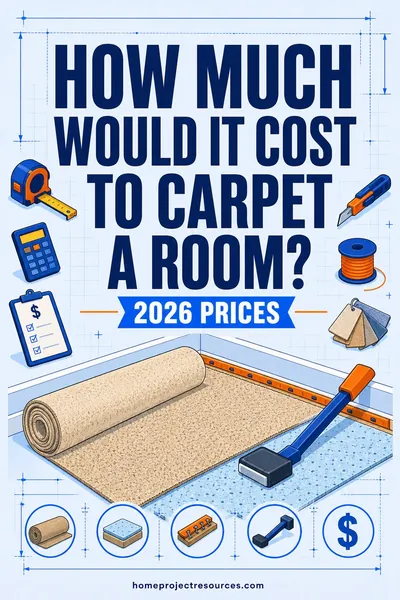
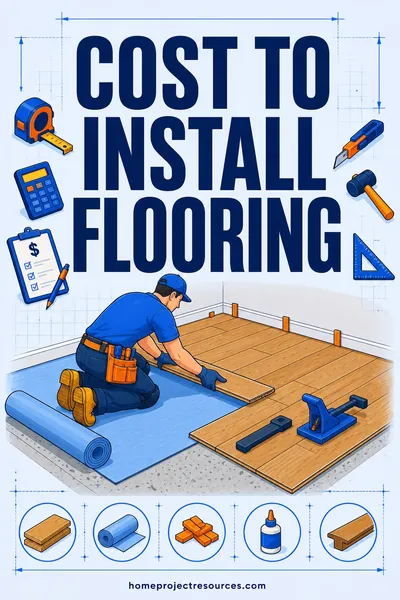
For a broader look at how flooring quotes get built, see our guides on cost to install flooring and how much would it cost to carpet a room.
Moisture, concrete, and basements
Pad over a concrete slab has one extra job: keeping slab moisture out of the carpet backing. A moisture barrier pad has a thin film laminated to the top face, which stops spills from soaking through and slows vapor coming up.
Two things worth knowing before you spec one.
First, a barrier pad is not a vapor barrier system. If the slab is actively wet, a film on the pad traps moisture underneath it and makes the problem worse, not better. Tape a 2 foot square of clear plastic to the bare slab, seal all four edges, and leave it 48 hours. Condensation under the plastic means the slab needs sealing before any flooring goes down.
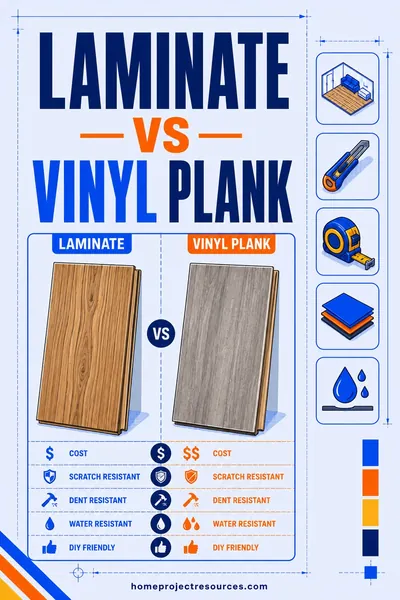
Second, below grade rooms with a moisture history are often better served by a hard surface. Our comparison of laminate vs vinyl plank covers the two usual alternatives.
If sound transfer is your reason for wanting a thick pad, a dense pad plus proper underlayment does more than a soft pad ever will. Our guide on how to soundproof a room covers what actually moves the needle on impact noise.
Can you reuse the old padding?
Usually not, and here is the honest test. Press your thumb hard into a piece of the old pad in a traffic lane. If it stays dented, it is done. Check the same spot under a sofa that has not moved in ten years and you will see what new pad looked like.
Reuse is defensible only when all four of these are true: the pad is under about five years old, it meets the new carpet's density and thickness spec, it has no stains or pet odor, and the traffic lanes still spring back. Miss any one and you are putting a warrantied carpet on a foundation that fails first.
Also expect an installer to decline. Most warranty their labor, and none of them want to warranty a floor over someone else's used pad.
How to compare two carpet quotes on the pad
- Density in pounds per cubic foot, written on the quote as a number.
- Thickness in inches, also a number.
- Pad type, named: rebond, frothed foam, fiber, rubber.
- Moisture barrier: yes or no, and why.
- Square yards of pad, and whether it matches the carpet yardage or the actual floor area.
- How pad is sold: whole roll or cut to length.
- Tack strip: new or reused.
- Stair pad: priced per step and stated separately.
- Removal and disposal of old carpet and old pad, both named.
- Subfloor prep: what is included and what is billed if found.
- Furniture moving: included, excluded, or per room.
- Warranty: on the pad, and on the labor, with lengths.
If one quote names an 8 pound 7/16 inch rebond and the other says "premium pad included," you do not have two quotes. You have one quote and one guess. Our guide on how to get contractor bids covers how to write the scope so every bidder answers the same questions.
FAQ
What density carpet pad should I buy?
Six pounds per cubic foot is the floor for residential cut pile and 8 pounds is the practical sweet spot for a family home. Berber, loop pile, and stairs want 8 pounds or better. Below 6 pounds the pad compresses permanently in traffic lanes within a couple of years, and the carpet above it wears at the same spots.
Is thicker carpet padding better?
No, and this is the most common padding mistake. Past about 7/16 inch, the carpet backing flexes too far with each step, which stresses seams and shortens the carpet's life. Most manufacturers cap pad thickness in the warranty for exactly that reason. Comfort comes from density holding the carpet up, not from softness letting it sink.
Does carpet padding come in the same width as carpet?
No. Carpet is usually a 12 foot roll and pad is usually a 6 foot roll, commonly 45 feet long for 270 square feet per roll. The narrower pad roll nests into rooms with less waste, so a quote that bills the same square yardage for pad and carpet is worth questioning.
How much padding do I need for stairs?
Figure the tread depth plus the nosing wrap for each step, roughly 13 inches for a standard 10 inch tread, at the width of the stair. Fourteen steps at 36 inches wide works out to about 46 square feet. Pad on stairs is cut per tread rather than run as a strip, and it should be the densest pad in the house.
Can I install carpet padding myself and have a pro do the carpet?
Most installers will not accept it, because they warranty the finished floor and cannot warranty a base someone else laid. Pad also has to be stapled at a specific spacing, seam taped, and cut back to the exact inside edge of the tack strip. Getting that wrong shows up as ridges under the carpet within weeks.
Does better padding make carpet last longer?
Yes, more reliably than almost any other upgrade on the quote. Pad absorbs the compression that would otherwise crush and abrade the carpet fibers, so a denser pad directly extends how long the carpet keeps its look. It also usually costs a small fraction of the carpet line, which is why it is the wrong place to save.
Do I need a moisture barrier pad?
Over a concrete slab, over radiant heat, in a basement, or in a house with pets or small children, it earns its place. On a dry wood subfloor upstairs it is optional. Test the slab first with the taped plastic square, because a barrier pad over an actively damp slab traps moisture rather than solving it.
Related: Size the job with the flooring calculator, then read the full quote breakdown in how much would it cost to carpet a room and cost to install flooring. For hard surface alternatives in damp rooms see laminate vs vinyl plank, and for noise see how to soundproof a room.