How to Soundproof a Room

There are only four mechanisms that reduce sound: mass, damping, decoupling, and absorption. Most people buy the fourth one, foam panels, when the problem calls for the first one, mass. Foam stuck on a wall does almost nothing to stop noise coming through that wall, and no amount of it will change that.
If you can hear the neighbors talking, you need weight and airtightness in the wall between you. If your own room echoes on a video call, you need soft surfaces inside the room. Those are two different problems with two different product aisles, and confusing them is the single most expensive mistake in this whole category.
Adding a second layer of drywall? Our drywall calculator gives you sheet counts, screws, and compound for the room so you can price the mass upgrade before you commit.
Updated September 2026
A note on numbers. This page gives you assemblies, STC ratings, quantities and sequence, not dollar figures. Drywall, lumber and trade labor are priced by your region and by how busy the market is, and none of that is ours to set. Work out your quantities here, then price them locally and get written quotes before you commit.
Absorption versus blocking, the distinction that decides everything
Say this out loud before you buy anything.
Sound absorption treats sound inside a room. Soft porous material, foam, mineral wool panels, heavy curtains, rugs, upholstered furniture, soaks up reflected sound energy. It kills echo, flutter, and reverb. It makes a room sound better to be in and better to record in. It does not stop sound from getting out or getting in.
Sound blocking stops sound passing between spaces. Heavy airtight assemblies, a second layer of drywall, mass loaded vinyl, solid core doors, sealed gaps, structural separation. It reduces how much noise transmits through the boundary. It does nothing for how the room sounds inside.
The reason foam is everywhere is that it looks like the solution. Studio photos are full of it. But a 2 inch foam panel weighs a few ounces per square foot. A wall assembly that blocks sound weighs 4 to 8 pounds per square foot. You cannot block sound with something that light, and stapling a hundred of them to the wall changes nothing about what the neighbors hear.
Simple test for which problem you have: clap once in the middle of the room. If you hear a ringing tail afterward, you have a reverb problem and absorption is the answer. If the room sounds fine but you can hear the TV next door, you have a transmission problem and absorption is a waste of money.
Airborne versus impact noise
Blocking splits again, and the split matters because the fixes are different.
Airborne noise travels through air and then vibrates the wall: voices, TV, music, traffic, dogs. It is rated by STC. The fixes are mass, sealing, damping, and decoupling in the wall or ceiling assembly.
Impact noise is structure borne. Something hits the building and the vibration travels through framing: footsteps upstairs, a dropped shoe, a chair scraping, a slammed door, a washing machine. It is rated by IIC. Adding drywall to the ceiling below does relatively little for it, because the energy is already inside the structure.
Impact noise fixes work at the source or at the connection:
- Carpet with a good pad on the floor above is the single most effective and cheapest fix. It can improve impact rating by 20 points or more, which no ceiling treatment matches.
- Underlayment under hard flooring: cork, rubber, or a rated acoustic mat.
- Decoupling the ceiling below with resilient channel, sound isolation clips, or a separate joist system, so the drywall is not rigidly connected to the joists.
- Isolation pads under appliances and equipment.
The honest summary: if the problem is footsteps from the apartment above and you cannot touch their floor, you are looking at a decoupled ceiling, which is a real construction project. There is no product you hang on the ceiling that solves it cheaply.
Seal the gaps first, because sound follows air
Before you spend a dollar on materials, seal the leaks. Sound behaves a lot like air, and a wall with a 1 percent open area loses most of its rating. A perfect STC 55 wall with an unsealed gap performs like a much cheaper wall.
Work through this list in order:
- Door undercut. The gap under a hollow interior door is often 3/4 to 1 inch tall across a 32 inch door, which is about 24 square inches of straight open path. This is usually the largest single leak in the room. An automatic door bottom or a sweep plus perimeter weatherstripping closes it.
- Electrical outlets and switches. Boxes are cut through the drywall and they are often back to back with a box in the next room, which is a nearly direct hole. Turn the power off at the breaker, verify it with a non-contact voltage tester at the outlet before removing anything, then add putty pads around the box exterior or acoustic sealant and foam gaskets. If you are not comfortable working around wiring, this is a small job for an electrician.
- The wall to floor and wall to ceiling joint. Pull the baseboard and look. Drywall usually stops half an inch short of the subfloor and that gap runs the whole length of the wall. Acoustic sealant, a non hardening flexible caulk, closes it.
- Recessed can lights. A can light is a hole in the ceiling with a fixture in it. Sealed IC rated housings or surface mount fixtures are better.
- HVAC ducts and returns. A duct running between two rooms is a speaking tube. Lined flex duct, longer runs with bends, and separate returns help.
- Window frames, pipe penetrations, and cable holes. Acoustic sealant on all of them.
Use acoustic sealant, not standard latex caulk, on anything structural. It stays flexible permanently, so the seal survives seasonal movement. A tube of it is one of the cheapest things in the aisle and it is the highest return per dollar in this entire article.
How to soundproof a room: techniques compared by cost
| Technique | Relative cost, 12 ft wall | Effort | Realistic gain | Honest note |
|---|---|---|---|---|
| Seal gaps, outlets, door bottom | The cheapest line here, a handful of tubes and pads | 2 to 4 hours | Up to 5 STC on a leaky wall | Do this first, always. Cheapest real gain |
| Heavy curtains over a window | Cheap to mid, driven entirely by the fabric you pick | 1 hour | 2 to 4 STC at the window | Helps a little on blocking, more on echo |
| Replace hollow door with solid core | Mid, and the door slab is nearly all of it | Half a day | 6 to 12 STC at the door | Only works if the perimeter is sealed too |
| Insulation in an open cavity | Cheap, one or two batts | Half a day | 4 to 8 STC | Only useful if the wall is already open |
| Mass loaded vinyl, 1 lb per sq ft | Several times what the same mass in drywall costs | 1 day, heavy | 3 to 6 STC over drywall | Overhyped for the price. Drywall is cheaper mass |
| Second layer of 5/8 drywall | Cheap for the mass gained, four sheets and screws | 1 to 2 days | 4 to 6 STC | Best dollar per point in the whole list |
| Second layer plus damping compound | Roughly double the plain second layer, the compound is the addition | 1 to 2 days | 8 to 12 STC | The real DIY sweet spot |
| Resilient channel plus new drywall | A little above the damped second layer | 2 days | 8 to 14 STC | Easy to short circuit with a long screw |
| Sound isolation clips and hat channel | Roughly double a damped second layer, the clips carry it | 2 days | 12 to 18 STC | More forgiving than RC, better result |
| Staggered stud wall, new build | Framing on top of everything above, only sane inside a build budget | Full rebuild | 12 to 18 STC | Only during construction |
| Double stud wall with a gap | The most expensive option here, and it costs floor space too | Full rebuild | 18 to 25 STC | The genuine solution, costs floor space |
The cost column compares the techniques against each other for a single 12 foot by 8 foot wall, materials only, before labor. What moves your actual number is what drywall and lumber are doing in your market that month, whether the wall has to be opened up, whether a door or window sits in it, and whether you hire out the hanging and finishing. Gains are realistic field results, not lab maximums, and they do not simply add up. Two 6 point improvements do not give you 12.
Where the value is. For most people in an existing room, the order is: seal everything, then add a second layer of 5/8 inch drywall with damping compound between the layers, then handle the door. That package typically lands somewhere in the 8 to 14 STC range of improvement, for materials you can fit in one trip, and it is genuinely noticeable.
On mass loaded vinyl. MLV works, and it is not a scam, but it is poor value on a wall. A pound per square foot of MLV costs several times what a pound per square foot of drywall costs, and drywall also gives you a paintable finished surface. MLV earns its place where thickness is the constraint, wrapping a duct, or lining the inside of a box, not as a general wall treatment.
On resilient channel. RC decouples the drywall from the studs, and it works well when installed correctly. The failure is brutally common: one screw driven through the drywall, through the channel, and into the stud behind it creates a rigid bridge that undoes the decoupling for a large area of wall. If you use RC, use 1 1/4 inch screws only, mark the stud lines carefully so you avoid them, and never let a heavy shelf bracket bolt through to the framing. Sound isolation clips with hat channel cost more and are much harder to get wrong.
What actually works inside the cavity
If the wall is open, or you are opening it anyway, insulation is cheap and useful.
- Fiberglass or mineral wool batts in the stud cavity are worth roughly 4 to 8 STC over an empty cavity. Mineral wool is denser and slightly better, and it handles friction fitting well.
- Do not compress the batt. Compressed insulation loses both thermal and acoustic performance. Cut to fit and friction fit it.
- Do not overfill. Packing the cavity tight can couple the two drywall faces together and give back some of what you gained. Fill the cavity, do not stuff it.
- Blown in cellulose works in a closed existing wall and is worth considering when you cannot open it up, though the gain is smaller than the marketing suggests.
- Skip specialty acoustic batts unless the price difference is small. Standard mineral wool at the same density performs nearly the same.
Our insulation calculator sizes the batts by cavity depth and wall area.
STC ratings, explained simply
STC stands for Sound Transmission Class. It is a single number summarizing how much a wall assembly reduces airborne sound across the speech frequency range. Higher is better.
Rough guide:
| STC | What you experience |
|---|---|
| 25 | Normal speech clearly understood through the wall |
| 30 | Loud speech understood, normal speech audible |
| 35 | Loud speech audible but not clearly understood |
| 40 | Loud speech faint, normal speech inaudible |
| 45 | Loud speech barely audible. Common code minimum between units |
| 50 | Loud speech not audible. Most sounds heavily muffled |
| 55 | Only very loud low frequency sound gets through |
| 60 plus | Effectively private for normal residential noise |
A standard 2x4 wall with 1/2 inch drywall on both sides and no insulation is about STC 33 to 35. Add insulation and you are around 38 to 39. Add a second layer of 5/8 drywall with damping compound and you are into the mid 40s. Decouple it and you can reach the low to mid 50s.
Now the honest caveat. STC numbers come from a laboratory test on a carefully built specimen, isolated from the surrounding structure, with no outlets, no ducts, no doors, and no flanking paths. Real construction rarely matches. A wall rated STC 52 in a lab commonly performs 5 to 10 points worse in a house, and worse than that if the gaps are not sealed.
Two more limits worth knowing. STC weights the speech range, so it undersells bass problems badly. A wall rated STC 55 can still pass a subwoofer or a bass heavy car stereo, which is why "I can only hear the thump" is the most common complaint after an expensive job. And flanking ruins otherwise good walls: sound goes over the wall through a shared ceiling cavity, under it through a continuous subfloor, or around through a shared duct. Treating one wall while ignoring the path over the top of it is a common and expensive disappointment.
What does not work
Save your money on these.
Egg cartons. They are a myth that will not die. They are thin, they are not porous enough to absorb meaningfully, and they have no mass. They do nothing for blocking and very little for absorption.
Thin acoustic foam tiles. One inch or two inch foam absorbs mid and high frequencies inside a room, so it will reduce echo. That is a real function. It has no useful effect on transmission through the wall, because it weighs almost nothing. Buying foam to stop a neighbor's TV is the classic mistake in this hobby.
Rugs and moving blankets hung on walls for blocking. A moving blanket weighs about 1/8 pound per square foot. Effective mass starts around 1 pound per square foot. It will soften the room's echo. It will not stop transmission.
Soundproof paint. A thick coating adds a fraction of a pound per square foot. The physics do not allow a paint layer to meaningfully add mass.
Bookshelves against the wall. Widely repeated and mostly wrong. A packed bookshelf adds some mass and some diffusion, and it is not nothing, but the effect is small and inconsistent compared to a single added layer of drywall.
White noise machines. These are not soundproofing, they are masking. That said, masking works, it is cheap, and for a bedroom next to a noisy street it often delivers more perceived relief per dollar than a construction project. Just be clear about what you are buying.
Windows and doors are the weak points
A wall is only as good as its weakest element, and doors and windows are almost always it.
Doors. A hollow core interior door is a cardboard honeycomb between two thin skins, weighing about 25 pounds, and it rates around STC 20 to 25. A solid core door of the same size weighs 60 to 90 pounds and rates around STC 30 to 35. Swapping it is the biggest single point gain available in most rooms.
But the door only performs if it is sealed. That means perimeter weatherstripping in the jamb and either an automatic drop bottom or a good sweep at the threshold. A solid core door with a 3/4 inch gap under it performs about like the hollow one it replaced. Budget for the slab and the seal kit together, because the slab alone does not buy you the rating. What moves the slab price is the core material, whether you buy a bare slab or a prehung unit, and whether the opening is a standard size.
Windows. A single pane window is roughly STC 26 to 28. A standard double pane is around 28 to 32, which is a smaller improvement than most people expect, because the two panes are the same thickness and they resonate together.
What actually helps:
- Laminated glass, which has a plastic interlayer that damps the pane. Often better than a plain double pane.
- Unequal pane thicknesses in a double glazed unit, which breaks the shared resonance.
- A wider air gap, since a thermal window's 1/2 inch gap is optimized for heat, not sound.
- An interior storm window or a secondary acoustic panel mounted 2 to 4 inches inside the existing window. This is the highest value option by a wide margin, often reaching STC 45 to 50 per window for far less than replacing the glass, and it is removable in a rental.
Sealing the window frame and adding heavy lined curtains helps at the margins. Neither substitutes for the glass.
Worked example: one shared wall in a bedroom
The wall is 12 feet long by 8 feet tall, which is 96 square feet. It is a standard 2x4 wall with 1/2 inch drywall on both sides, no insulation, currently about STC 34. There is one bedroom door in the room, hollow core, and two outlets in the shared wall. You can hear the neighbor's television clearly.
You are not opening the wall, so the cavity insulation option is out. Here is the package.
Step 1, seal everything. Pull the baseboard, run acoustic sealant along the drywall to subfloor joint. Shut off the breaker, verify dead with a non-contact tester, add putty pads behind both outlet boxes. Two tubes of sealant, two putty pads. This is the cheapest step in the whole package and the one you must not skip.
Step 2, add a damped second layer of drywall. Cover the existing wall with 5/8 inch drywall, applied over damping compound, screwed into the studs through the existing layer with 2 inch screws. Then seal the perimeter of the new layer with acoustic sealant before taping.
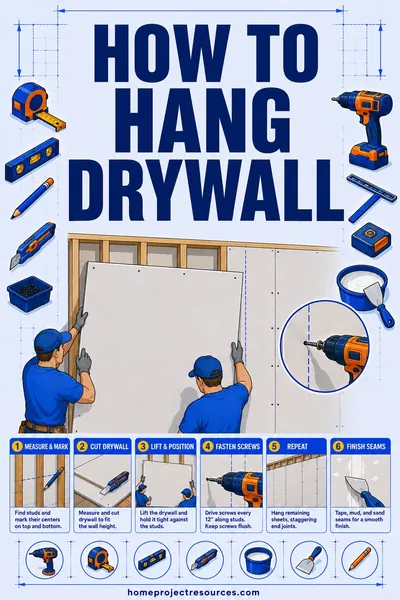
96 square feet at 32 square feet per 4x8 sheet is exactly 3 sheets, and you buy 4 for cuts and waste. Damping compound is applied at roughly one tube per 16 square feet, so 96 / 16 = 6 tubes. Our drywall calculator runs the sheet, screw, tape, and compound counts for the room, and our how to hang drywall guide covers the hanging technique, since a second layer goes on exactly like a first one with the seams offset.
Step 3, the door. Replace the hollow core with a solid core slab, add jamb weatherstripping and an automatic door bottom.
Step 4, finish. Tape, mud, sand, prime, paint. If you are new to finishing, our how to patch drywall guide covers the mudding and feathering technique that makes a seam disappear.
| Item | Quantity | Share of the bill, and what moves it |
|---|---|---|
| Acoustic sealant | 3 tubes | Minor. Buy the acoustic grade, not latex caulk |
| Outlet putty pads | 2 | Minor. Fixed cost, one pad per box |
| 5/8 inch drywall, 4x8 sheets | 4 | Moderate. Moves with lumber and gypsum pricing and with delivery if you cannot haul sheets |
| Damping compound | 6 tubes | One of the two largest lines. Tube count scales directly with wall area |
| 2 inch drywall screws | 1 lb box | Minor |
| Joint compound, tape, corner bead | 1 lot | Minor, but a second coat means a second bucket |
| Primer and paint | 1 gallon each | Modest. Driven by the paint line you choose, not by the soundproofing |
| Solid core door slab | 1 | The largest single line. Core material, prehung versus bare slab, and a non-standard opening all push it up |
| Door seal kit and automatic bottom | 1 | Modest. An automatic drop bottom costs more than a sweep and works better |
| Hinges, hardware, misc | 1 lot | Minor |
| Labor if hired out | 2 to 3 days | Roughly doubles the job. Hanging, finishing and door hanging are three separate skills, so ask whether one crew covers all three |
Realistic result. The wall goes from roughly STC 34 to somewhere in the low to mid 40s. The neighbor's television goes from clearly audible to a faint murmur you notice only when your own room is quiet. Bass and impact noise improve much less, and if the noise is also coming over the top of the wall through a shared ceiling cavity, this wall treatment will not fix that part.
That last sentence is the honest one. Diagnose the path before you spend, by having someone make noise on the other side while you listen with an ear against the wall, then the ceiling, then the floor, then an outlet. The loudest spot tells you where the money should go.
Price this list yourself before you commit. Take the quantities above to two suppliers, and if you are hiring the work, get three bids written against that identical scope, each one broken into materials, hanging and finishing, and the door. Bids that lump everything into one number cannot be compared, and a lowball bid on this job is usually one that skips the sealing step or leaves the door alone.
When to stop and hire someone
Get a professional involved when:
- The noise is impact from above and you need a decoupled ceiling. It is structural work, it lowers the ceiling by 1 to 2 inches, and it interacts with lighting and HVAC.
- You are building new and want a double stud or staggered stud wall. Design it before framing, because it is nearly free at that stage and very expensive later.
- The work touches electrical, HVAC, or structure. Moving a duct, relocating outlets, or altering framing may need a permit and licensed trades. Any work inside a panel is licensed electrician territory in most jurisdictions.
- You are in a multifamily building. Lease and condo rules usually govern what you can attach to a shared wall, and the actual fix may be the building's responsibility.
- The room is being built as a studio. Room within a room construction is a specialty, and a small mistake in the isolation detail wastes the entire budget.
One older building caution. If you are removing drywall, plaster, or flooring in a home built before 1978, assume the paint may contain lead, and in a home built before about 1990, assume floor tile, tile mastic, pipe wrap, and some textured ceiling finishes may contain asbestos. Do not sand, grind, or demolish suspect materials. Test first, or hire a certified abatement contractor.
Frequently asked questions
Does acoustic foam block sound?
No. Acoustic foam absorbs sound reflections inside a room, which reduces echo and makes the room sound better on a recording or a call. It has essentially no effect on sound passing through a wall, because blocking requires mass and foam weighs almost nothing. If you want to stop noise from a neighbor, foam is the wrong product entirely.
What is the cheapest way to soundproof a room?
Sealing air gaps. Acoustic sealant at the wall to floor joint, putty pads behind outlet boxes, and weatherstripping plus a door bottom on the door add up to a single small shopping trip and can gain several STC points on a leaky wall. It is the only cheap step with a real return. After that, everything effective involves adding mass, which means real material and real work.
How do I stop hearing my upstairs neighbor's footsteps?
Footsteps are impact noise, and the cheapest genuinely effective fix is carpet with a quality pad on the floor above, which you may not control. From below, the fix is decoupling the ceiling with sound isolation clips and hat channel plus a new layer of drywall, which is a real construction project priced by the square foot, and the spread on those bids is wide because ceiling height, access, lighting that has to be relocated, and whether the existing ceiling comes down first all change the labor. Adding drywall directly to the existing ceiling does very little for impact noise.
Is mass loaded vinyl worth it?
Sometimes, but usually not on a wall. MLV adds about 1 pound per square foot at high cost, while a sheet of 5/8 inch drywall adds about 2.75 pounds per square foot for a fraction of the price and gives you a paintable surface. MLV earns its place where thickness is the limiting factor, such as wrapping a duct or lining an enclosure, not as a general wall upgrade.
What STC rating do I need?
STC 50 is the common code minimum between dwelling units and is roughly the point where normal speech becomes inaudible and loud speech is faint. For a home office or bedroom next to a living room, the mid 40s is usually enough. For a music room or drum space, you want the mid 50s or better plus attention to low frequencies, which STC does not measure well.
Do soundproof curtains work?
They help with echo inside the room and they take a small edge off window noise, maybe 2 to 4 STC at the window itself. They do not block sound through a wall and no curtain will. If the noise comes through a window, an interior secondary window panel mounted a few inches inside the existing glass gives dramatically more improvement for similar money.
Should I use resilient channel or isolation clips?
Clips with hat channel, if the budget allows. Resilient channel is cheaper and works when installed perfectly, but a single screw that reaches the stud behind it short circuits the decoupling across a wide area, and that mistake is extremely common. Clips are more forgiving, perform better, and cost meaningfully more than channel on a typical wall.
Can I soundproof a room in a rental?
Partially, and without construction. Seal the door with removable weatherstripping and a door bottom, add a heavy free standing bookcase wall or acoustic panels on stands, use a removable interior window insert, put down thick rugs with pads, and use masking sound at night. You will get real relief from those. You will not reach the results that come from adding mass to the wall assembly, since that requires permanent work.
The short version
Decide first whether you have an echo problem or a transmission problem, because absorption and blocking are unrelated. Foam panels fix the first and do nothing for the second.
For blocking, the order is always the same. Seal every gap, because sound follows air and an open outlet or a door undercut defeats any wall you build. Then add mass, and the cheapest useful mass is a second layer of 5/8 inch drywall with damping compound between the layers. Then fix the door, since a hollow core slab is the weakest thing in most rooms.
Decoupling with clips and hat channel is the next step up and it is where the big gains live, and a double stud wall is the real answer if you are building new. Skip egg cartons, thin foam, soundproof paint, and blankets on the wall for anything to do with blocking.
Price the mass upgrade with our drywall calculator, size any cavity work with the insulation calculator, and use our how to hang drywall and how to patch drywall guides for the install and finish.