Asphalt Shingle Cost: How Roofing Bids Are Measured

Asphalt shingle cost is quoted per square, and a square is 100 square feet of roof surface. That per square number is not a material price. It is a bundle of five separate things rolled into one figure: how many squares you have, what comes off first, what spec goes back on, how hard the roof is to work on, and what the company carries in overhead and warranty. Two roofers can hand you very different per square numbers and both be honest, because they have bundled different things.
So the useful question is never "what is the going rate." It is "what is inside your number, and what happens when the crew finds something." Get those two answered in writing and three bids become comparable in about fifteen minutes.
Updated September 2026
A note on numbers. You will not find a dollar figure on this page. Roofing material, labor, disposal, and permit pricing move by region, by season, by supplier, and by how busy the crews are after a storm, so any printed range would be wrong for most readers and stale for the rest. What is here instead is the measuring method, the line items that belong on a bid, and the questions that keep quotes honest.
Know your square count before the first appointment. Our free roofing calculator takes your footprint, overhang, and pitch and gives you roof area, squares, bundles, underlayment rolls, starter, and ridge cap. Every rate a roofer quotes multiplies against that square count, so owning the number yourself is the fastest way to catch a bid built on a guess.
What actually goes into asphalt shingle cost per square
Break any shingle bid into these five buckets and it stops being mysterious.
1. Quantity. The square count, plus the waste percentage applied to it. This is pure arithmetic and you can verify it yourself. If you are new to the unit, what is a roofing square explains the bundle math and the pitch multipliers behind it.
2. Removal. How many layers come off, how heavy they are, and where they go. A second layer roughly doubles tear-off labor and disposal weight.
3. Replacement spec. Shingle line, underlayment type, ice barrier coverage, starter, ridge cap, drip edge, and flashing. This is where two bids diverge most quietly, because the spec is written in one line of small type.
4. Access and difficulty. Pitch, height, how close the driveway is, whether a boom truck can reach the roof or everything gets carried, whether landscaping has to be protected, and how cut up the roof is.
5. Company overhead. Insurance, workers comp, crew pay structure, warranty backing, and how long the company plans to be around to honor it. This is real and it is not padding.
A bid that gives you one lump figure has collapsed all five into a black box. A bid that separates them lets you find out which bucket is actually different.
The line items that belong on a written roofing bid
| Line item | How it is measured | Why it matters |
|---|---|---|
| Roof area | Squares, with waste stated separately | The base every other number multiplies against |
| Tear-off | Squares, per layer | Layer count is the single most common surprise |
| Disposal | Container size and number of hauls | Old shingles are heavy, weight drives haul count |
| Deck repair | Per sheet, at a stated unit price | Only known after tear-off, so it needs a price agreed in advance |
| Underlayment | Squares, type named | Synthetic and felt are not the same product |
| Ice and water barrier | Linear feet of eave, courses deep | Often code-required, often quietly omitted |
| Starter strip | Linear feet, eaves and rakes | Manufacturer wind rating depends on it |
| Shingles | Squares, exact product line named | "Architectural shingle" is not a spec, a product name is |
| Nail pattern | 4 or 6 nails per shingle | Sets the wind rating you actually get |
| Ridge and hip cap | Linear feet | Cut-up field shingles are not the same as pre-formed cap |
| Ventilation | Net free area, intake and exhaust | Warranty and attic moisture both depend on it |
| Flashing | Each penetration listed | New versus reused is a real difference |
| Drip edge | Linear feet, eaves and rakes | Required by code in most jurisdictions |
| Permit and inspection | Named, and who pulls it | Someone has to, and it should say who |
| Cleanup | Magnet sweep, gutter clean | Cheap to include, miserable to skip |
| Warranty | Material years, workmanship years | Two different warranties from two different parties |
If a bid is missing five of those lines, it is not a cheaper roof. It is a less specific one, and specificity is the only thing that lets you hold someone to a price later.
Shingle spec: what changes the number without changing the look
Asphalt shingles come in tiers, and the tiers are defined by measurable things, not marketing.
3-tab strip. One flat layer, 12 by 36 inches, roughly 5 inches of exposure, three bundles per square. Lightest, thinnest, shortest rated wind resistance, commonly 60 mph. Increasingly hard to find in some markets because most of the industry moved on.
Architectural laminate. Two layers bonded together, roughly 13 1/4 by 39 3/8 inches, about 5 5/8 inches of exposure, still three bundles per square. Standard wind rating is commonly 110 mph with a four nail pattern, and many lines reach 130 mph only when installed with six nails and starter strip along the rakes. That difference is an installation spec, not a product upgrade, and it belongs on your bid in writing.
Designer and luxury. Heavier, thicker, meant to imitate slate or shake. Four or five bundles per square instead of three, which changes bundle counts, delivery weight, and labor.
Two other spec choices move the number and are easy to miss:
Algae resistance. Copper granule blends that resist the dark streaking you see on north facing slopes. Worth naming in the spec if you live somewhere humid.
Underlayment type. Synthetic rolls cover 10 squares each. Number 15 felt rolls cover 4 squares and number 30 covers 2. Synthetic is lighter, tears less, and stays put longer if the roof gets left dried-in overnight. They are not interchangeable, and a bid that just says "underlayment" has told you nothing.
What is usually not in the per square number
This is where estimates grow after the handshake. None of these are dishonest, they are just genuinely unknowable until the old roof is off or until someone looks.
- Deck replacement. Nobody knows how much sheathing is rotten until the shingles come off. It should be quoted as a unit price per 4x8 sheet, which covers 32 square feet.
- Fascia and soffit repair. Same problem, found at the same moment.
- Chimney flashing and cricket work. Masonry chimneys often need step flashing and counterflashing cut into the mortar, which is a different trade skill than laying shingles.
- Skylights. Reflashing an existing skylight and replacing a failed one are two very different scopes. Decide before, not during.
- Ventilation upgrades. If the attic is under-vented, fixing it while the roof is open is far easier than later. It is still a separate line.
- Gutters and gutter guards. Frequently sold alongside a roof, almost never included in the roofing square rate.
- Structural repair. Sagging ridges and undersized rafters are an engineering question, not a roofing one.
Ask for a unit price on the first three before work starts. "We will let you know" is how a comfortable estimate turns into an uncomfortable invoice.
Worked example: normalizing three bids on the same house
Say you have a 40 by 30 ranch with 12 inch overhangs and a 6/12 pitch. Your own measurement gives you a covered footprint of 42 by 32, which is 1,344 square feet, times the 6/12 multiplier of 1.118, which is 1,502.6 square feet, or 15.03 squares. Call it 15 squares of field area before waste.
Three bids come in. Instead of comparing the bottom lines, put them side by side on what they actually contain.
| What to compare | Bid A | Bid B | Bid C |
|---|---|---|---|
| Squares stated | 15 | 13.5 | 15 |
| Waste stated | 10%, separate line | not stated | 10%, separate line |
| Layers to remove | 1 | 1 | 2, verified in attic |
| Shingle | product line named | "architectural" only | product line named |
| Nail pattern | 6 nail | not stated | 6 nail |
| Ice barrier | 2 courses at eaves | not listed | 2 courses at eaves |
| Underlayment | synthetic, named | "felt" | synthetic, named |
| Deck repair | unit price per sheet | not addressed | unit price per sheet |
| Ridge cap | pre-formed, linear feet | cut field shingles | pre-formed, linear feet |
| Ventilation | ridge vent, linear feet | existing reused | ridge vent, linear feet |
| Workmanship warranty | stated years | verbal | stated years |
Bid B is not cheaper. Bid B measured 1.5 squares light, which is a hint the roofer never accounted for the overhang, and it left seven line items off the page. Every one of those omissions is a place the final invoice can grow.
Bid C looks higher than Bid A on paper, but Bid C found a second layer of old shingles that A missed. That is more tear-off labor, more disposal weight, and a bigger container. Once you add the second layer to A's scope, the two bids may land in the same neighborhood, and C is the one that actually looked.
That is what normalizing means: make every bid describe the same job, then compare. Our guide on how to compare contractor bids covers the contract side of the same process, including allowances, exclusions, and payment schedules.
How to normalize in five steps
- Fix the quantity. Use your own square count as the reference. Ask anyone who is more than half a square off how they measured.
- Fix the removal scope. Get everyone bidding the same number of layers. Check the attic or lift a shingle at a rake edge to find out.
- Fix the spec. Name one shingle product line, one underlayment type, one nail pattern, and one ridge cap product, then send that spec to all three.
- Fix the unknowns. Get a unit price per sheet of decking from each, written down.
- Compare what is left. Now the difference between the bids is actual labor and overhead, which is a fair thing to choose on.
What makes an estimate go up after work starts
Four things, in order of how often they happen.
Rotten or delaminated deck. Found the moment the shingles come off. Usually clustered at eaves, around chimneys, and under old valleys. This is why the unit price per sheet matters so much.
An extra layer. A roof that was overlaid once may have been overlaid twice. Weight, labor, and disposal all move.
Flashing that cannot be reused. Old step flashing at a wall or chimney that comes out mangled has to be replaced, and that means cutting mortar joints.
Weather. A crew that has to dry-in and come back adds days, and days on a job are the roofer's real cost.
None of those are red flags on their own. What is a red flag is a contractor who will not put a unit price on them beforehand, or who wants a large payment before material is delivered. Our list of contractor red flags covers the patterns worth walking away from.
Questions to ask every roofer before you sign
- How many squares is my roof, and how did you measure it?
- What waste percentage is in your material order?
- How many layers are you expecting to remove, and how did you check?
- Exactly which shingle product line, and what nail pattern?
- Where does ice and water barrier go, and how many courses?
- Is the ridge cap pre-formed, or cut from field shingles?
- What is your unit price per sheet of replaced decking?
- Who pulls the permit, and is the inspection included?
- What is your workmanship warranty, in years, in writing, and who honors it if you sell the business?
- Are you carrying general liability and workers comp right now, and can I get the certificate directly from the insurer?
Bring your own measurement to that conversation. If you also walk the roof from the ground first with our roof inspection checklist, you will be describing the same problems the roofer is looking at, which changes the whole tone of the visit.
Frequently asked questions
Why is asphalt shingle cost quoted per square instead of per square foot?
Because everything on the job is packaged and bid in hundreds of square feet. Shingles come three bundles to a square, underlayment comes in 10, 4, and 2 square rolls, tear-off is bid per square, and disposal is weighed by square. Quoting per square keeps the whole estimate in whole numbers.
Is an overlay cheaper than a tear-off?
An overlay skips removal and disposal, so the immediate scope is smaller. It also traps the old roof's problems, hides deck damage nobody will see for another twenty years, adds weight, and shortens the life of the new shingles because the deck runs hotter. Most codes cap a roof at two total layers. If a bid offers an overlay, ask why, and ask what happens to the warranty.
Why did two roofers give me different square counts?
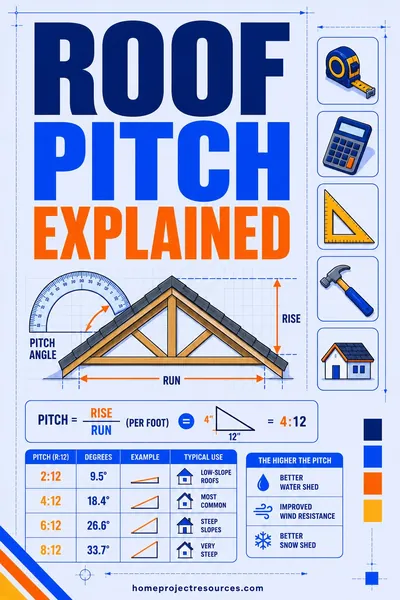
Usually the overhang or the pitch. A 12 inch overhang adds 8 to 12 percent to the area, and a 6/12 pitch adds another 11.8 percent on top of the footprint. A count taken off a floor plan without either adjustment comes in low every time. Our roof pitch explained guide shows how to measure the slope yourself so you can tell which count is right.
Should the bid include the dumpster?
It should at least name it. Tear-off waste is heavy and container hauls are priced by weight as well as size, so a roof with two layers can need a second haul. Ask what container is planned and what happens if it fills early. Our dumpster size calculator will tell you what a given tear-off actually needs.
What does a manufacturer warranty actually cover?
Material defects, and only if the roof was installed to the manufacturer's published instructions. That is why the nail pattern, starter strip, ventilation, and underlayment all appear in the fine print. Workmanship is a completely separate warranty from the contractor, and it is the one that matters in the first ten years.
Does a steeper roof change the number?
Yes, in two ways. It adds area through the pitch multiplier, and above roughly 7/12 crews need staging, roof jacks, and slower movement, which adds labor per square. Ask any bidder whether a steep charge is included and where it starts.
Can I supply my own shingles?
Some contractors allow it, many will not, and it usually voids their workmanship warranty and complicates the manufacturer warranty. It also puts the ordering mistake on you if the count is short. Unless you have a specific reason, let the roofer supply material and hold them accountable for the whole assembly.