Emergency AC Repair: When to Call and What to Ask

Call for emergency AC repair right now if you smell burning or hot electrical insulation, if the breaker trips again after one reset, if water is running out of the air handler onto ceilings or flooring, if the outdoor unit is making a grinding or screeching noise, or if someone in the house is elderly, an infant, or medically vulnerable during a heat advisory. Everything else can almost always wait for a normal appointment, and waiting one day usually gets you a better tech, a fuller parts truck, and a calmer conversation about scope.
The other half of the answer is less obvious. A lot of "my AC died" calls turn out to be a tripped float switch, a filter nobody has changed since spring, a thermostat set to fan instead of cool, or an evaporator coil frozen into a solid block of ice. Five minutes of checking before you dial can save you an after hours visit entirely.
Updated September 2026
A note on numbers. There are no dollar figures on this page. After hours rates, diagnostic fees, refrigerant pricing and parts availability vary enormously by region and by week, so a published range would mislead more people than it helped. What follows is triage, the measurements a real diagnosis produces, and the questions that keep an emergency from turning into an unnecessary system replacement.
One thing worth checking while you wait for the tech. In a heat wave, plenty of systems are not broken at all, they are simply losing to the attic above them. If your AC runs nonstop and never quite catches up, measure the attic and see what the insulation job would take with our free Insulation Calculator. An attic sitting at R-13 in a hot climate loads the system all afternoon, and no repair fixes that.
When emergency AC repair is actually an emergency
Emergencies fall into three buckets: fire and shock risk, active water damage, and human health risk. Comfort alone, uncomfortable as it is, is not usually one of them.
| Symptom | Treat it as | Why |
|---|---|---|
| Burning smell, melted plastic smell, scorch marks at the disconnect | Call now, shut off power | Failing contactor, compressor windings or a loose lug can start a fire |
| Breaker trips again after one reset | Call now, leave it off | A repeat trip means a real short or a locked compressor, not a nuisance trip |
| Grinding, screeching or a loud metallic bang outside | Call now, shut it off | Failing bearings or a loose fan blade destroy the unit fast |
| Water dripping through a ceiling or pooling at the air handler | Call now | Drain pan overflow ruins drywall, insulation and flooring quickly |
| Heat advisory plus an infant, elderly resident or medical condition | Call now | This is a health call, not a comfort call |
| Warm air, everything else normal | Same or next day | Usually a capacitor, contactor, fan motor or refrigerant issue |
| Ice on the copper lines or the indoor coil | Thaw first, then same or next day | A tech cannot diagnose a frozen system anyway |
| System runs constantly but holds within a few degrees | Schedule normally | Almost always load, airflow or sizing, not a failed part |
| Short cycling, on and off every few minutes | Schedule soon | Could be a control, a low charge or an oversized system |
Notice the pattern. The true emergencies are the ones where waiting makes the damage worse. Warm air on a Saturday is miserable, but nothing is deteriorating while you wait for Monday.
The five minute check before you call
Do these in order. Each one rules out a service call that would have embarrassed you.
- Thermostat. Mode set to cool, not fan or heat. Setpoint at least a few degrees below room temperature. Fresh batteries. A blank screen with a working furnace switch usually means the float switch cut power to the thermostat wire.
- The float switch and drain. Look at the condensate pan and the little switch clipped to the pan or the drain line. If the pan has water in it, the drain is clogged and the switch did its job. Clearing a drain line is homeowner work in most systems, and it is on our home maintenance checklist for exactly this reason.
- Filter. Hold it up to a light. If you cannot see light through it, that is your airflow problem and possibly your frozen coil. A 1 inch pleated filter in a dusty house can load up in six weeks.
- Breaker and disconnect. Reset a tripped breaker once. If it trips again, stop and leave it off. Also check the pull out disconnect box on the wall next to the outdoor unit, which people knock loose while landscaping.
- The outdoor unit. Is the fan spinning? Is the coil packed with cottonwood, grass clippings or dryer lint? Is a shrub crowding it? The condenser needs clear air on all sides and above.
If the fan outside is not spinning but the unit hums, that is the classic run capacitor symptom. Do not open the panel to poke at it. A capacitor holds a charge after power is off and can hurt you.
Frozen coil: what to do before anyone arrives
Ice on the suction line or a block of frost on the indoor coil means airflow dropped or the refrigerant charge is low. Either way, the system cannot be diagnosed until it thaws.
- Set the thermostat to off for cooling, and set the fan to on.
- Leave it that way for two to four hours. A badly iced coil can take longer.
- Watch the condensate pan and drain while it melts. All that ice becomes water, and a marginal drain will overflow.
- Replace the filter and open every supply register in the house.
- Restart in cool mode and watch. If it ices again within a day, the charge is low and you have a leak.
Two hours of thawing before the appointment is a real gift to the tech. A frozen system tells him nothing, and he will have to leave and come back.
What a real diagnosis produces
Here is the thing that separates a good invoice from a bad one. A competent tech leaves measured values behind, not adjectives. Ask for these on paper.
| Measurement | What it tells you | Typical healthy reading |
|---|---|---|
| Supply and return air temperature split (delta T) | Whether the coil is actually removing heat | About 16 to 22 degrees F on a properly charged, correctly airflowed system |
| Capacitor microfarads, measured versus rated | Whether the run capacitor is dying | Within about 6 percent of the rating stamped on the can |
| Compressor and fan amp draw versus nameplate | Whether the motor is straining | At or below the RLA and FLA printed on the data plate |
| Superheat or subcooling | The actual refrigerant charge | Compared against the manufacturer's chart for that model and conditions |
| Total external static pressure | Whether the duct system can move the air | Compared against the blower table, commonly around 0.5 inch water column |
| Refrigerant added, weighed | How much left the system | Stated in pounds and ounces, never "a little" |
| Line voltage at the contactor | Whether the electrical supply is the problem | Within the range on the data plate |
If an invoice says "added freon, system cooling" with no weight, no superheat and no leak search, you were sold a temporary fix. Refrigerant is a closed loop. It does not get used up. If it is low, it left through a hole, and that hole is still there.
Worked example: reading a delta T on a hot afternoon
Say the house is not cooling well and you want to know whether to call. Tape a probe thermometer in the return grille and another in the nearest supply register, and let the system run for 15 minutes.
- Return air reads 78 degrees F.
- Supply air reads 62 degrees F.
- Delta T is 78 minus 62 = 16 degrees.
That is at the bottom edge of healthy but still inside the band. The system is cooling. If the house is not holding temperature with a working 16 degree split, the problem is load or duct leakage, not the equipment, and no emergency repair will change that. Now suppose the supply reads 72 instead. A 6 degree split means the system is barely doing anything, and that is a genuine service call.
What drives the number on an emergency call
Emergency work is priced off the situation more than the part. These are the levers.
- Time of day and day of week. After hours, weekends and holidays carry a different rate structure than a scheduled weekday visit. Ask what the rate is before dispatch, and ask when the after hours window starts.
- Diagnostic fee handling. Some companies credit the diagnostic toward the repair, some do not, and some credit it only if you approve the work on the spot. Ask which, in those words.
- Parts availability. A universal run capacitor or contactor is on every truck. An ECM blower module, a variable speed control board or a matched TXV is not, and a weekend means the supply house is closed.
- Refrigerant type. R-22 systems are long out of production and the refrigerant is reclaimed only, which makes any charge conversation on those systems expensive and often pointless. R-410A is standard on most systems installed in the last two decades. Newer equipment uses lower global warming potential blends such as R-454B, which need their own gauges and recovery equipment.
- Warranty status. Many manufacturers cover parts for five or ten years to the original registered owner. Warranty almost never covers labor, refrigerant or the trip. Look up your model and serial before the tech arrives.
- Access. An attic air handler on a pull down ladder in August is slower work than a garage unit at eye level. A rooftop unit adds a ladder, fall protection and sometimes a second person.
- Electrical condition. Burned lugs, an undersized whip or a corroded disconnect turn a part swap into electrical work.
Questions to ask on the phone and at the door
Read these off your screen. They take a minute and they change how the call goes.
On the phone: 1. What is the after hours rate structure, and is the diagnostic fee credited toward the repair? 2. Are you sending a licensed technician or an apprentice tonight? 3. Do you carry capacitors, contactors and condenser fan motors on the truck? 4. If the part is not on the truck, what happens to the fee tonight?
At the door, before work starts: 1. Can you show me the delta T and the capacitor reading before you replace anything? 2. If you are adding refrigerant, will you weigh it in and note the amount, and what leak search method are you using? 3. Is this repair covered under the manufacturer parts warranty? 4. Will you write the model and serial on the invoice? 5. What is the labor warranty on tonight's work?
That third question matters more than people expect. A homeowner who pays cash for a part still under warranty has paid twice, and nobody volunteers the information.
Repair or replace, decided without pressure
Emergency visits are where the replacement conversation gets pushed hardest, usually at the worst possible moment for clear thinking. Use a framework instead.
Repair is usually right when: - The failed part is a capacitor, contactor, fan motor, blower motor, float switch, control board or thermostat. - The system uses current refrigerant and the coil and compressor are healthy. - The equipment is within its expected service life, commonly 12 to 18 years for a condenser and 15 to 25 for a furnace or air handler.
Replacement deserves a real look when: - The compressor has failed and the unit is out of warranty. That is the single most expensive component in the system. - The system runs R-22, so any leak repair means a charge you may not be able to source again. - The evaporator coil is leaking on an older matched system. - You have paid for three or more separate failures in two seasons.
Even then, do not sign on the emergency visit. Get the failing system running or accept a temporary fix, then price the replacement properly against our HVAC replacement drivers, the air conditioner installation scope, and the heat pump installation option if you are in a mixed or mild climate. A same night replacement decision is almost never your best one.
Preventing the next emergency
Most August failures were visible in April.
- Change the filter on a schedule, not when you remember. Mark it on a calendar.
- Flush the condensate drain each spring. A cup of warm water and a wet vacuum on the outdoor end clears most of them.
- Rinse the condenser coil from the inside out with a garden hose, power off at the disconnect.
- Keep 18 to 24 inches of clear space around the outdoor unit and nothing solid overhead.
- Have the capacitor measured during a spring tune up. It is the cheapest part in the system and the most common single failure.
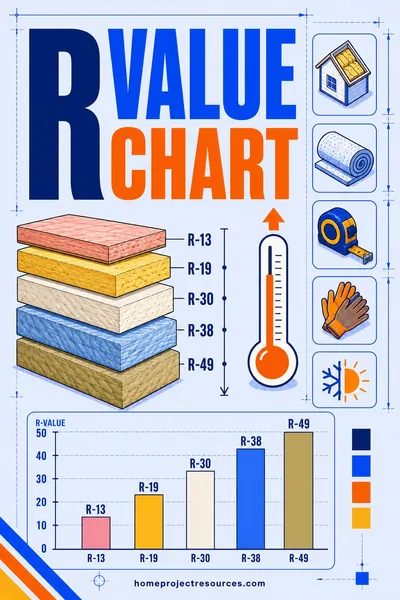
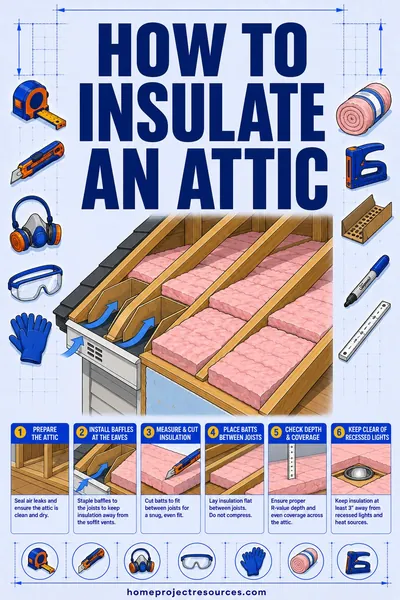
- Fix the load, not just the machine. Attic R-value, duct leakage in unconditioned space and west facing glass do more damage on a 100 degree day than any component. Our attic insulation guide and the R-value chart show what your climate zone actually calls for.
Frequently asked questions
My AC is blowing warm air but the outdoor fan is running. What is that?
Start with the filter and the coil, then look at the temperature split. If the split is under about 10 degrees F with clean airflow, the charge is likely low or the compressor is not pumping. A running condenser fan only proves the fan motor and the contactor work, not that the compressor is doing anything.
Should I keep resetting the breaker until it holds?
No. Reset it once. If it trips again, leave it off and call. Repeated resets on a hard shorted compressor or a burned contactor push a lot of current through damaged parts and are how a nuisance problem becomes a fire.
Is it cheaper to wait until morning?
Usually yes, unless the situation is on the emergency list above. Scheduled daytime work carries the standard rate, the supply houses are open, and you get more of the technician's attention. Water damage and health risk are the two things worth paying the after hours difference for.
Why does my system freeze up again a week after a repair?
Because refrigerant does not disappear on its own. If the fix was a top off with no leak search, the leak is still open and the charge is dropping again. Ask for a leak search with either electronic detection, bubble solution or an injected dye, and ask for the leak location in writing.
How long should an air conditioner last?
Most condensers give 12 to 18 years, and indoor air handlers and furnaces often run 15 to 25. Coastal salt air shortens the outdoor unit noticeably, and a system that was oversized from day one short cycles its way to an early failure regardless of maintenance.
Can I run the fan only while I wait for the technician?
Yes, and it often helps. Fan only mode moves air, evens out room temperatures, and thaws a frozen coil safely. It uses a fraction of the power of the compressor. The one exception is an active water leak at the air handler, where you want everything off until someone looks at it.
What is a reasonable temperature difference between the thermostat setting and the actual room?
On a design day, a correctly sized system is expected to hold roughly 20 to 25 degrees below the outdoor temperature, not any setpoint you choose. At 100 degrees outside, holding 78 inside is normal performance. Expecting 68 on that same afternoon is a sizing and insulation question, not a repair question.