Types of Insulation

There are eight types of insulation worth knowing, and they sort into four families: fluffy material that fills cavities (fiberglass batts, blown fiberglass, mineral wool, cellulose), foam that expands in place (open cell and closed cell spray foam), rigid boards (EPS, XPS, polyiso), and radiant barrier, which is not really insulation at all and should not be compared to the others.
For most homes the answer is boring and correct: blown cellulose or blown fiberglass in the attic, batts or dense pack in the walls, closed cell foam at the rim joists, and rigid foam on basement walls. Spray foam everywhere is rarely worth what it costs.
Updated August 2026
A note on numbers. This page compares products on R per inch, moisture behavior, fire behavior and relative cost rather than dollar figures. Insulation pricing moves with foam chemicals, with crew availability and with your region, so a printed per square foot range would be wrong in most markets. Work out your quantities here, then get quotes on one identical scope.
Work out how much you need first. Our free insulation calculator converts your square footage and target R value into batts or bags, so you can compare products against each other honestly.
The honest part nobody leads with: R value is not the whole story
Insulation slows heat that moves by conduction. R value measures exactly that, and only that.
But a large share of the heat leaving your house does not conduct through the insulation. It rides on moving air: out through the attic hatch, up the wall cavities behind the drywall, around recessed lights, through the gaps where plumbing and wiring penetrate the top plate. Fluffy insulation does almost nothing to stop that. Air moves through fiberglass the way it moves through a sweater.
Here is the practical consequence. In a typical older house, sealing air leaks buys more comfort for the money than adding R value does. A day of careful air sealing with caulk, canned foam and fire rated sealant at the top plates and penetrations costs very little in materials, and it usually does more for a drafty room than doubling the attic R value.
Of everything on this page, only closed cell spray foam is an air barrier on its own. Open cell foam is close if it is thick enough and continuous. Everything else needs a separate air barrier to work as advertised, and that air barrier is usually caulk, sealant, taped sheathing or carefully installed drywall.
So the order of operations is: air seal first, then insulate, then worry about how much R you added. A contractor who quotes R 60 in the attic without mentioning air sealing the top plates and the attic hatch is selling you fluff on top of a leak.
Types of insulation compared
Relative cost below means installed cost per square foot at a given R, compared with standard fiberglass batts as the market baseline. Materials only for the DIY friendly products is roughly a third to a half of installed.
| Type | R per inch | Relative cost | DIY friendly | Air sealing | Moisture behavior | Fire behavior | Sound |
|---|---|---|---|---|---|---|---|
| Fiberglass batt | R 3.1 to R 3.4 | The baseline, cheapest per R | Yes, easiest | None | Does not absorb water, but stays wet and loses R when damp | Noncombustible glass, facing is combustible | Fair |
| Fiberglass batt, high density | R 3.7 to R 4.3 | Modestly above standard batts | Yes | None | Same as standard | Same as standard | Fair |
| Blown fiberglass, loose fill | R 2.2 to R 2.7 | Low, and cheapest per R in an attic | Rental blower, yes | None | Sheds water, dries fast | Noncombustible | Fair |
| Mineral wool, rock wool | R 3.7 to R 4.3 | Roughly 50 to 100 percent above fiberglass | Yes, cuts with a bread knife | Minimal | Hydrophobic, water runs off, dries readily | Melts above 2,000 degrees F, best in class | Best of the fibrous types |
| Cellulose, blown or dense pack | R 3.2 to R 3.8 | Close to fiberglass, slightly above for dense pack | Blown attic yes, dense pack no | Slight, dense pack slows air | Absorbs and releases moisture, needs to be able to dry | Borate treated, chars rather than flames | Very good, dense pack especially |
| Open cell spray foam | R 3.5 to R 3.9 | Well above any fibrous option | No | Very good at full depth | Vapor permeable, will let water through and show a leak | Needs a thermal or ignition barrier | Excellent |
| Closed cell spray foam | R 6.0 to R 7.0 | The most expensive per square foot, roughly double open cell | No, kits are a poor value | Excellent, the only true standalone air barrier | Vapor retarder at about 1.5 in and up, blocks liquid | Needs a thermal or ignition barrier | Good, adds stiffness |
| Rigid EPS board | R 3.6 to R 4.2 | Cheapest of the boards per R | Yes | Good if taped and sealed | Vapor semi permeable, allows drying | Combustible, needs covering | Poor |
| Rigid XPS board | R 4.7 to R 5.0 | Mid priced board | Yes | Good if taped and sealed | Low perm, absorbs less water than EPS | Combustible, needs covering | Poor |
| Rigid polyiso board | R 5.6 to R 6.5 | Priciest board, best R per inch on the shelf | Yes | Good if taped and sealed | Facers can wick water, keep it out of the ground | Best fire performance of the boards | Poor |
| Radiant barrier | Not applicable | Low, and not a substitute for R | Yes | None | Reflective, must stay clean | Foil is noncombustible, backing varies | None |
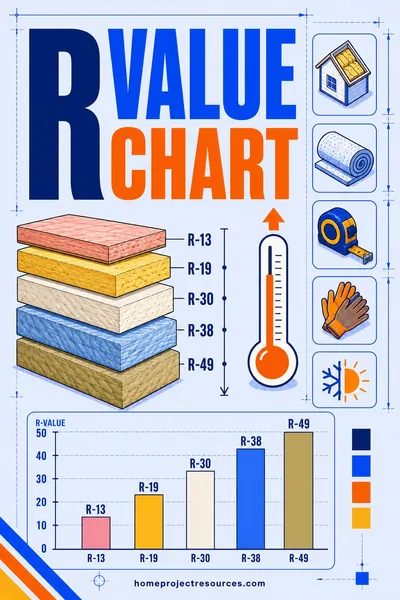
Our R value insulation chart has the full per inch table plus the recommended totals by climate zone if you need to pick a target number.
The fibrous types
Fiberglass batts
The default, and there is nothing wrong with it. Cheap, available everywhere, and installable by anyone with a utility knife and patience.
The catch is that batts are unforgiving. Fiberglass only performs when it fully fills the cavity with no compression and no gaps. A batt cut short at the top, stuffed behind a wire, or compressed by a plumbing pipe loses a large fraction of its rated R in that spot. Field studies of ordinary installations routinely find that sloppy batt work delivers a fraction of nominal performance.
Split the batt around wiring instead of squashing it behind. Cut around outlet boxes rather than crushing the batt into them. That care is the whole difference between R 13 on the label and R 13 in the wall.
Blown fiberglass
Loose fiberglass fired into an attic through a hose. It has the lowest R per inch on the list, but attics have effectively unlimited depth, so per inch performance matters less there than cost per R. It is cheap, it does not settle much, and it flows around framing and wires in a way batts cannot.
This is the standard attic answer, for good reason.
Mineral wool
Spun from molten rock and slag. Denser and stiffer than fiberglass, so it holds its shape and friction fits into a cavity without sagging. Water runs off it. It does not burn, and it is the best sound absorber of the fibrous types, which is why it is the usual pick for interior walls around bedrooms, bathrooms and media rooms.
It costs meaningfully more than fiberglass for the same R, and it earns that in basements, rim joists, interior sound walls and anywhere near a heat source. Our how to soundproof a room guide covers where it makes the biggest difference.
Cellulose
Recycled paper, ground up and treated with borates for fire and pest resistance. Blown loose in attics, or dense packed at about 3.5 pounds per cubic foot into wall cavities where it will not settle.
Two things make it interesting. Dense pack cellulose slows air movement inside the cavity, which is why it often outperforms same R fiberglass in the field. And it buffers moisture, taking on and releasing water vapor without losing much performance, as long as the assembly can dry.
The catch: loose fill attic cellulose settles 10 to 20 percent, so you have to install extra depth to hit your target. And it has to stay dry over the long run. Cellulose that gets repeatedly wet from a roof leak turns into a compacted mat that insulates very little.
Spray foam, and when it is actually worth it
Open cell versus closed cell
Open cell foam expands a great deal, stays soft and spongy, and is vapor permeable. Around R 3.5 to R 3.9 per inch, so it needs depth. Its permeability is a feature in some assemblies, because a roof leak will show up on your ceiling instead of hiding in the sheathing.
Closed cell foam is dense and rigid, R 6.0 to R 7.0 per inch, and at about 1.5 inches and up it acts as a vapor retarder as well as an air barrier. It adds real racking strength to a wall. It is also roughly twice the price of open cell for the same square footage.
| Open cell | Closed cell | |
|---|---|---|
| R per inch | R 3.5 to R 3.9 | R 6.0 to R 7.0 |
| Relative cost per board foot | The cheaper of the two foams | Roughly double open cell |
| Vapor permeable | Yes | No, at 1.5 in and up |
| Best for | Cathedral ceilings with a vented path, interior sound, attic roof decks in mild climates | Rim joists, crawl spaces, basement walls, coastal and flood prone framing, anywhere depth is limited |
Where foam earns its price
Rim joists. Crawl space walls. The underside of a cantilevered floor. Van and tiny house builds. Odd geometry where batts cannot seal. In those spots a couple of inches of closed cell foam does something no other product does, and the area is small enough that the total stays sane.
Where it usually does not
Filling a whole 2x6 wall with closed cell foam. You are paying the most expensive product on the list to gain a handful of R over dense pack cellulose, and the wall can no longer dry to the inside. The same money spent on air sealing plus continuous exterior rigid foam buys more performance.
Two cautions worth stating plainly. Foam has to be installed at the right temperature and mix ratio, and a bad batch can off gas an odor that is very hard to fix. Use an installer with a track record and ask for references on jobs at least two years old. And spray foam must be covered with drywall or an approved ignition barrier in living space, because it is combustible.
Rigid foam boards
Boards are the answer when the problem is thermal bridging, meaning heat taking a shortcut through the framing.
A 2x6 wall framed 16 inches on center is roughly 20 to 25 percent wood by area, and wood is about R 1.25 per inch. That framing drags a nominal R 21 wall down to an effective R 15 or so. Cavity insulation cannot fix this, because the problem is the studs themselves. A continuous layer of foam on the outside of the sheathing covers every stud at once.
EPS is the white beadboard. Cheapest per R, stable over time, semi permeable so the wall can dry outward.
XPS is the pink or blue board. Higher R per inch when new, but it off gasses its blowing agent and drifts toward about R 4.5 per inch over decades. Low perm.
Polyiso has the highest R per inch on the shelf, but its R value drops as it gets colder, which is backwards from what you want in a cold climate. Many cold climate builders derate it to about R 5 per inch for design, or use EPS instead. Keep polyiso out of ground contact, because the facers wick water.
For below grade and ground contact work, EPS and XPS are the choices. Polyiso is for above grade walls and roofs.
Which insulation goes where
| Assembly | First choice | Also works | Avoid |
|---|---|---|---|
| Attic floor, vented attic | Blown fiberglass or blown cellulose to R 49 to R 60 | Batts, if you are meticulous | Anything that blocks soffit vents. Use baffles |
| Attic roof deck, unvented | Closed cell foam, or a foam plus fiberglass hybrid | Open cell in mild climates with careful design | Fiberglass alone against the deck |
| Wall cavity, new build | Dense pack cellulose or high density batt, plus exterior rigid foam | Mineral wool batt | Full depth closed cell foam, poor value |
| Wall cavity, retrofit | Dense pack cellulose blown through drilled holes | Injection foam | Blown fiberglass in walls, it can bridge and leave voids |
| Rim joist or band joist | Closed cell spray foam, 2 inches | Cut and cobble rigid foam, sealed at every edge | Bare fiberglass batts, they trap moist air against cold wood |
| Crawl space, sealed | Closed cell foam on the walls, plus a sealed ground vapor barrier | Rigid foam board on walls | Fiberglass in the floor above a vented crawl, it falls down and gets wet |
| Basement wall | Rigid foam board against the concrete, framed and drywalled over | Closed cell foam directly on the wall | Fiberglass batts against bare concrete. This is how you grow mold |
| Cathedral ceiling | Closed cell against the deck, or a fully vented assembly with baffles and batts | Rigid foam above the deck | Stuffing batts into an unvented rafter bay with no air gap |
| Interior sound walls | Mineral wool | Cellulose | Fiberglass, it works but not as well |
| Slab edge | EPS or XPS board | Anything absorbent |
The one to internalize: never put fiberglass batts directly against a basement wall or a rim joist. Warm humid indoor air passes right through the batt, hits the cold concrete or the cold band joist, and condenses there. The batt then hides it. Foam board or closed cell foam keeps that air off the cold surface. Our musty basement smell page covers what that condensation turns into when it goes unnoticed.
The radiant barrier category error
Radiant barriers get compared to batts in advertising, and the comparison is meaningless.
Insulation slows conduction, and R value measures that. A radiant barrier is a sheet of foil that reflects radiant heat. Those are different mechanisms. Asking for the R value of a radiant barrier is like asking for the horsepower of a raincoat.
A foil barrier only works when it faces an air gap, and it stops working when it gets dusty, because dust on the foil raises its emissivity. Stapled to the underside of attic rafters in a hot sunny climate, it can cut cooling load somewhere in the range of 5 to 10 percent by keeping radiant roof heat off the attic floor insulation. In a cold climate, where the problem is heat leaving by conduction in January, it does close to nothing.
Any product advertising a radiant barrier as equivalent to R 40 is quoting a lab condition, not a roof. Use it as a supplement in hot climates. Never as a substitute for attic R value.
Vapor retarders and which side they face
Vapor retarders slow water vapor from diffusing through an assembly and condensing where it is cold. They are classified by permeance:
- Class I, 0.1 perm or less: polyethylene sheet, sheet metal, closed cell foam at depth. A true vapor barrier.
- Class II, 0.1 to 1.0 perm: kraft facing on a batt, some smart membranes.
- Class III, 1.0 to 10 perm: standard latex paint on drywall. Yes, paint counts.
The rule of thumb: the vapor retarder goes on the warm in winter side of the assembly. In cold climates that is the interior. In hot humid climates the warm side is the outside for most of the year, so an interior poly sheet traps moisture against the drywall and grows mold behind it.
| Climate zone | Interior vapor retarder | Notes |
|---|---|---|
| Zones 1 to 3, hot and hot humid | None. Latex paint only | Never install interior poly. Air conditioning makes the inside the cold side |
| Zone 4, mixed | Class III, latex paint | Assemblies need to dry in both directions |
| Zones 5 to 8, cold | Class II, kraft facing or a smart membrane | Poly is allowed but a smart membrane is more forgiving |
Two things change the calculus. Enough continuous exterior rigid foam keeps the sheathing above the dew point, at which point an interior vapor retarder is not needed and can be harmful. And closed cell spray foam is its own vapor retarder, so you do not add another one on top of it.
Confirm the requirement with your local building department before you buy, because code adoption varies by state and county.
Worked example: a 1,400 square foot attic in zone 5
You are topping up an attic in Ohio that currently has about 6 inches of old fiberglass, roughly R 19, and you want to reach R 60.
Step one, air seal. Before any insulation goes in, foam and caulk the top plates, the chimney chase using fire rated sealant only, plumbing stacks, wiring penetrations and the attic hatch. Materials are about a dozen cans of foam and a few tubes of sealant. Time is a Saturday. This is the highest value part of the whole job, and it is the part most quotes leave out.
Step two, add depth. You need about R 41 more. Blown fiberglass at R 2.5 per inch needs about 16.5 inches on top. Blown cellulose at R 3.5 per inch needs about 12 inches, plus another 15 percent for settling, so call it 13.5 inches installed.
Step three, work out the bag count. Cellulose is sold by the bag with a coverage chart printed on it, giving square feet per bag at a stated settled depth. Divide your 1,400 square feet by the coverage at your target depth to get bags, then add a bag or two, because the last one always goes further than you expect and returning an unopened bag is easy. Most retailers lend or rent the blower free with a minimum bag purchase, which is what makes this a genuinely cheap do it yourself job.
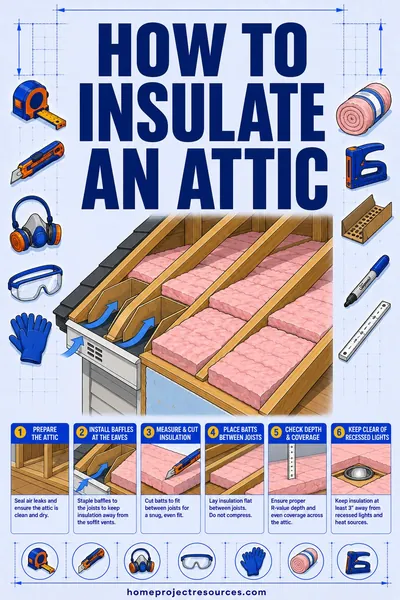
Step four, protect the eaves. Add attic baffles at every rafter bay so you do not bury the soffit vents. Burying them is the most common homeowner mistake in an attic top up, and it turns a ventilation problem into a moisture problem within a winter.
Run your own numbers through the insulation calculator, and if you need to measure the attic footprint first, the square footage calculator handles L shapes and bump outs. For the full walkthrough, see how to insulate an attic.
Frequently asked questions
What is the best type of insulation for an attic?
Blown cellulose or blown fiberglass, piled to R 49 to R 60 depending on your climate zone. Both are cheap per R, both flow around framing, and attics have the depth that makes a low R per inch irrelevant. Air seal the ceiling plane first, because insulation over an unsealed ceiling is filtering air rather than stopping it.
Is spray foam worth the extra cost?
In small, high value spots, yes. Rim joists, crawl space walls and tight geometry are where closed cell foam does something nothing else does. Filling every wall cavity with foam usually is not worth it, since the same money spent on air sealing plus exterior rigid board buys more real world performance and leaves the wall able to dry.
Is mineral wool better than fiberglass?
For fire resistance, sound, water tolerance and holding its shape, yes. For cost per R, no. Use mineral wool in basements, rim joists and interior sound walls, and use fiberglass where you simply need inexpensive R in a dry cavity.
Can you put new insulation over old insulation?
Yes, in an attic, as long as the old material is dry and not moldy. Add unfaced material over the existing layer. Never add a faced batt on top, because the second facing traps moisture between the layers and you will not see it happening.
How much insulation do I actually need?
It depends on your climate zone and the assembly. Attics generally run R 30 in the far south up to R 60 in cold climates, and wall cavities are limited by framing depth. The zone by zone targets are in our R value chart.
Does insulation stop drafts?
Fiberglass and cellulose barely slow air at all. If a room is drafty, the fix is air sealing rather than more R. Only closed cell foam, and open cell at full depth, stops air movement on its own. For window drafts specifically, see drafty windows fix.
What R value can I fit in a 2x4 wall?
A 2x4 cavity is 3.5 inches deep. Standard fiberglass gets you R 13, high density gets R 15, mineral wool gets R 15, and full fill closed cell foam reaches roughly R 21 to R 24. Beyond that you need exterior rigid foam, because the cavity is simply out of room.
Which side does the paper facing go on?
The kraft paper faces the heated living space, so in a wall it faces the room and in an attic floor it faces down toward the ceiling below. In hot humid climates, use unfaced batts and let latex paint act as the vapor retarder instead.
The short version
Pick the material to match the assembly, not the marketing. Cheap fluff in the attic where depth is free, dense pack or high density batts in walls, foam only where geometry or moisture demands it, and rigid board wherever you need to cover the studs.
Then remember the part the labels leave off: air sealing usually buys more comfort for the money than added R value. Do that part first.