Staircase Railing Height: Usual Handrail, Guard and Deck Railing Heights, and How to Measure

A stair handrail is usually 34 to 38 inches high, measured straight up from the front edge of the steps. A guard, the barrier along an open landing, balcony or open side of a stair, is often at least 36 inches high. Deck railings commonly start at 36 inches too, and some places ask for more. Between the balusters, a common rule is that a 4-inch ball should not be able to pass through, so small children can't slip between them.
Those are common ranges, not rules for your house. Codes vary by location, and your local code and inspector decide what's required, not this page. If you're building new stairs, adding a deck or changing a railing, check with your local building office first. If you're simply curious whether your existing rail is in the usual range, a tape measure and five minutes will tell you.
Key facts
- Stair handrails: usually 34 to 38 inches above the step's front edge.
- Guards on landings and open edges: often at least 36 inches.
- Deck railings: often at least 36 inches; some places ask for more.
- Baluster gaps: commonly, a 4-inch ball should not pass through.
- Codes vary by location, so check your local building office.
Free calculator from Home Project Resources
Railing Height Checker: Usual Range for Your Rail
Pick the kind of railing and your home type. You get the usual height range and a local-code reminder.
Need more? Open the free Paint Calculator.
 Paint Calculator
 Square Footage Calculator
 Wallpaper Calculator
The Railing Height Checker above has two questions. First, pick the railing you're checking: a stair handrail along the steps, a landing or open floor edge (a guard), or an outdoor deck railing. Then pick your project: checking an existing home, a new build or big remodel, or not sure what applies. It gives the usual height range for that rail, a note on what to keep in mind for your kind of project, and a reminder that your local code has the final word.
Quick reference: usual railing heights
| Rail | Usual height | Notes |
|---|---|---|
| Stair handrail | 34 to 38 inches | Measured straight up from the front edge of the treads |
| Guard on a landing or open edge | Often at least 36 inches | Small gaps so a child cannot slip through |
| Deck railing | Often at least 36 inches | Some places ask for more; posts must be strong |
| Baluster gaps | A 4-inch ball cannot pass | A common safety rule |
These are typical ranges, not legal advice. Your local code may differ, and it's the one that counts.
Handrail or guardrail: two jobs, two heights
People use the words loosely, but a handrail and a guardrail do different jobs. A handrail is the part you hold as you walk up or down. It's there to steady you, so it needs to sit at a comfortable height and be easy to wrap your hand around. A guardrail, often just called a guard, is a barrier that stops someone from falling off an open side, like the edge of a landing, a balcony or a stair with no wall.
Many stairs have a handrail on the wall side, and both a handrail and a guard on the open side. Sometimes one rail does both jobs, and sometimes the handrail is mounted lower on the inside of a taller guard. Because they're measured differently and have different purposes, check each one on its own rather than assuming one number covers both.
How to measure a stair handrail
You'll need a tape measure and maybe a helper to hold the end. If reading fractions on the tape slows you down, our guide on how to read a tape measure makes it quick. Then follow these steps:
- Find the front edge of a step, called the nosing.
- Hold the tape straight up from the nosing, not slanted along the stairs.
- Read the height at the top of the handrail.
- Repeat on a few steps near the top, middle and bottom.
- Write down the numbers and compare them with your local code.
The height should be about the same all the way up. If one end is much lower or higher than the other, the brackets may have shifted or the rail was installed unevenly. While you're there, wrap your hand around the rail. A round rail is usually easier to hold than a wide, flat board, and a good grip matters more than an exact inch when someone slips.
What makes a handrail easy to hold
Height is only part of a good handrail. The shape matters just as much. A rail you can wrap your fingers around, like a round or oval profile, lets you catch yourself if you slip. A wide, flat board looks tidy but gives your hand nothing to close on. Your local code may set rules for the shape and size of the grip, so check those along with the height.
A good rail also runs smoothly from the bottom step to the top without breaks, so your hand doesn't have to let go halfway. There should be enough space between the rail and the wall for your knuckles. And the ends should turn into the wall or down into a post, so a sleeve or a bag strap can't catch on them. Children and older family members lean on handrails the most, so if you're choosing a new rail, test the grip with their hands in mind too.
Measuring guards and checking baluster gaps
A guard on a landing or open floor edge is measured from the floor straight up to the top of the rail. Along the sloped side of a stair, it's measured from the front edge of the steps, the same way as a handrail. Write down what you find and compare it with your local code, since guard heights vary more from place to place than handrail heights do.
For the gaps, the common test is a 4-inch ball. If a ball that size can pass between two balusters, or under the bottom rail, the gap is likely too wide for a home with small children. You don't need a special tool: a 4-inch wide piece of cardboard or a small ball of about the right size works for a quick check. Look at the triangle under the bottom rail at the side of the stairs too, since that gap is easy to miss.
A worked example: checking an older staircase
Say you're checking the stairs in an older home before a toddler starts climbing. On the wall side, you measure straight up from the nosing of the bottom, middle and top steps and get 33 inches, 33 1/2 inches and 33 inches. That's a little below the usual 34 to 38 inch range. On the open side, the guard along the landing measures 34 inches from the floor, and a 4-inch ball slips easily between a few balusters near the bottom.
None of that means your house is breaking the rules. Older stairs were built to the codes of their time, and you shouldn't assume they match today's. But it does tell you where to focus. The wide baluster gaps are the most urgent thing for a small child. Write down what you found, and if you plan to change anything, ask your local building office what applies and whether a permit is needed. A licensed pro can raise or replace a rail safely.
Deck railings and outdoor stairs
Deck railings are often required to be at least 36 inches high, and some places ask for more, especially on decks that sit higher off the ground. The posts must be strong and well attached, since a guard is only as good as what holds it up. Weather is hard on outdoor rails, so give them a firm push every spring. A railing that wobbles, has loose posts or rotten wood at the base needs attention before anyone leans on it.
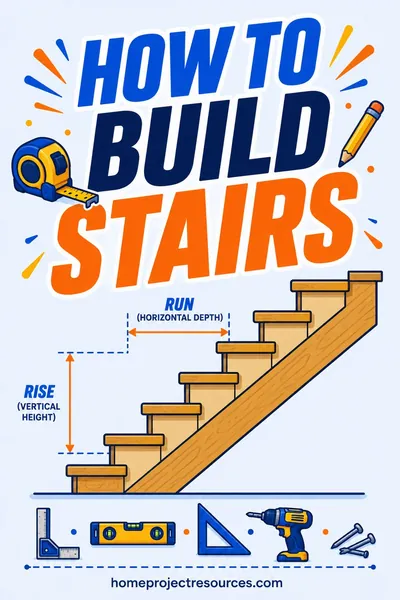
If you're planning a new deck, our guide on how to build a deck covers footings, framing and code steps, and our deck calculator works out boards, joists and screws. For the steps down to the yard, our stair calculator figures out risers, treads and stringer length, and how to build stairs walks through the cuts. Keeping the wood sealed helps rails last, and how to stain a deck covers prep and stain types.
Holiday garland and decor on stair rails
A banister wrapped in garland is lovely, and it's a good moment to look at the rail itself. The key rule is simple: never hang decor in a way that blocks a handrail or an exit path. Use soft ties or removable hooks instead of nails, and don't wrap the handrail so tightly or so thickly that you can't grip it. If you have to choose, keep the garland on the guard side and leave the handrail clear.
Keep lights and cords off the steps so no one trips, and skip open flames near greenery. Take natural garland down before it dries out and drops needles on the treads. Our guide on how to hang garland on a staircase has a step-by-step method that won't damage the rail.
When to call a pro and when you need a permit
Call a licensed pro when the rail wobbles or the posts are loose, when you're building new stairs or a deck, when you need to change the height of an existing rail, or when you're not sure what your local code requires. Railings are structural safety parts, and a wrong fastener or a weak post can fail exactly when someone needs it.
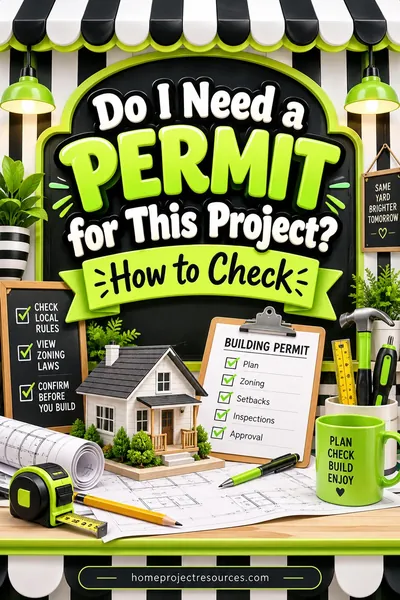
New stairs, decks and major railing changes often need a permit and an inspection. Rules vary, so ask your local building office before you start. Our guide on whether you need a permit explains how to check, and if you're hiring someone, how to hire a contractor walks through the checklist. More free tools live on our home page.
Keeping rails safe over time
Even a well-built rail loosens with years of hands pulling on it. Once or twice a year, give every handrail a firm tug along its length and check each bracket. Loose screws in drywall are a common culprit, and a bracket fixed into a stud holds far better. Our guide on how to use a stud finder helps you locate solid wood behind the wall. Check the balusters for any that spin or rattle, and look at the newel post at the bottom, which takes the most force.
Inside, keep the stairs clear of shoes, baskets and toys, and add good lighting so every step is easy to see. Outside, sweep away leaves, ice and snow, and check deck rails after storms. Small fixes made early keep a railing doing its job for years.
Quick answers about staircase railing height
How high should a stair handrail be?
Most US residential codes call for a handrail 34 to 38 inches above the front edge of the stair treads, measured straight up. Always confirm with your local building office, since codes vary by location, and the local code and inspector decide what's required for your home.
How high should a guardrail be on a landing or balcony?
Many residential codes use at least 36 inches for guards around open edges, and some places ask for more. Measure from the floor straight up to the top of the rail. Check your local code, and ask an inspector if you're not sure what applies to your home.
What is the difference between a handrail and a guardrail?
A handrail is the part you hold while you climb or go down. A guardrail, or guard, is a barrier that stops a fall from an open edge, like a landing or the open side of a stair. A stairway can have both, and each is measured and checked separately.
How far apart can balusters be?
A common rule is that a 4-inch ball should not be able to pass between balusters. The point is to keep small children from slipping through. Check the triangle under the bottom rail at the stairs too. Your local code sets the exact rule where you live.
How high should a deck railing be?
Deck railings are often required to be at least 36 inches high, and some places ask for more, especially on higher decks. The posts must be strong and firmly attached. Ask your local building office what applies before you build or change a deck railing.
Do older homes have to meet today's railing code?
Older stairs were usually built to the codes of their time, so don't assume they match today's. Measure and compare, and fix obvious hazards like loose rails or wide gaps. If you plan changes, ask your local building office what applies to your project.
Can I hang holiday garland on my stair railing?
Yes, with care. Use soft ties or removable hooks instead of nails, keep lights and cords from creating a tripping hazard, and never block the handrail grip. Keep open flames away from greenery, and take natural garland down before it dries out.
Do I need a permit to change a stair railing?
Often a permit or inspection is needed for new stairs, new decks or major railing changes. Rules vary by location, so ask your local building office before you start. A licensed pro can handle the structural work and help with the paperwork.