Standard Garage Door Sizes and Two Car Garage Dimensions: Widths, Heights and Room to Park

Standard garage door sizes are easy to remember. A single door for one car is usually 8 or 9 feet wide, a double door for two cars is usually 16 feet wide, and most doors are 7 feet tall. If you park a pickup, a big SUV or a van, an 8 foot tall door is the common step up.
The garage itself follows a similar pattern. A two car garage is usually somewhere between 20 by 20 feet, which is a tight minimum, and 24 by 24 feet, which feels roomy. 22 by 22 is the common middle. These are typical sizes, and older or custom homes can be different, so measure your own opening and your own vehicles before you order a door or sign off on plans. Local rules on sizes, doors and heights also vary, so check with your local building office before you build.
Key facts
- Single garage doors: usually 8 or 9 feet wide.
- Double garage doors: usually 16 feet wide, with 18 feet for a wide two-car opening.
- Most doors are 7 feet tall; 8 feet suits trucks, vans and roof racks.
- Two car garages: 20 x 20 ft tight, 22 x 22 ft common, 24 x 24 ft roomy.
- Plan about 3 feet between vehicles and along each wall.
Free calculator from Home Project Resources
Garage Door Size Finder: Common Width and Height
Pick your opening width and the vehicles you park. You get the common door size and height.
Need more? Open the free Paint Calculator.
 Paint Calculator
 Square Footage Calculator
 Wallpaper Calculator
The Garage Door Size Finder above takes two quick choices. Under "Your opening width," pick about 8 to 9 feet for one car, about 16 feet for two cars, or about 18 feet for a wide two-car opening. Under "What you park," choose cars and small SUVs, pickups and large SUVs, or vans, roof racks and cargo boxes. It shows the common door width and height for that mix, plus a reminder to check headroom and side room before you shop.
Quick reference: garage door and garage sizes
| Item | Common size | Notes |
|---|---|---|
| Single door (one car) | 8 or 9 ft wide, 7 ft tall | 8 ft tall for taller vehicles |
| Double door (two cars) | 16 ft wide, 7 ft tall | 8 ft tall is a popular upgrade |
| Wide double door | 18 ft wide, 7 or 8 ft tall | Two large vehicles |
| Two single doors | 8 to 9 ft wide each | Post in the middle |
| Two car garage, tight | 20 x 20 ft | Little door or storage room |
| Two car garage, common | 22 x 22 ft | Some walking room |
| Two car garage, roomy | 24 x 24 ft | Shelves or a small workbench |
| Garage ceiling | 8 to 9 ft | 10 ft or more for racks or a lift |
Single door widths: 8 feet or 9 feet?
For one car, both 8 and 9 foot doors are common, and both will let a normal car through. A 9 foot door gives you about six more inches on each side, which makes pulling in easier, especially for a new driver or a wide SUV. When replacing a door, the existing opening decides. If you are building new, I would lean toward 9 feet.
Height is the other half of the choice. A 7 foot tall door is usually plenty for cars, small SUVs and most crossovers. Pickups, large SUVs and anything with a roof rack or cargo box can get close to the top, so measure your vehicle with the rack on. An 8 foot door is the usual answer when the numbers are tight.
Double doors, wide doors and two singles
For two cars, the classic choice is one 16 foot wide door. It is a single big panel with one opener, and it gives you a wide, open target to pull into. If both of your vehicles are large, an 18 foot wide door adds two more feet of room, which really helps when two full-size trucks share the space.
The other route is two separate 8 or 9 foot doors with a post in the middle. If one door or opener has a problem, the other still works, and each door is lighter. The center post means you aim more carefully, and two doors usually mean two openers. A single wide door gives the most flexibility for big vehicles or a workspace.
How to measure for a garage door
Good measurements save you from ordering the wrong door. Grab a sturdy tape, a pencil and a notepad, and if fractions trip you up, our guide on how to read a tape measure walks through every mark.
Start with the width of the finished opening, side to side, and the height from the floor to the top of the opening. Then check the headroom above the opening for the track, which is often several inches to a foot or more. Check the side room at each side for the vertical track, usually a few inches, and the back room into the garage for the opener and horizontal track. Measure the width and height in a few spots, since older openings are rarely square, and write down the smallest number. An installer will check again before ordering, but your numbers make quotes faster. If headroom is short, say so, since low-headroom track kits exist.
Two car garage dimensions: from tight to roomy
This is where garage door sizes meet the rest of the room. A 20 by 20 foot garage is the tight minimum. Two cars fit, but you will be squeezing past mirrors and opening doors carefully, and there is very little room for bikes, bins or shelves. A 22 by 22 foot garage is the common size and fits two cars with some walking room. At 24 by 24 feet it starts to feel roomy, with space for shelves along one wall or a small workbench.
If you want comfort for trucks, a workbench or a lot of storage, aim for 24 by 26 feet or more. At 30 by 30 feet or more, you have a very roomy space with room for a real workshop or a larger vehicle. When you are planning new construction, round up. A little extra garage space is never wasted, and it is much cheaper to add at the plan stage than later. If you are pricing the slab too, our concrete calculator turns the footprint into cubic yards, and how much a yard of concrete covers gives a quick sanity check.
Free calculator from Home Project Resources
Garage Fit Planner: Minimum Footprint for Your Vehicles
Pick your two vehicles and what you want to store. You get a minimum footprint and the standard size to round up to.
Need more? Open the free Paint Calculator.
In the Garage Fit Planner, pick your two vehicles (two cars, two SUVs or minivans, or two full-size pickups) and your storage plan (just parking, shelves along one wall, or a workbench or deep storage) to see a minimum footprint and the standard size to round up to.
How big are the vehicles you park?
Garage planning starts with the vehicles, not the building. A compact or mid-size car is about 6 feet wide and 14 to 16 feet long. An SUV or minivan runs about 6 to 6 1/2 feet wide and 16 to 18 feet long. A full-size pickup is about 6 1/2 to 7 feet wide and 19 to 21 feet long. These are rough numbers, and mirrors add width, so measure your own vehicles with the doors open.
Next, add the space you need around them. Plan about 3 feet between the two vehicles so doors can open without dings, about 3 feet between each vehicle and the side wall, and about 3 feet at the front or back for walking. Shelves along a wall take about 2 feet of depth, and a workbench about 3 feet. Many people get by with 2 feet between vehicles and walls, but tighter than that and doors start to hit.
A worked example: two cars and a wall of shelves
Say you park two mid-size cars, each about 6 feet wide and 16 feet long, and you want shelves along the front wall. Start with the width. You have 3 feet at the left wall, 6 feet for the first car, 3 feet between the cars, 6 feet for the second car and 3 feet at the right wall. That adds up to 21 feet wide.
Now the depth. Each car is 16 feet long. Add 3 feet of walking room at the front and 2 feet for the shelves, and you get 21 feet deep. So the minimum footprint is about 21 by 21 feet, and the nearest standard size to round up to is 22 by 22 feet. With no shelves at all, the same two cars need about 21 by 19 feet, which rounds up to 22 by 20 feet. Swap in two full-size pickups, and that depth jumps by 4 or 5 feet, which is why truck owners so often end up at 24 by 26 or bigger. Once you know the footprint, our square footage calculator turns it into floor area for quotes on epoxy, insulation or heating.
Garage ceiling height and headroom
Many garages have 8 to 9 foot ceilings. That works fine for a 7 foot door with a standard track and opener. If you want an 8 foot door, overhead storage racks or a vehicle lift, plan for 10 feet or more. The open door, its track and the opener all hang from the ceiling, so for overhead storage, measure to the lowest point of the open door, not to the ceiling.
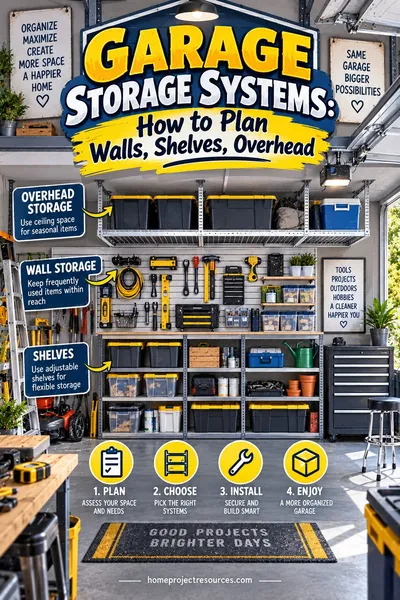
Our guide to garage storage systems covers walls, shelves and overhead racks in more detail, and it is often the best fix for a garage that already exists and feels tight.
How door size affects cost
Bigger doors cost more. A wider or taller door needs more material, stronger hardware and heavier springs, and sometimes a stronger header above the opening. Insulation, windows and style change the price too. If you are comparing a 16 foot door with two 9 foot doors, count the second opener and the extra installation work. Our guide to the cost to replace a garage door lays out every cost driver and what to ask in a quote. Prices are typical US ranges that vary by region and by home, so get written quotes from licensed pros, and our guide on how to compare contractor bids helps you line them up fairly. A new door is also one of the upgrades people weigh in home improvement ROI.
Changing the size of an opening is a bigger job. Making a door wider or taller can mean a new header and new framing, which is work for a licensed pro, and it often needs a permit. Our guide on whether you need a permit explains how to check with your local office. If a bigger garage is part of a larger plan, the garage remodel cost guide covers what changes the price.
Safety around garage doors
Garage door springs are under high tension and can hurt people badly. Leave spring and cable work to a trained pro. Now and then, set a roll of paper towels in the door's path to test the safety sensors; the door should stop and reverse. If your door sticks, makes loud noises or will not close, see our guide to garage door repair before you touch anything.
Keep kids away from the opener buttons and the moving door, and do not walk under a door that is moving. In a tight garage, a floor stop or a hanging tennis ball marks the parking spot so no one creeps into shelves or a freezer. More free planning tools live on our home page.
Quick answers about garage door sizes and garage dimensions
What is the standard size of a garage door?
For one car, 8 or 9 feet wide by 7 feet tall is common. For two cars, 16 feet wide by 7 feet tall is the most common choice, with 8 feet tall used for taller vehicles. Sizes vary by home and region, and older or custom homes can be different, so measure your opening before you shop.
What size is a 2-car garage door?
Usually 16 feet wide. Some homes have an 18 foot wide door for a bit more room, which helps with two large vehicles. Others use two separate single doors that are 8 or 9 feet wide each, with a post in the middle. Heights are commonly 7 or 8 feet.
How tall are garage doors?
Most homes have 7 foot tall doors, and 8 foot doors are popular for pickups, vans and roof racks. A taller door needs more headroom above the opening for the track and opener, so check your ceiling height before you choose one. Measure your tallest vehicle with any rack or cargo box in place.
What are the standard dimensions of a two car garage?
Most are between 20 by 20 feet and 24 by 24 feet. 20 by 20 is a tight minimum, 22 by 22 is common, and 24 by 24 is roomy and comfortable for two vehicles plus some storage. For trucks, a workbench or lots of storage, aim for 24 by 26 feet or more.
How much space do I need between cars in a garage?
About 2 to 3 feet between vehicles, and the same along each wall, lets you open doors and walk through. I'd plan for 3 feet if you can. Tighter than about 2 feet, doors start to hit each other or the wall, and getting kids in and out of car seats gets awkward.
Will a full-size truck fit in a 2 car garage?
Often yes in a 24 by 24 foot garage, but it can be tight in a 20 by 20. A full-size pickup is about 19 to 21 feet long, so measure yours and allow a few feet at the front for walking and storage. A taller 8 foot door also helps.
How tall should a garage ceiling be?
Many garage ceilings are 8 to 9 feet. A higher ceiling of about 10 feet or more helps with overhead storage racks, an 8 foot door or a vehicle lift. Remember that the open door, its track and the opener take up some of that ceiling space.
Can I change the garage door size?
Sometimes, but it can mean changing the header and framing, which is a job for a licensed pro. It often needs a permit, too. Ask for a quote first, and check with your local building office about the rules where you live before any wall gets opened up.